
Bluetooth vs RF Remote Battery Disconnect: Which Is Better?
, by iFJF Direct, 7 min reading time
, by iFJF Direct, 7 min reading time

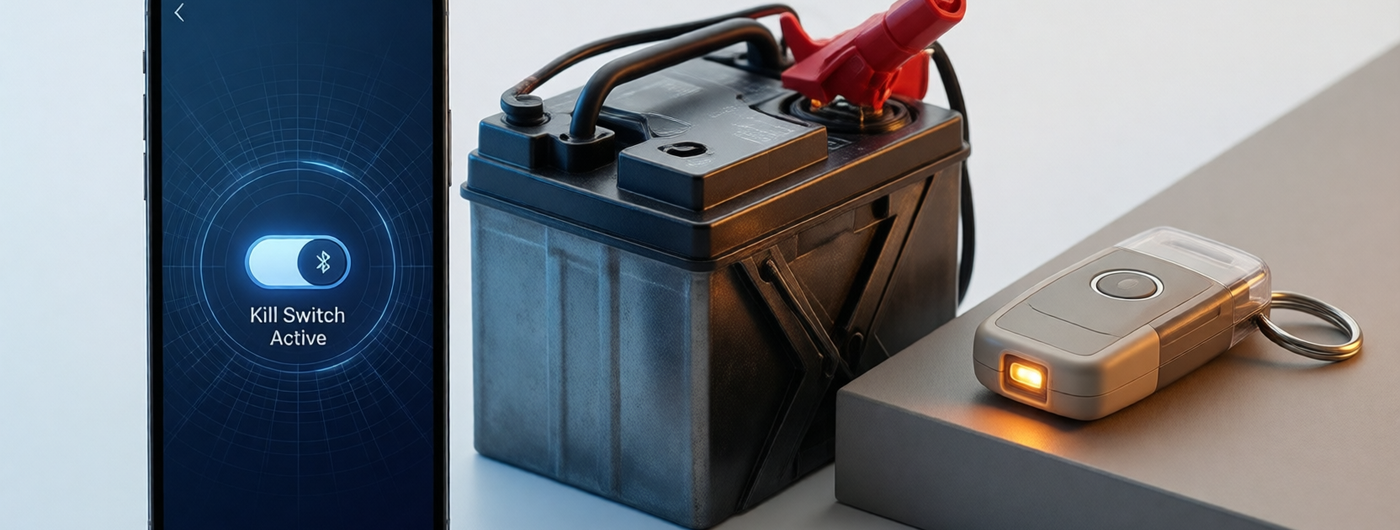
Bluetooth kill switch or RF remote — which remote battery disconnect is right for your vehicle? We compare security, range, current rating, and real-world reliability side by side.
Remote battery disconnect switches come in two flavors: Bluetooth (controlled from your smartphone) and RF remote (controlled from a separate key fob). At first glance, the RF versions look like a bargain — $15–$30 on eBay and Amazon, compared to $50–$60 for Bluetooth. But the price difference tells a story.
This comparison breaks down exactly what you get (and what you don't) at each price point, so you can make an informed decision for your vehicle.
| Bluetooth Kill Switch | RF Remote Kill Switch | |
|---|---|---|
| Controller | Your smartphone (iOS/Android) | Dedicated key fob (coin battery powered) |
| Connection Security | AES-128 encrypted pairing | Fixed-code RF (315/433 MHz) — easily intercepted |
| Range | 15–30 ft (Bluetooth 4.2 BLE) | 30–100 ft (RF — but unencrypted) |
| What happens if you lose the controller? | Pair another phone (or use backup phone) | You're locked out — must manually bypass the relay |
| Battery in controller | Your phone's battery (rechargeable) | Coin cell (CR2032, ~1 year, dies without warning) |
This is where the gap is widest — and most important.
RF remote switches use fixed-code transmission on 315MHz or 433MHz. These are the same frequencies used by garage door openers from the 1990s. With a $20 software-defined radio (SDR) USB dongle — freely available on Amazon — anyone within 300 feet can capture the signal when you press the button, then replay it to disable your kill switch. This is not theoretical; it's a well-documented vulnerability that's been demonstrated at DEF CON and on .
Bluetooth kill switches use AES-128 encryption with secure pairing. Each connection establishes a unique encryption key that changes with every session. Even if someone captures the Bluetooth traffic, they can't replay it because the encryption key from one session won't work in the next. This is the same encryption standard used by modern wireless payment terminals.
Bottom line: An RF kill switch stops opportunistic thieves. A Bluetooth kill switch stops both opportunistic and technically-capable thieves.
| Vehicle Type | Typical Cranking Current | RF Remote Switch (100A) | Bluetooth Switch (250A) |
|---|---|---|---|
| Compact car (4-cyl gas) | 80–120A | ⚠️ Borderline | ✅ Comfortable |
| Full-size truck (V8 gas) | 150–200A | ❌ Will fail | ✅ Comfortable |
| Diesel truck (dual battery) | 200–250A | ❌ Contacts weld shut | ✅ Within spec |
| RV with generator start | 150–200A | ❌ Will fail | ✅ Comfortable |
Most RF remote switches are rated at 100A peak — and that's optimistic. Under real cranking loads, the contacts overheat, arc, and eventually weld themselves closed. When the contacts weld, the switch is permanently ON — you've lost the ability to disconnect the battery. Worse, a welded contact can overheat and become a fire hazard.
The 250A rating on quality Bluetooth switches isn't marketing — it's dictated by the physical contact area and spring pressure in the relay. For diesel trucks with dual batteries and high-compression engines, 250A isn't a luxury; it's the minimum.
| Budget RF Remote ($15–30) | Quality Bluetooth ($50–60) | |
|---|---|---|
| Upfront cost | $15–30 | $50–60 |
| Replacement fob cost | $10–15 (if available) | $0 (use any compatible phone) |
| Fob battery replacement | $3/year (CR2032) | $0 (phone is rechargeable) |
| Risk of contacts welding | High (100A on a diesel) | Low (250A rated) |
| Risk of signal interception | Moderate-High | Very Low (AES-128) |
| 3-year total cost | $25–40 + replacement risk | $50–60 — one and done |
The $20–$30 you save on an RF remote switch evaporates the first time you lose the key fob, replace the relay because the contacts welded, or — worst case — your vehicle is stolen because someone with an SDR captured your kill switch signal.
For most truck and RV owners, the choice is clear. The Bluetooth kill switch costs twice as much up front and delivers 10 times the reliability, security, and peace of mind.
Q: Can an RF remote's signal really be intercepted that easily?
A: Yes. Fixed-code RF remotes transmit the same digital code every time you press the button. With a $20 RTL-SDR dongle and free software (available to anyone), you can capture that code and replay it. This is how car thieves have been bypassing aftermarket alarms and remote starters for years. Modern Bluetooth uses rolling encryption keys that change each session — replay attacks don't work.
Q: Is Bluetooth range really enough?
A: For a kill switch, 15–30 feet is plenty. You're not controlling it from across a parking lot — you're using it when you approach the vehicle or walk away from it. More range would actually be a security risk (someone farther away could potentially attempt to connect).
Q: What if I want a physical backup?
A: Any kill switch — Bluetooth or RF — can be bypassed at the relay terminals with basic tools. This is intentional: in an emergency, you want to be able to restore power. The kill switch is a deterrent and a convenience feature; it's not an impenetrable vault.

AES-128 encrypted Bluetooth control, 250A peak rating for diesel trucks and RVs, weather-resistant construction, and stainless steel hardware. Don't settle for an RF remote that can be bypassed with a $20 radio dongle.
Includes relay, control module, wiring harness, and mounting kit. 1-year warranty. Free US shipping.
Shop Now →