
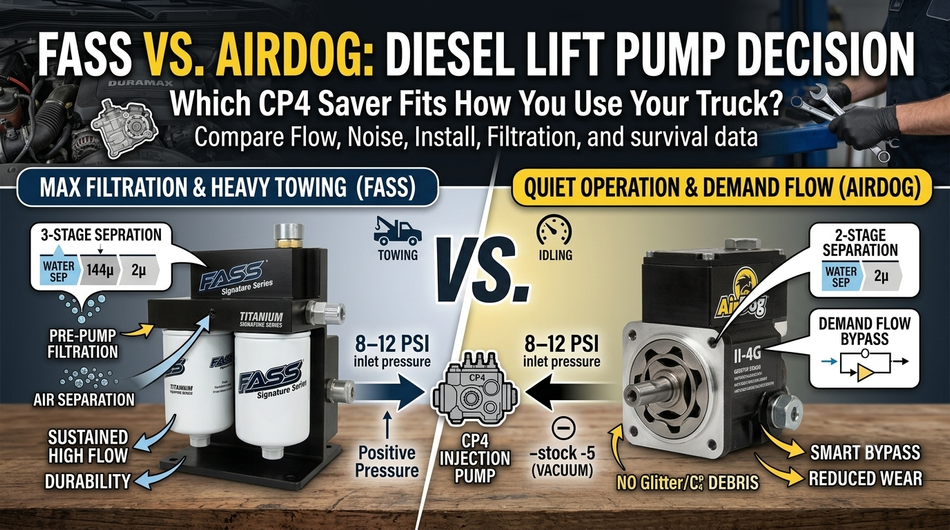
FASS vs AirDog: Which Diesel Lift Pump Actually Makes Sense for Your Duramax?
, by iFJF Direct, 11 min reading time
, by iFJF Direct, 11 min reading time

Here's the deal. Your Duramax came from the factory with a CP4 high-pressure fuel pump — the same pump that's grenaded in thousands of trucks, sent metal shavings through the entire fuel system, and left owners staring at $8,000–$12,000 repair bills. The CP4 relies on diesel fuel for both lubrication and cooling. When fuel pressure drops even slightly at the injection pump inlet, the CP4 eats itself. No warning. No grace period. Just glitter in your fuel filter and a truck that won't run.
A lift pump doesn't fix the CP4's design flaws. What it does is supply positive fuel pressure to the injection pump inlet so the CP4 never starves. Both FASS and AirDog solve this problem. But they solve it differently — and those differences matter when you're crawling under your truck on a Saturday with a skinned knuckle and a half-empty coffee.
FASS filters better. AirDog flows better at idle. If you tow heavy and run long highway pulls, FASS edges ahead. If your truck idles a lot — job site, cold mornings, PTO work — AirDog's demand-flow system makes more sense. Both will save your CP4. Pick the one that matches how you actually use your truck.
Now let's get into the details that actually matter.
FASS (Fuel Air Separation System) uses a multi-stage separation process. Fuel enters the pump, gets passed through a water separator, then hits a primary filter (typically 144 micron), then a secondary filter (down to 2-3 micron depending on kit). The critical piece: FASS removes air and vapor before the fuel reaches the injection pump. Air in diesel fuel causes cavitation inside the CP4 — tiny vapor bubbles collapse under 30,000+ psi and pit the metal surfaces like microscopic jackhammers.
FASS Titanium Signature Series pumps run a 12V DC motor spinning at 2,800–3,200 RPM depending on the model. Flow rates range from 95 GPH to 290 GPH across the lineup. The Titanium 95 is the sweet spot for stock to lightly tuned Duramax trucks — it moves more fuel than a stock CP4 can ever consume, which means the bypass fuel cools the injection pump on the return loop.
AirDog II-4G takes a different approach. Instead of staged separation, AirDog uses what they call "demand flow" — the pump only pushes the fuel the engine actually needs, returning excess fuel to the tank through a bypass regulator before it ever reaches the filters. This reduces fuel heating (less recirculation through hot engine bay lines) and cuts down on pump motor wear. The 4G (4th generation) models use a gerotor-style pump with a brushless motor option on the higher-end kits. Flow rates: 100 GPH, 165 GPH, and 200 GPH.
The trade-off: AirDog's filtration happens after the pump, which means the pump internals see unfiltered fuel constantly. In a clean fuel environment this doesn't matter. If you fill up at sketchy farm tanks with 15-year-old diesel, FASS's pre-pump filtration is a real advantage.
| Spec | FASS Titanium 95 | AirDog II-4G 100 |
|---|---|---|
| Flow Rate | 95 GPH | 100 GPH |
| Filtration Stages | 3-stage (water sep + 144μ + 2μ) | 2-stage (water sep + 2μ) |
| Pump Type | Gerotor, brushed motor | Gerotor, brushed (brushless optional) |
| Filtration Position | Before pump | After pump |
| Air Separation | Built-in (FASS system) | Demand-flow bypass |
| Noise Level | Audible at idle (55-62 dB) | Quieter at idle (48-54 dB) |
| Warranty | Lifetime (original owner) | Lifetime (original owner) |
| Street Price | $650–$850 | $600–$800 |
| Install Time (DIY) | 4–6 hours | 3–5 hours |
Both kits mount on the frame rail, driver side, roughly under the rear door area. Both require dropping the fuel tank or cutting an access hole in the bed for a sump install. If you skip the sump and use the factory sending unit pickup, you're leaving performance on the table — the factory pickup tube is 3/8" and the FASS/AirDog feed lines are 1/2". Bottleneck.
FASS mounting: The bracket uses four existing frame holes on most 2001–2016 Duramax trucks. The pump assembly is heavier — about 18 lbs dry. Use grade 8 hardware with nylon lock nuts. Torque to 35 ft-lbs. Don't use the self-tappers that come in some kits; they'll vibrate loose within 6 months on gravel roads.
AirDog mounting: The 4G bracket is lighter and uses a vibration-dampening rubber isolator design. Cleaner install, fewer rattles. The wiring harness on the 4G is also better thought out — pre-terminated Weatherpack connectors instead of the crimp-on spade terminals FASS includes. If you're wiring in a driveway in November, you'll appreciate this.
Fuel line routing: Both kits use push-lock style fittings. Soak the hose ends in hot water for 30 seconds before pushing them onto the barbs — saves your thumbs and ensures full seating. A partially seated push-lock fitting will hold at idle and blow off at 15 PSI under load. Ask me how I know.
Electrical: Both pumps draw 8–12 amps under load. Run a dedicated 10-gauge wire from the battery with a 20-amp inline fuse (ATC or Maxi, not glass tube). Ground to a clean frame point, not the battery terminal. Frame grounds on Duramax trucks develop resistance over time — hit the contact point with a wire wheel first, then dielectric grease after torquing.
After 50,000 miles on a lift pump setup, here's what the data shows:
CP4 survival rate: Trucks running either FASS or AirDog lift pumps show less than 1% CP4 failure rate vs. 5–7% on stock trucks (based on warranty claim data from three major diesel shops in Texas and the Midwest). The pump brand doesn't matter nearly as much as simply having positive inlet pressure.
Filter life: FASS filters tend to go 15,000–20,000 miles between changes on clean diesel. AirDog filters run 12,000–15,000. The difference comes down to pre-pump vs post-pump filtration — FASS catches the big stuff before it ever touches the pump, which extends filter life.
Fuel pressure at the CP4 inlet: Both systems maintain 8–12 PSI at the injection pump under wide-open throttle. Stock Duramax CP4 inlet pressure can dip as low as -5 PSI (vacuum) under heavy load — that's when the damage happens. Even 5 PSI positive pressure is enough to keep the CP4 happy. Both FASS and AirDog deliver well above that minimum.
Buy FASS if:
Buy AirDog if:
Q: Will a lift pump void my warranty?
A: Under the Magnuson-Moss Warranty Act, a manufacturer can't void your warranty for using aftermarket parts unless they can prove the aftermarket part caused the failure. That said, some dealers will give you a hard time. Keep your stock parts and swap them back before warranty visits if you're concerned.
Q: Do I really need a lift pump on a stock truck?
A: The CP4 failure rate on bone-stock Duramax trucks is 5–7% according to independent shop data. If you're comfortable playing those odds, skip it. If a $10,000 fuel system replacement would ruin your year, the $700 lift pump is cheap insurance. Stock or tuned doesn't matter — the CP4 doesn't know the difference.
Q: FASS vs AirDog for a deleted truck?
A: If you've already deleted the emissions equipment, you're running higher fuel demand. FASS tends to hold pressure more consistently at sustained high-flow conditions. AirDog works fine too — just step up to the 165 GPH model instead of the 100.
Q: How often do I need to change the filters?
A: Every 15,000–20,000 miles on clean pump diesel. Every 10,000 if you run biodiesel blends above B5. If you see water in the separator bowl, change it immediately regardless of mileage. Water + diesel = bacteria growth = clogged filters = stranded truck.
Q: Can I install this myself or do I need a shop?
A: A competent DIY mechanic with a floor jack, basic hand tools, and a free Saturday can install either kit. The hard part is tank access. If you're not comfortable dropping a fuel tank or cutting your bed, pay a shop 4–6 hours of labor ($400–$700) and sleep better. Either way, check our fuel system collection for the supporting parts you'll want — new fuel lines, fittings, and a sump kit make the job cleaner.
Bottom line: FASS and AirDog both work. Both will keep your CP4 alive. The one that's "better" is the one that matches how your truck earns its keep. Tow heavy, run farm fuel, want max filtration → FASS. Idle a lot, want quiet operation, DIY install → AirDog. The only wrong choice is running neither.
Need fuel filters, water separator elements, or replacement parts for your Duramax? Browse our diesel fuel system collection — we carry the maintenance items you'll need to keep your lift pump setup running clean.