
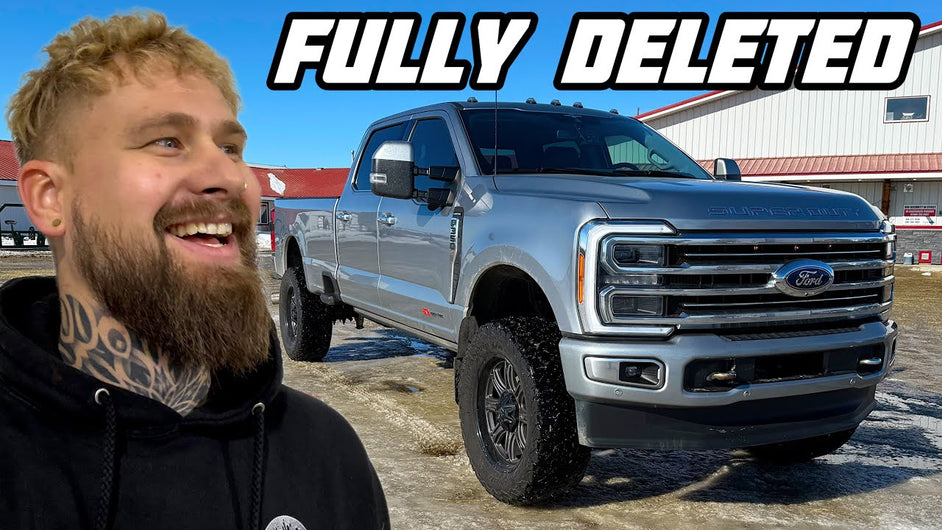
How To Delete DEF DPF EGR On 2023-2026 6.7 Powerstroke
, by iFJF Direct, 18 min reading time
, by iFJF Direct, 18 min reading time

Introduction If you own a 2023–2026 Ford 6.7L Power Stroke and you’re tired of DEF refills, DPF regen cycles, and EGR soot buildup, a full emissions delete is one of the most discussed upgrades in the...
This content is for informational and educational purposes only. Removing or disabling emissions control equipment — including DPF (Diesel Particulate Filter), DEF (Diesel Exhaust Fluid) systems, and EGR (Exhaust Gas Recirculation) — on vehicles operated on public roads is a violation of the Clean Air Act in the United States and similar laws in many other countries.
This guide is intended exclusively for dedicated off-road, competition, or closed-course vehicles that are never operated on public highways. iFJF assumes no liability for how you use this information. Always consult local regulations before modifying your vehicle.
| 1. | Engine & Turbo Damage: Removing DPF/DEF systems alters backpressure and exhaust flow. An improperly tuned delete can cause turbo overspeed, EGT spikes, and premature engine wear. |
| 2. | ECU Bricking: If battery voltage drops during the ECU flash, the engine control module can be permanently damaged ("bricked"), requiring a costly replacement. Always use a battery charger during tuning. |
| 3. | Increased Emissions: A deleted diesel truck emits significantly higher levels of NOx (nitrogen oxides) and particulate matter — pollutants linked to respiratory illness, acid rain, and smog. |
| 4. | State Inspections & Fines: States like California, Colorado, New York, and others actively enforce diesel emissions compliance. A deleted truck can be flagged, fined, and ordered off the road. |
| 5. | Insurance Denial: In the event of an accident, your insurance provider may deny coverage if emissions tampering is discovered, as the vehicle is no longer legally compliant. |
| 6. | Resale & Trade-In Issues: Many dealerships will refuse trade-ins on deleted trucks. Private buyers may demand a steep discount or walk away entirely. |

If you own a 2023–2026 Ford 6.7L Power Stroke and you're looking to understand how a full emissions delete is performed on an off-road-only truck, this guide walks through the complete mechanical and tuning process. It is based on a real shop-floor demonstration covering the ECU flash with an Easy Link Auto Agent, EGR cooler removal, DPF/SCR exhaust drop, and installation of a full 5-inch delete exhaust.
⚠️ OFF-ROAD USE ONLY: Emissions deletes are illegal for on-road use in the United States and in many other jurisdictions. This write-up is for educational and off-road/competition purposes only. Operating a deleted vehicle on public roads carries serious legal, financial, and safety risks. Always check your local laws before modifying emissions equipment.
The procedure below is based on a 30-minute hands-on video using a Diesel Dudes delete kit (EGR delete, exhaust, and Easy Link tuner). While the demonstration covers 2023–2026 trucks, the same general principles apply to other 6.7L Power Stroke builds. If you need an EGR delete kit for 2011–2019 6.7L Power Stroke models, iFJF offers a verified bolt-on kit — also for off-road use only.

This iFJF kit includes billet aluminum block-off plates, coolant block-off plates, a stainless hose clamp, barbed fitting, vacuum cap, and all hardware needed to remove the EGR system on 2011–2019 Ford F-250/F-350/F-450/F-550 6.7L Power Stroke diesels. CNC-machined components and a complete coolant circuit design help keep engine temperatures in check after the EGR cooler is removed.
⚠️ Off-Road / Competition Use Only. If you're doing an EGR delete on a dedicated off-road 6.7L Power Stroke, having a purpose-built kit on hand saves time, prevents leaks, and keeps the engine bay clean.
Shop Now →| Item | Notes |
|---|---|
| DPF/DEF/EGR delete kit | EGR cooler delete hardware, blocker plates, exhaust system, tuner (e.g., Diesel Dudes kit) |
| Easy Link Auto Agent + app | Used to flash the off-road tune and clear codes |
| Battery charger | 5–10 amp setting; keep batteries alive during flashing |
| Metric socket set | 7 mm, 10 mm, 13 mm, 15 mm, 21 mm sockets and ratchets |
| Extensions and swivel socket | Long 1/4" extension with swivel for back EGR bolts |
| Pry bar / exhaust hanger pliers | For rubber exhaust hangers and separating flanges |
| 7 mm nut driver | For air intake piping bolts |
| Pick / small screwdriver | For unlocking red connector tabs |
| Electrical tape and zip ties | To seal and secure unplugged sensors |
| Clean drain pan | Coolant will be reused |
| Exhaust lubricant / penetrating oil | For rubber hangers and exhaust clamps |
| Lift or ramps | Makes exhaust work much easier and safer |
On 2023–2026 6.7L Power Strokes, the ECM must be tuned before any physical hardware is removed. At the time of the source video, only one off-road tune was available for these trucks, which makes the process straightforward.
Warning: Do not change the tire size in the Easy Link app. Users report it throws an error code. Leave the tire size stock.
Before the engine is started, you need to unplug three key connectors:
Wrap each open connector with electrical tape and zip-tie them away from the fan and belts. For older trucks, plug kits are available; for 2023+ models, they had not yet been released at the time of the video.
Although the exhaust can technically be left on with the tune, the 2023+ trucks have a particulate filter built into the downpipe that must be removed. The EGR cooler is removed first because it gives better access to the downpipe clamp.
With the EGR cooler out of the way, the exhaust can be removed. This is the heaviest part of the job and is much easier with a lift or ramps and a second set of hands.
| Tip | Why It Matters |
|---|---|
| Always flash the tune before turning a wrench on emissions hardware. | Starting or moving the truck with missing sensors can throw hard codes that complicate the flash. |
| Keep a battery charger connected during the tune. | A voltage drop mid-flash can corrupt the ECU. |
| Label and tape every unplugged connector immediately. | Prevents fan/belt damage and keeps the engine bay tidy. |
| Use a second person when dropping the DPF/SCR canister. | The assembly is heavy and awkward; an extra set of hands prevents injury and damage. |
| Do not over-tighten EGR blocker-plate bolts. | Small Allen bolts and O-rings only need to be snug; over-tightening can distort the plate or strip threads. |
| Reinstall removed downpipe studs before mounting the new downpipe. | The new downpipe slides over the studs, so they must be in the head first. |
| Component | Brand | Fitment / Notes |
|---|---|---|
| EGR Delete Kit | iFJF | 2011–2019 Ford 6.7L Power Stroke F-250/F-350/F-450/F-550 — Off-Road Use Only |
| Full 5" Delete Exhaust | Diesel Dudes | 2023–2026 6.7L Power Stroke (as shown in source video) |
| EGR Delete Kit | Diesel Dudes | 2023–2026 6.7L Power Stroke |
| Easy Link Auto Agent | Easy Link | Tuner and code reader for supported Power Stroke models |
Yes. On 2023–2026 6.7L Power Strokes, the ECU must be flashed with an off-road tune before the emissions sensors are unplugged. Starting the truck without a tune will trigger limp mode and a lit dashboard.
With the tune used in this guide, the EGR temperature sensor must be unplugged, but the cooler could theoretically stay installed. However, because the 2023+ downpipe has a built-in filter that must be removed, the EGR cooler is typically removed first to gain access to the downpipe clamp.
Only if you are installing a full exhaust system. One of the rear exhaust sensors is routed between the frame and the spare tire, and the connector cannot be reached otherwise. If you install only delete/race pipes, that sensor can usually stay connected.
Yes, as long as you drain it into a clean pan and no debris gets in. After the first drive, check the coolant level again; the thermostat may open and the level can drop.
No. Removing or disabling emissions equipment is illegal for on-road vehicles in the United States. Under the Clean Air Act (42 U.S.C. § 7522), tampering with emissions controls is a federal violation. The EPA can impose fines of up to $4,819 per defeat device. A deleted truck will not pass state emissions inspections, may void your warranty, and could cause your insurance provider to deny coverage in the event of an accident. This guide is intended exclusively for off-road, competition, or closed-course vehicles. Always follow local laws and regulations.
Key risks include: (1) ECU damage — a voltage drop during tuning can brick the engine control module; (2) Engine/turbo wear — improper tuning can cause turbo overspeed and excessive EGT; (3) Warranty void — Ford and most dealerships will void coverage on related components; (4) Resale issues — many dealers and buyers refuse deleted trucks; (5) Legal penalties — fines, registration denial, and in some cases vehicle impoundment. This is not a modification to take lightly.
A full DPF/DEF/EGR delete on a 2023–2026 6.7L Power Stroke is a significant mechanical undertaking. It requires methodical planning, the right kit, a reliable tuner, and a clear understanding of the legal and mechanical risks involved. Flash first, then remove the EGR cooler, then drop the exhaust, and finish by reinstalling the coolant and checking for leaks. Whether you are working on a 2023+ truck or an earlier 6.7L model, using quality bolt-on hardware like the iFJF EGR delete kit makes the job cleaner and more reliable.
⚠️ REMINDER: This content is for OFF-ROAD / COMPETITION USE ONLY. Do not operate a deleted vehicle on public roads.
