
RV Generator Fuel Filter Replacement: Two Expert Methods Compared (Quiet Diesel vs QG 4000)
, by iFJF Direct, 15 min reading time
, by iFJF Direct, 15 min reading time

Two expert YouTube methods for replacing your Onan RV generator fuel filter — RVgeeks (191K views, Quiet Diesel inline canister) vs RV Habit (107K views, QG 4000 spin-on). Complete step-by-step with tools, part numbers, cross-references, and common mistakes to avoid. Includes which method applies to YOUR generator.
Two of the most-watched RV generator maintenance videos on come from RVgeeks (191K views) and RV Habit (107K views). We watched both, compared their techniques, and distilled everything into this guide — plus we'll tell you which method applies to YOUR generator and where to get quality replacement filters without paying Cummins dealer prices.
| ⛽ 149-2513 Fuel Filter | Quiet Diesel HDK series · Baldwin BF806 · Fleetguard FF236 · WIX 33063 | From $15.83/ea |
| 🛢️ 122-0833 Oil Filter | Quiet Diesel + QG series · LF3591 · WIX 51064 · B179 | $9.99 |
| 🔧 3-Filter Maintenance Kit | Fuel + Oil + Air · One order, one box · All IATF 16949 certified | $43.99 |
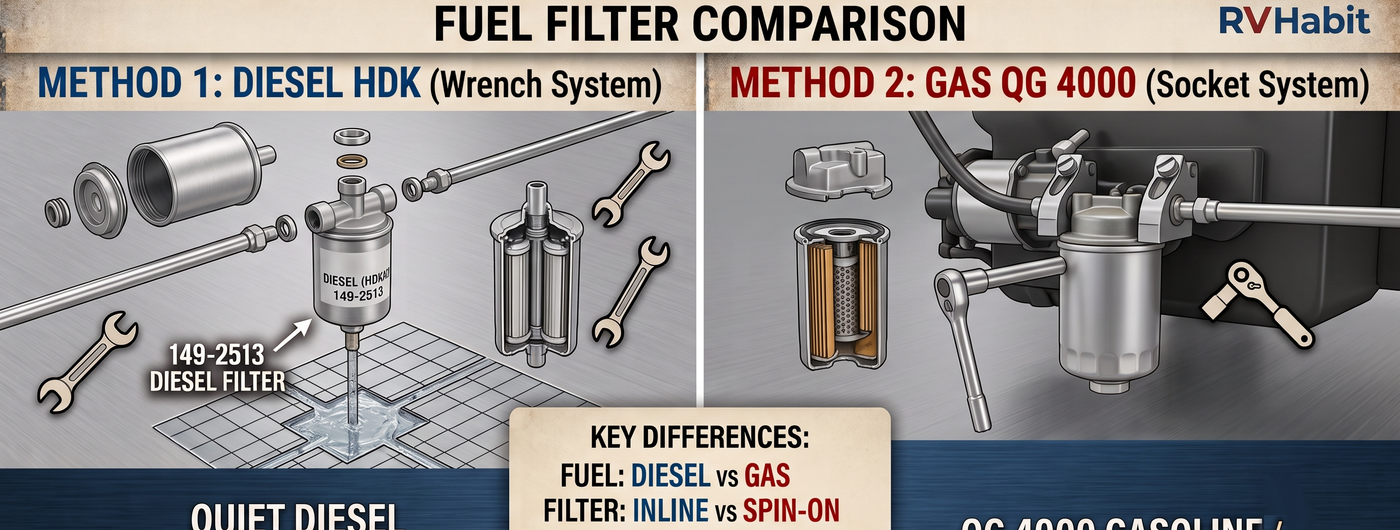
RVgeeks' 7.5kW Onan Quiet Diesel uses an inline canister-style fuel filter — the standard for all HDK-series Quiet Diesel generators: HDKAH (7.5HDK/8HDK), HDKAK (10HDK), HDKAJ, HDKBA, HDKCA, HDKCB, HDCAA, HDCAB. If your generator data plate says "Quiet Diesel" with an HDK prefix, this is your method.
Tools You'll Need:
The Procedure (Quiet Diesel HDK Series):
"This job is really easy" — despite what you may have heard. The 500-hour interval is longer than the annual oil change, so many RV owners skip it. Don't. A clogged fuel filter causes surging, hard starting, and can destroy your injection pump.
RV Habit's Cummins Onan QG 4000 is a gasoline generator commonly found in smaller Class B and Class C RVs. It uses a different filter type: a threaded spin-on canister (like a small oil filter) mounted on the fuel pump. Note: This is NOT the same filter as the 149-2513 used on Quiet Diesel models. The QG 4000 uses part number 149-2457 for the fuel filter and 140-3280 for the air filter — completely different parts from the HDK diesel series.
We carry filters for the Quiet Diesel HDK series. If you have a QG gasoline generator, this section shows you the technique — but make sure you purchase the correct 149-2457 filter for your model.
Tools You'll Need:
The Procedure (QG Gasoline Series):
"Five hundred hours would take me several years to get to," Lou explains. "I don't like to leave the fuel filter in for two years because it does begin to rust — and I don't want it to get stuck in a fuel pump, and I don't want it to start to leak." The rusty filter he pulls out on camera makes his case perfectly: time-based replacement prevents corrosion failures, regardless of hours.
| Feature | Quiet Diesel HDK (RVgeeks) | QG 4000 Gasoline (RV Habit) |
|---|---|---|
| Generator Type | Diesel, 7.5kW–12.5kW | Gasoline, 4kW |
| Filter Type | Inline canister with fuel line fittings | Threaded spin-on (similar to small oil filter) |
| Fuel Filter Part # | 149-2513 | 149-2457 |
| Filter Location | Behind bottom access panel | Attached directly to fuel pump, underneath |
| Special Tool | Two open-end wrenches | 9/16" deep socket + thread sealant |
| Priming Method | Hold Stop switch 1 min (electric pump) | Self-priming (fuel pump draws from tank) |
| Common RVs | Class A diesel pushers, large fifth-wheels | Class B/C vans, small Class A gas |
| Oil Filter | 122-0833 | Different (122-0893 or similar) |
| Air Filter | 140-2897 | 140-3280 |
| Filter | OEM Part # | Also Replaces | Price |
|---|---|---|---|
| Fuel Filter | 149-2513 | BF806 · FF236 · WIX 33063 · P55-0888 | From $15.83/ea |
| Oil Filter | 122-0833 | LF3591 · B179 · WIX 51064 · PH3593A | $9.99 |
| Air Filter | 140-2897 | AF27906 · PA5658 · WIX 49697 · P181050 | $13.99 |
Both RVgeeks and RV Habit emphasize this: always start threads by hand. "To avoid cross-threading, always start nuts by hand," says RVgeeks. RV Habit echoes: "Start just by hand, that way you're not cross-threading it." A cross-threaded fuel fitting on the pump = replacing the entire fuel pump. That $20 filter just became a $300+ repair.
"You don't want it too tight," says RV Habit. RVgeeks specifies: "One more flat" (⅙ turn) after the nut is seated. Overtightening crushes gaskets, strips threads, and cracks filter housings. Diesel fuel under pressure will find the path of least resistance.
RVgeeks runs the generator for 5–10 minutes with the air conditioner and water heater on before closing up. "Let the Gen set run for five or ten minutes under load while checking for any fuel leaks." A filter that doesn't leak at idle might leak under the higher fuel demand of a loaded generator. Don't skip this step.
The Quiet Diesel's self-priming electric pump needs that one-minute prime cycle. "If it doesn't fire up after several seconds, you might need to prime the system a second time." Crank in 10–15 second bursts to avoid overheating the starter.
RV Habit's two-year-old filter tells the story: "Look at how bad that has rusted. I don't want this to break apart and then it'll be a big project to get it off." If your generator lives in a moist compartment or you camp near the coast, consider time-based replacement regardless of runtime hours.
Q: Can I use the same fuel filter for Quiet Diesel and QG series generators?
A: No. The Quiet Diesel uses a 149-2513 inline canister filter. The QG 4000 gasoline model uses a 149-2457 spin-on filter. They are completely different parts with different connections and filtration specifications. Always check your generator data plate and owner's manual for the correct part number.
Q: How often should I really change the fuel filter?
A: Cummins Onan recommends every 500 hours or annually for Quiet Diesel generators. However, RV Habit makes a valid point: if you only put 50 hours per year on your generator, replace it at least every 2 years regardless of hours. Fuel filters can rust and deteriorate over time, especially in RV generator compartments that see moisture and temperature swings.
Q: Do I need genuine Cummins filters, or are aftermarket ones okay?
A: RV Habit recommends genuine Cummins parts, but he notes "they're not that expensive." Our take: Cummins doesn't manufacture their own filters — they source from Fleetguard, Baldwin, and other industrial filter manufacturers. A quality IATF 16949 certified aftermarket filter (like our 149-2513 fuel filter) meets the same specifications at a significant cost saving. The key is certification and quality standards, not the logo on the box.
Q: Should I change the oil and air filters at the same time?
A: If you're already underneath the RV with your tools out, absolutely. The oil filter (every 150 hours or annually) lives right next to the fuel filter on most models. The air filter (every 500 hours) takes 5 minutes with no tools. Our 3-filter maintenance kit gives you everything in one box for $43.99 — cheaper than buying separately and way cheaper than three trips to the Cummins dealer.
Q: What if my generator won't start after replacing the fuel filter?
A: On Quiet Diesel models, the system needs to be primed. Hold the Stop switch for 60 seconds — you'll hear the electric fuel pump running. Then crank in 10–15 second bursts. It typically fires on the 2nd or 3rd attempt. On QG gasoline models, the pump self-primes — but if it doesn't fire, check that the fuel line clamp is fully seated and the filter isn't cross-threaded (which can create an air leak).
Q: RV Habit uses Permatex thread sealant. Do I need it?
A: For the QG gasoline series spin-on filter (149-2457), thread sealant is recommended because the filter threads directly into the fuel pump housing — any fuel leak there drips onto hot engine components. For the Quiet Diesel inline canister (149-2513), thread sealant is NOT needed or recommended — the connections use compression fittings with hex nuts, and sealant could contaminate your diesel injection system.
Whether you have a massive 10kW Quiet Diesel in a Class A pusher or a compact QG 4000 in a Class C, the message from both experts is the same: fuel filter replacement is easy, cheap, and absolutely critical. A $15–$20 filter prevents hundreds or thousands in fuel system repairs.
RVgeeks sums it up: the filter change takes 4 minutes on video for a reason — it's genuinely that straightforward. RV Habit's rusty filter proves the other side: neglect it, and a simple swap becomes an extraction nightmare.
If you have a Quiet Diesel HDK generator, grab our 3-filter maintenance kit ($43.99) or the 149-2513 fuel filter individually (from $15.83/ea in multi-packs). All IATF 16949 certified, all ship from US warehouse, all backed by our satisfaction guarantee.
Get the Kit → Fuel Filter Only → Oil Filter →
Sources: RVgeeks — "Onan RV Generator Fuel Filter Replacement" (, 191K views); RV Habit — "Replacing A Fuel Filter On A Cummins Onan RV Generator" (, 107K views). Video thumbnails used for reference and commentary under fair use. All product recommendations are our own.


