
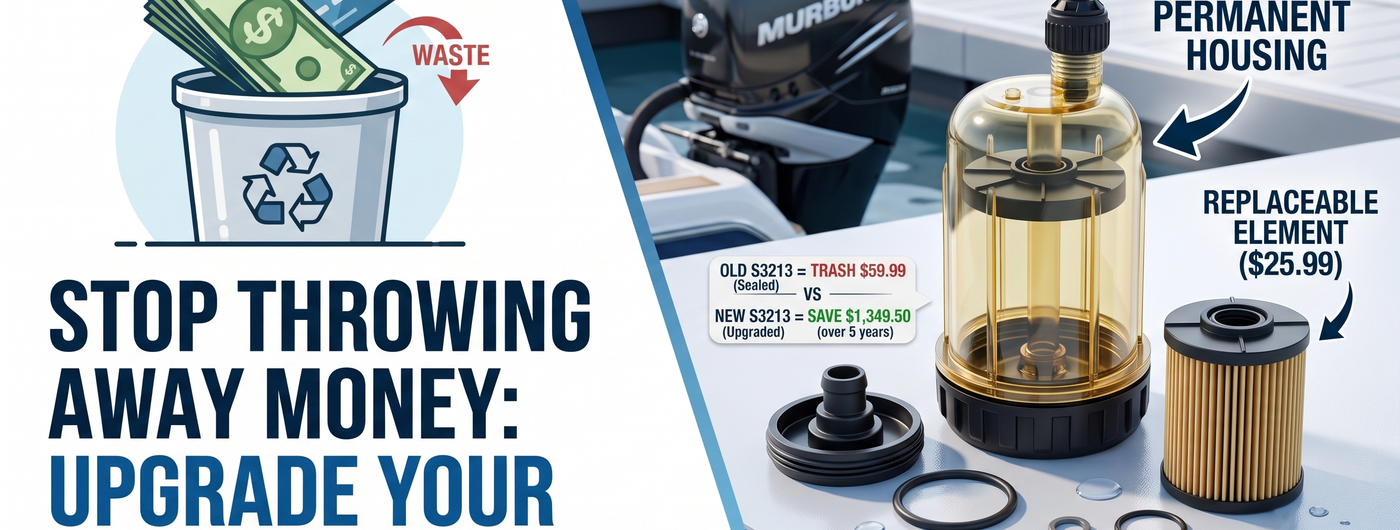
S3213 Upgrade Guide: Why the Replaceable Filter Pays for Itself in 2 Services
, by iFJF Direct, 11 min reading time
, by iFJF Direct, 11 min reading time

Compare the old sealed S3213 vs the new replaceable-element design. Real cost data shows the upgraded version pays for itself by the second service — and saves fleet operators $490+ over 5 years.
If you own a Mercury, Yamaha, or Volvo Penta outboard, you know the drill: every 100 hours (or once a season), you spin off the old fuel water separator and spin on a new one. The sealed S3213 filter has been the marine standard for decades — it works, it's reliable, and it's what most boat owners use.
But there's a problem hiding in plain sight: every time you service it, you're throwing away a perfectly good filter housing. The threaded cap, the clear bowl, the drain plug — all of it goes in the trash along with the dirty filter element.
That's not just wasteful. It's expensive. And there's a better way.
The traditional S3213 (Mercury 35-60494-1, Yamaha S3213, Sierra 18-7932) is a one-piece sealed assembly. The filter media is permanently bonded inside the housing — you can't open it, you can't clean it, and you can't replace just the element. When the 10-micron media clogs with rust, water, and diesel sludge after 100 hours of operation, the entire unit becomes disposable.

Here's what that means over time:
| Service Interval | Old S3213 (Sealed) | Upgraded S3213 (Replaceable) |
|---|---|---|
| First service (100 hrs) | $23.99 — replace entire unit | $27.99 housing + included cartridge |
| Second service (200 hrs) | $23.99 — replace entire unit | $10.00 — replace cartridge only |
| Third service (300 hrs) | $23.99 — replace entire unit | $10.00 — replace cartridge only |
| 3-Year Total | $71.97 | $47.99 (or $43.99 with 3-pack) |
The math is simple: the upgraded version pays for itself by the second service. Every service after that is pure savings.
The upgraded S3213 separates the filter into two components:

The filtration performance is identical — 10 microns at 90%+ efficiency. But instead of throwing away the housing every time, you're only replacing the part that actually wears out.
Replacement cartridges cost $10.00 each — less than half the price of a complete sealed S3213. Stock up with the 3-pack at $19.00 ($6.33 per cartridge) and you're paying less than the cost of a gallon of marine fuel for a season's worth of filtration.
With the old design, replacing the filter means disconnecting fuel lines, draining the bowl, wrestling off the old housing, and seating a new one — with the risk of cross-threading the NPT ports every time. The upgraded version: unscrew the collar, swap the cartridge, tighten. Done. No fuel line disconnection means no air intrusion into the system and no repriming.
The clear nylon inspection bowl stays on the engine. Between services, you can glance at it and immediately see if there's water accumulation or sediment buildup. With the old sealed design, you get one look during installation and that's it until the next service.
This isn't a retrofit that requires re-plumbing your fuel system. The upgraded S3213 uses the exact same 3/8" NPT thread pattern as the original. It spins onto your existing mounting bracket in 30 seconds — no adapters, no new hose fittings, no drilling.
Compatible with:
Think about this: the average tournament fishing boat puts 200-300 hours on the engine per year. That's 3 complete filter assemblies thrown away annually — plastic housing, metal threads, rubber gaskets, and all. Multiply that by the roughly 12 million registered recreational boats in the US, and the waste adds up fast.
The replaceable-element S3213 reduces waste by roughly 70% per service. The only thing going in the trash is the paper filter media — everything else stays on the engine. If you care about keeping the waterways clean, this is a small change with a real impact.
Let's be honest — the sealed design isn't obsolete. It's still the right choice in a few situations:
For everyone else — especially fleet operators, fishing guides, and owners putting 100+ hours per season on their outboards — the upgraded S3213 is the mathematically correct choice.
I've talked to charter captains running twin Yamaha F250s who log 400+ hours per season in the Gulf. That's 4 filter changes per engine per year — 8 total. Here's the math:
| Old S3213 | Upgraded + 3-Pack | |
|---|---|---|
| Per-engine annual filter cost | 4 × $23.99 = $95.96 | $27.99 housing + 3 × $6.33 = $46.98 |
| Twin-engine annual cost | $191.92 | $93.96 |
| 5-year total | $959.60 | $469.80 |
$489.80 saved over 5 years. That's the equivalent of a free Garmin chartplotter — from switching filter types. No extra work, no performance trade-off, just smarter purchasing.
Q: Can I use the old S3213 cartridges with the upgraded housing?
A: No. The upgraded housing uses a proprietary cartridge design — you'll need the replacement cartridges specifically made for this housing. Old sealed S3213 filters are not compatible with the upgraded housing and vice versa.
Q: Will this work with ethanol-blended marine fuel (E10)?
A: Yes. The polymer housing and gasket materials are ethanol-resistant. However, ethanol attracts moisture, so check the clear bowl more frequently — every 25-30 hours with E10 fuel is a good rule of thumb.
Q: Does the clear bowl eventually cloud or yellow?
A: Over several years of UV exposure, yes — that's true of any clear nylon bowl. The R25T replacement bowl is available separately ($15.99) if yours becomes too cloudy to inspect. But in normal engine-compartment conditions (shielded from direct sunlight), expect 4-5 seasons before noticeable yellowing.
Q: Is the polymer housing as tough as the metal one?
A: For 99% of applications, yes. The housing is rated for the same pressure range (0-15 PSI operating, 45 PSI burst). The only scenario where metal wins is direct impact — if a loose anchor or toolbox bangs against the filter in rough seas. In a protected engine compartment, polymer holds up just fine.
Q: How do I know when the cartridge needs replacing?
A: Three ways: (1) follow the 100-hour/annual schedule, (2) watch the clear bowl — if you see a dark sediment layer or a water layer at the bottom, replace immediately regardless of hours, and (3) symptom check — hard starting, surging at cruise speed, or a water-in-fuel alarm all signal a saturated filter element.
Q: Can I switch back to the old sealed S3213 if I don't like the upgraded one?
A: Absolutely. Both designs use the same 3/8" NPT thread pattern. If you ever want to switch back, just spin off the upgraded housing and spin on a sealed S3213 — no modifications needed in either direction.
S3213 Upgraded Fuel Water Separator — Replaceable Filter Element
10-micron filtration • 3/8" NPT ports • Fits Mercury, Yamaha, Volvo Penta • Replaces 35-60494-1
$27.99
Shop Now →
 Fuel Filter Assembly for 1992-2002 Chevy GMC 6.5L Diesel — Suburban Tahoe Silverado Sierra Yukon Hummer H1 — Replaces 10226035
$177.99
Fuel Filter Assembly for 1992-2002 Chevy GMC 6.5L Diesel — Suburban Tahoe Silverado Sierra Yukon Hummer H1 — Replaces 10226035
$177.99
 FS1098 Fuel Water Separator w/ PCV for Cummins B6.7 ISL8.9 — 10 Micron
$79.99
FS1098 Fuel Water Separator w/ PCV for Cummins B6.7 ISL8.9 — 10 Micron
$79.99
 68394482AA Water Separator for 2014-2018 Ram 1500 3.0L EcoDiesel
$489.73
68394482AA Water Separator for 2014-2018 Ram 1500 3.0L EcoDiesel
$489.73
 FS20081 Fuel Water Separator for EPA 2017 Cummins ISX15 X15
$47.99
FS20081 Fuel Water Separator for EPA 2017 Cummins ISX15 X15
$47.99