
Autolite 1100 vs 1101 Carburetor: What's the Difference?
, by iFJF Direct, 5 min reading time
, by iFJF Direct, 5 min reading time

Confused between the Autolite 1100 and 1101 carburetor? Learn the key differences in venturi size, engine compatibility, and which one your classic Ford actually needs.
If you own a 1960s Ford with an inline-6 engine, you've probably run into the Autolite 1100 vs 1101 question. They look nearly identical, they bolt to the same intake manifold, and they're often listed interchangeably on eBay and parts sites. But there is a difference — and picking the wrong one can leave you with a carburetor that's undersized for your engine.
In this guide, we'll break down exactly what sets the Autolite 1100 and 1101 apart, which engines each one was designed for, and what to look for when buying a replacement today.
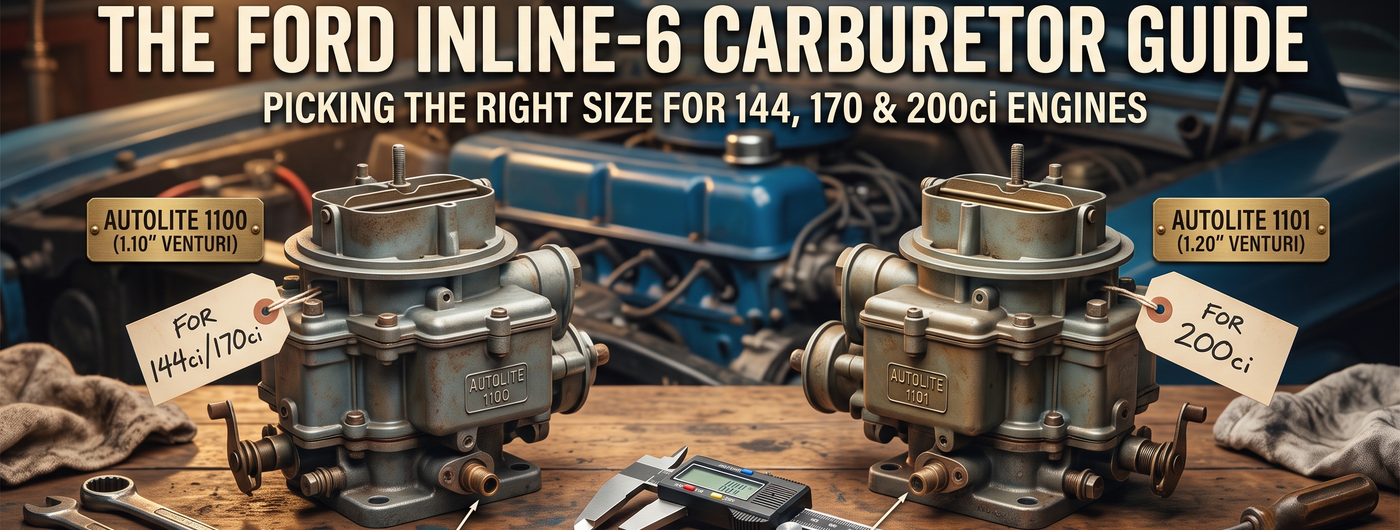
The Autolite 1100 has a 1.10" venturi and was factory-installed on the 144ci and 170ci inline-6 engines (Falcon, Comet, early Mustang). The Autolite 1101 has a slightly larger 1.20" venturi and was designed for the 200ci inline-6 (later Mustangs, Fairlanes, and trucks).
Both are 1-barrel downdraft carburetors with manual chokes. They share the same mounting flange, the same throttle linkage geometry, and the same fuel inlet configuration. The only functional difference is the venturi bore diameter — 0.10 inches.
Because the 1101 has the larger venturi, it's backward-compatible with 144/170ci engines (though slightly over-carbureted at low RPM). A 1100 on a 200ci engine will work, but you'll leave horsepower on the table — the smaller venturi restricts airflow at wide-open throttle.
| Spec | Autolite 1100 | Autolite 1101 |
|---|---|---|
| Venturi Diameter | 1.10" | 1.20" |
| Throttle Bore | 1.50" | 1.50" |
| Choke Type | Manual (Cable) | Manual (Cable) |
| Barrel Count | 1 | 1 |
| Factory Engine | 144ci / 170ci I6 | 200ci I6 |
| Spark Control Valve | Yes | Yes |
| Fuel Inlet | 5/16" Barb | 5/16" Barb |
| Mounting Flange | 2-Stud | 2-Stud |
If you're shopping for a replacement today, here's the reality: most new aftermarket carburetors sold as "Autolite 1100/1101" are built to the 1101 venturi spec. Manufacturers produce one unit that covers both applications because the larger venturi works on all three engine sizes.
Here's what to check before you buy:
Swapping an Autolite 1100/1101 is one of the easier carburetor jobs on a classic car:
Q: Can I put an 1101 on a 170ci engine?
A: Yes — the larger venturi won't hurt anything, and many 170ci owners prefer the slight airflow gain. You may notice a small drop in low-RPM throttle response compared to the correctly-sized 1100.
Q: What about the Autolite 1100 with automatic choke?
A: Some later 1100 variants (1968–1969) used a hot-air automatic choke. These are not directly interchangeable with the manual-choke versions without modifying the choke cable and heat riser plumbing. Stick with manual choke for 1963–1967 applications.
Q: Will an 1100/1101 fit a 289 V8?
A: Absolutely not. V8 engines use the Autolite 2100 (2-barrel) or 4100 (4-barrel). The mounting flange, bore spacing, and throttle linkage are completely different.
Q: How do I identify which one I have?
A: Look at the casting number on the float bowl. The 1100 typically has a tag or stamp reading "C4DF" through "C7DF" series. The 1101 uses "C5DF" through "C8DF" tags. If the tag is missing (common on 50-year-old carbs), measure the venturi with a caliper — 1.10" = 1100, 1.20" = 1101.
Q: What's a fair price for a new replacement?
A: A quality complete carburetor with hardware and gaskets: $150–$200. Rebuild kits: $30–$60. Used cores: $50–$100 (but expect to rebuild). If you see a "new Autolite 1101" for $40, it's almost certainly a rebuild kit, not a complete carburetor.

Stop searching through rebuild kits and used cores. Our Autolite 1100/1101 is a fully assembled, pre-tuned replacement — bolt it on and go. Built to the 1101 venturi spec for compatibility with all 144/170/200ci Ford inline-6 engines from 1963–1967.
Includes mounting gasket, fuel filter, fuel line, and hardware kit.
Shop Now →
 Carburetor Rebuild Kit for Edelbrock 1400-1409 & Carter 9000 Series 4-BBL — 809064
$39.99
Carburetor Rebuild Kit for Edelbrock 1400-1409 & Carter 9000 Series 4-BBL — 809064
$39.99
 Carburetor Calibration Tuning Kit for Edelbrock 1400-1411 & Carter AFB — Jets Rods Springs
$35.99
Carburetor Calibration Tuning Kit for Edelbrock 1400-1411 & Carter AFB — Jets Rods Springs
$35.99
 Edelbrock 1406 Performer 600 CFM 4-Barrel Carburetor — Electric Choke, for Chevy/GMC/Ford (Gold)
$419.99
Edelbrock 1406 Performer 600 CFM 4-Barrel Carburetor — Electric Choke, for Chevy/GMC/Ford (Gold)
$419.99
 1404 Performer 500 CFM 4-Barrel Carburetor Manual Choke NO EGR
$419.99
1404 Performer 500 CFM 4-Barrel Carburetor Manual Choke NO EGR
$419.99