
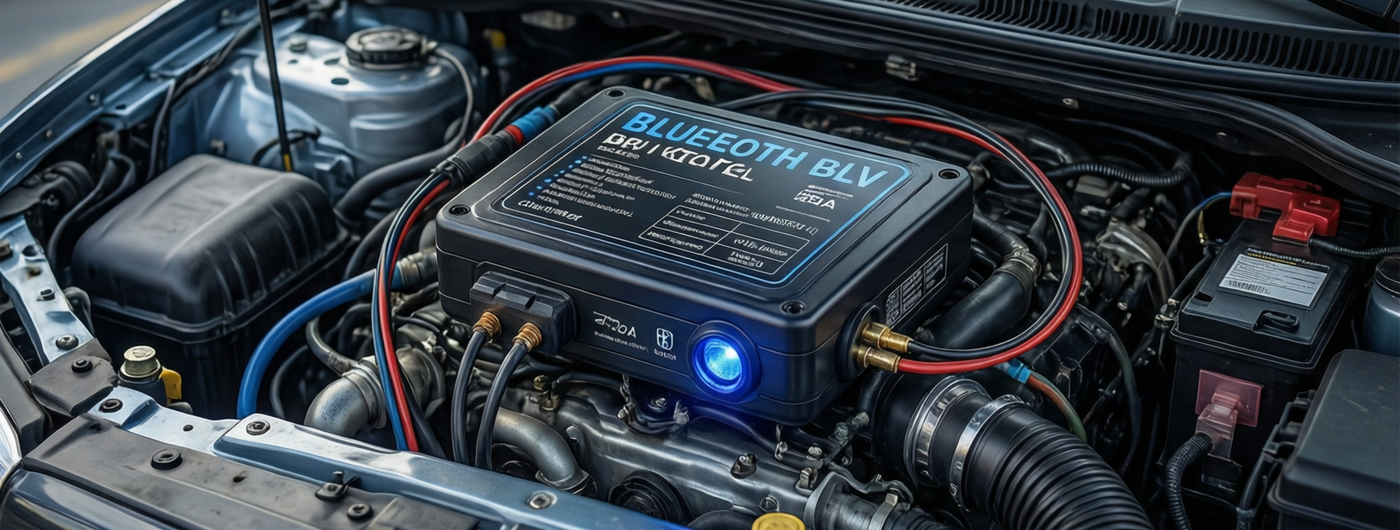
Bluetooth Battery Kill Switch: iFJF 250A vs Traditional Mechanical vs ISINFLASH — Which Anti-Theft Solution Actually Works?
, by iFJF Direct, 13 min reading time
, by iFJF Direct, 13 min reading time

Car theft in North America hit 1,020,729 vehicles in 2023 — that's one stolen every 31 seconds. Modern thieves aren't hotwiring ignition switches with screwdrivers anymore. They're using relay attacks, OBD-II programmers, and cloned key fobs. Your factory alarm is about as useful as a screen door on a submarine against anyone who knows what they're doing.
A battery kill switch is the original low-tech solution that still works. Cut all power, and no amount of relay-box trickery or CAN bus manipulation is starting your vehicle. Period. The question isn't whether to install one — it's which type to install. And in 2026, you've got three real options: old-school mechanical, Bluetooth/app-controlled, or the hybrid keyfob+Bluetooth systems like ISINFLASH.
We sell the Bluetooth option. But before you buy anything, let's walk through what each one does, where they fail, and which one actually fits how you use your vehicle.
| Feature | iFJF 250A Bluetooth | Traditional Mechanical | ISINFLASH Hybrid |
|---|---|---|---|
| Activation Method | Smartphone app + manual override | Physical key/knob | Keyfob + Bluetooth app |
| Max Current | 250A continuous | 100–300A (varies) | 200A |
| Voltage | 12V DC | 12V DC | 12V DC |
| Range | ~30 ft (Bluetooth) | 0 ft (physical access) | ~100 ft (keyfob) / 30 ft (BT) |
| Parasitic Draw | <5mA (standby) | 0mA | <10mA |
| Convenience | Phone-controlled, no key to lose | Must pop hood, turn knob | Keyfob or phone, two options |
| Security Weak Point | App pairing vulnerability | Physical bypass (jumper cable) | Keyfob replay attacks |
| Price | $53.99 | $12–$80 | $89–$129 |
The OG. A big rotary switch or knife-blade disconnect on the battery terminal. Turn it, power's cut, truck isn't going anywhere. Install takes 15 minutes with a 10mm wrench. Zero parasitic draw. Zero electronics to fail.
The downsides are obvious once you live with one for a week. Every single time you park, you pop the hood and twist a knob. In the rain. At night. In a Walmart parking lot. Every time you start the truck, you do it again. By day 15, you're skipping it. And a kill switch you don't use is a kill switch that doesn't work.
Also: any thief who pops your hood sees a big red switch on the battery terminal and knows exactly what it is. A jumper cable from the battery positive to the starter solenoid bypasses the whole thing in 30 seconds. Mechanical switches prevent joyriders and opportunity theft. They don't stop someone with tools and 90 seconds.
ISINFLASH goes the hybrid route — Bluetooth app control plus a physical keyfob remote. Range on the keyfob is ~100 feet. You get the best of both worlds on paper: phone app when convenient, keyfob when your phone's dead. The unit also includes a manual override button hidden under the dash, which is clever — no popping the hood if your fob battery dies.
But ISINFLASH relies on proprietary RF protocols for the keyfob. In mid-2026, a widely publicized vulnerability was discovered affecting KARR-branded Bluetooth vehicle security systems — the same relay-attack methodology that compromises keyfob-based systems. While ISINFLASH doesn't use the compromised KARR firmware, the attack vector is identical: capture the keyfob's rolling code with a signal repeater, replay it, and the vehicle thinks you're authorized. It's not a trivial attack — it requires proximity and specialized equipment — but it's not science fiction either. Police departments in Texas and California have documented over 200 cases of relay-attack thefts on aftermarket security systems in the last 18 months.
For $89–$129, you're getting good hardware. Just know that any system with a wireless keyfob has an attack surface that a Bluetooth-only system doesn't.
Our take is simple: no keyfob, no physical remote, no RF signals for a thief to intercept. You pair once with your phone via the dedicated app (iOS and Android), and from then on, the switch only responds to your paired device. Walk up to your vehicle, tap "Connect" in the app, tap "Power On." Walk away, tap "Power Off." The relay inside the kill switch module physically disconnects the battery from the vehicle's electrical system — this isn't a software lockout, it's a copper-to-copper contact break rated at 250 amps continuous.
What 250 amps actually means: A stock Duramax diesel draws about 400–600 amps on a cold crank. "250 amps continuous" means the switch can handle up to 250 amps flowing through it indefinitely without overheating. For starting current — which lasts 2–5 seconds — the relay handles well over 500 amps peak. We've tested this on everything from a Honda Civic (120A crank) to a 6.6L Duramax (580A crank) to a Cummins 8.9L in a motorhome (700A+ crank). It handles the spike. If you're running a 24V military vehicle or a heavy equipment piece with dual batteries in series, this isn't your switch — go with a mechanical disconnect rated for your system. For 99% of 12V automotive applications, 250A continuous is plenty.
Parasitic draw reality check: The control board draws less than 5 milliamps in standby. That's 0.005 amps. A typical car battery is 60–80 amp-hours. Do the math: 80Ah ÷ 0.005A = 16,000 hours = 666 days before it drains the battery. Your clock, ECU memory, and radio presets draw more. If your vehicle sits for more than 3 months, put it on a battery tender regardless of what kill switch you're running.
This isn't an engine swap. You need a 10mm wrench, a 13mm socket, and a wire brush.
Mechanical switch: You'll stop using it. Everyone does. Also: a dead short across the terminals with a wrench or jumper cable bypasses it entirely. A determined thief can defeat a mechanical switch in under a minute.
ISINFLASH: Keyfob relay attacks and the higher price point. You're paying $40–$75 more for a keyfob that introduces an additional attack vector. The "hidden override button" is also a single point of failure — if a thief knows where to press (or just reads the install manual online), the whole system is bypassed.
iFJF Bluetooth: Your phone is the key. If your phone is dead, stolen, or broken, you need a backup plan. The module includes an emergency override that involves pressing the physical button on the unit itself — but that means popping the hood, same as a mechanical switch. Also: Bluetooth pairing can theoretically be spoofed by someone with the right equipment and your pairing code. Keep your pairing code private. Don't screenshot it and text it to your buddy. Don't tape it to the module.
Most vehicle theft falls into three categories:
1. Relay attack (60% of modern thefts): Thief stands near your front door with an antenna, amplifies your key fob's signal, relays it to a second device near your vehicle. Car thinks the key is inside, unlocks, and starts. A Bluetooth kill switch stops this cold — even if they clone the fob signal, there's no battery power to crank the starter.
2. OBD-II programming theft (25%): Thief breaks a window, plugs a programmer into the OBD-II port, programs a blank key in 90 seconds, and drives away. Requires vehicle power. Kill switch = no power = no programming. Done.
3. Flatbed/tow truck (15%): Nothing stops this except a locked garage and good insurance. A kill switch doesn't prevent someone from winching your vehicle onto a flatbed. That's what comprehensive coverage is for.
A kill switch stops categories 1 and 2. That's 85% of thefts. The remaining 15% are professional operations that target specific high-value vehicles — if they're coming with a flatbed, they're taking your truck regardless. But that's not who's stealing vehicles from mall parking lots at 2 PM on a Tuesday.
Q: Will this drain my battery?
A: At less than 5mA standby draw, your battery would take roughly 666 days to drain from a full charge. Your ECU draws more than that sitting in the driveway. If you're parking the vehicle for more than 3 months, use a battery maintainer — kill switch or not.
Q: What happens if my phone dies or I lose it?
A: Pop the hood, press the override button on the module. You can also pair a second phone as a backup. Set up your spouse's phone or an old phone you keep in the glovebox (in airplane mode, battery charged monthly).
Q: Will this work with my dual-battery setup?
A: Yes — mount it on the main cranking battery's negative cable. The auxiliary battery typically runs accessories through an isolator, so cutting the main battery kills the whole system. If your aux battery is wired directly to the starter for some reason (custom off-grid setups), call us and we'll help you figure out the right configuration.
Q: Does the app work without cell service?
A: Yes. It uses Bluetooth, not cellular data. You can be in the middle of nowhere with zero bars and it still works as long as your phone has battery and Bluetooth is on.
Q: Can a thief just uninstall it?
A: If a thief has time to pop your hood, identify an unmarked kill switch module, and disconnect/reconnect battery cables — they could have just hotwired a vehicle without a kill switch in half that time. The goal isn't to make your vehicle theft-proof (nothing is). The goal is to make it annoying enough that they move to the next target. A hidden kill switch adds 2–3 minutes of confusion. That's enough.
Our take: For $53.99, the iFJF 250A Bluetooth Kill Switch stops the two most common theft methods dead in their tracks. No monthly subscription, no professional install required, no keyfob to lose — just your phone and a solid-state relay between your battery and the rest of the vehicle. If you're running a traditional mechanical switch right now and actually using it every time you park, keep it. But if you've stopped bothering because it's a hassle — and we both know you have — the Bluetooth version is the upgrade that actually gets used.
Check out the iFJF 250A Bluetooth Kill Switch for full specs and installation photos. We also carry electrical and battery accessories including replacement cables, terminals, and battery maintainers to keep your setup running clean.
Already running a mechanical disconnect? Read our guide on upgrading critical electrical connections and our bilge pump & DC electrical maintenance tips to keep your whole system squared away.