
Cummins FF266 Fuel Filter Cross-Reference: 5335504 vs 800154401 — Complete Replacement Guide
, by iFJF Direct, 12 min reading time
, by iFJF Direct, 12 min reading time

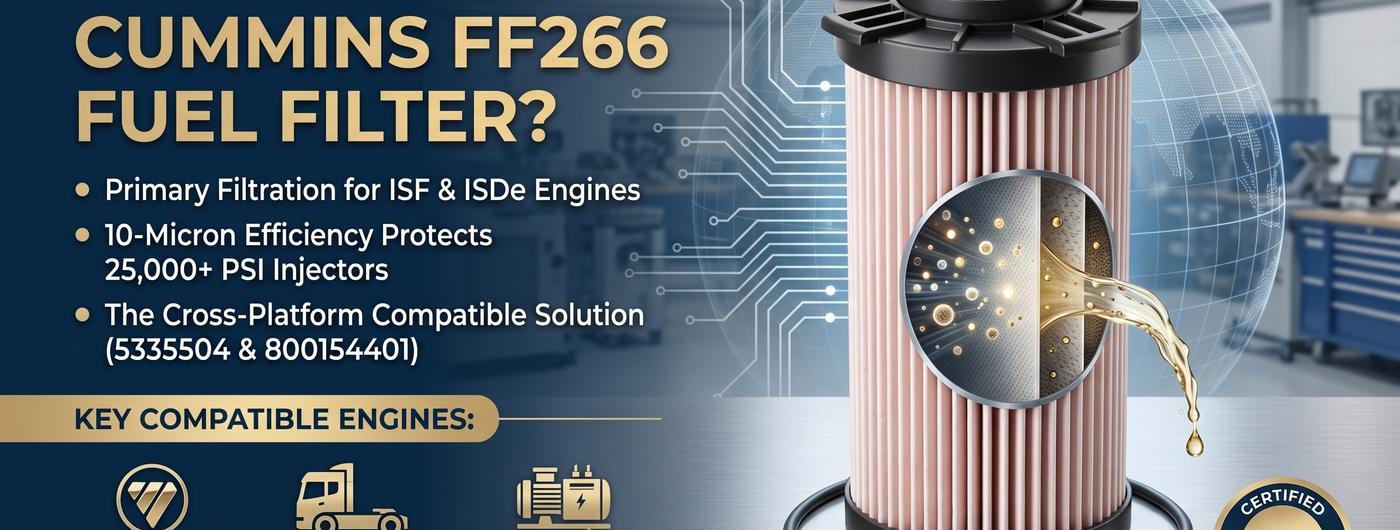
The FF266 is a spin-on diesel fuel filter designed for Cummins ISF and ISDe engine platforms. It serves as the primary fuel filtration component, removing water, debris, and contaminants before they reach your injection system. At 10-micron filtration efficiency, the FF266 catches particles smaller than a human hair — protecting injectors that operate at pressures exceeding 25,000 PSI in common-rail systems.
What makes the FF266 particularly interesting is its cross-platform compatibility. Unlike engine-specific filters that lock you into one part number, the FF266 design was adopted across multiple Cummins engine families shipped globally. This means the same filter you'd find on a Chinese-market Foton Auman truck also fits industrial generator sets and marine applications running ISDe powerplants.
The filter cartridge itself uses a cellulose-synthetic blend media with a steel canister housing, rated for typical service intervals of 15,000-20,000 miles in on-highway use. If you operate in dusty construction environments or with high-sulfur fuels, you'll want to cut that interval in half.
Finding the right filter shouldn't require a decoder ring. Here's the definitive FF266 cross-reference table covering every OEM and aftermarket part number that interchanges:
| Manufacturer | Part Number | Notes |
|---|---|---|
| Cummins OEM | 5335504 | Original equipment; assembly-level P/N C5303404 |
| Cummins OEM | 800154401 | Later revision; supersedes 5335504 |
| Cummins OEM | 3698447 | Chinese domestic market variant |
| Fleetguard | FF266 | Aftermarket equivalent; most common replacement |
| Donaldson | P550500 | Premium filtration alternative |
| Baldwin | BF7687 | Heavy-duty option with water-block media |
| WIX | 33463 | Budget alternative; 90% efficiency @ 10 micron |
| iFJF Direct | FJ-FF266 | Direct replacement; US-stocked, IATF-certified |
Important: While all these part numbers interchange physically, filtration efficiency and media quality vary significantly between brands. The Fleetguard FF266 uses StrataPore™ synthetic media achieving 99% efficiency at 10 microns, while budget alternatives may only hit 90%. In a common-rail diesel where injector replacement costs $4,000-$8,000, that 9% gap matters.
The 5335504 (first gen) and 800154401 (current revision) are functionally identical in fitment. Cummins consolidated these part numbers circa 2018 when they standardized the ISF fuel system across global production. If you're buying from a Cummins dealer, they'll sell you the 800154401 regardless of what your engine plate says.
The FF266 filter fits a surprisingly broad range of Cummins-powered equipment. Here's what it covers:
Cummins ISF 2.8L (ISF2.8): This 4-cylinder light-duty diesel powers the Foton Auman M3 and Aumark light trucks popular across Southeast Asia, Africa, and South America. Fleet owners running ISF2.8 engines in delivery trucks typically replace the FF266 every 10,000 km due to variable fuel quality. The 2.8L produces 148 hp and 360 Nm — modest numbers that rely entirely on clean fuel delivery.
Cummins ISF 3.8L (ISF3.8): The 4-cylinder workhorse found in Foton Auman medium-duty trucks, city buses, and industrial equipment. Rated at 168 hp and 600 Nm, the 3.8L sees severe-duty cycles in urban logistics where stop-and-go operation stresses the entire fuel system. A clogged FF266 on an ISF3.8 manifests as power loss under load — the ECM detects low rail pressure and dials back fueling.
Cummins ISDe 4.5L & 6.7L: These inline-six engines appear in Dongfeng and Foton heavy trucks, plus generator sets and marine applications. The ISDe 6.7L produces up to 300 hp in truck trim and demands clean fuel with its Bosch CP3 high-pressure pump. A single tank of contaminated diesel can destroy a CP3 — replacement cost approaches $2,500 before labor.
Industrial & Stationary: The FF266 also fits Cummins-powered generator sets in the 50-150 kW range, irrigation pumps, and construction equipment. Stationary engines often run on stored fuel tanks where water accumulation and microbial growth ("diesel bug") are common — making fuel filtration even more critical than in on-road use.
Don't wait for symptoms — by the time you feel them, injector damage may have already begun. Here's what to watch for and when to act:
Recommended Replacement Intervals:
Warning Signs of a Clogged FF266:
1. Loss of Power Under Load: The most common first symptom. As the filter element loads up with debris, fuel flow restriction increases. The ECM compensates by reducing injection quantity — you'll feel it as hesitation during acceleration or inability to maintain speed on grades. On an ISF3.8-powered truck carrying 8 tons, this shows up as a 10-15 km/h speed drop on highway climbs.
2. Hard Starting / Extended Crank Time: When the filter is partially clogged, the low-pressure pump struggles to build adequate supply pressure during cranking. Instead of firing within 2-3 revolutions, the engine cranks for 5-8 seconds. Cold mornings make this worse — the thicker fuel can't push through a restricted filter.
3. Rough Idle & Stalling: Inconsistent fuel delivery causes RPM fluctuation at idle (±50-100 RPM). In extreme cases, the engine stalls when coming to a stop. This is your fuel system screaming for help.
4. Water-in-Fuel Warning Light: If your vehicle has a water sensor in the fuel filter housing, this light means the FF266's water-separating media is saturated. Drain the water immediately and consider replacing the filter — saturated media loses its ability to separate water from diesel.
5. Black Smoke from Exhaust: Partially clogged filters can cause uneven fueling — some cylinders get adequate fuel while others run lean. The ECM overcompensates, resulting in incomplete combustion and visible black smoke.
Let's talk money. The price spread on FF266-equivalent filters is wide enough to make any fleet manager pause:
| Source | Brand | Unit Price | Bulk Price (12-pack) | Per-Unit Bulk |
|---|---|---|---|---|
| Cummins Dealer | Cummins 800154401 | $45-65 | N/A | N/A |
| Fleetguard Dealer | Fleetguard FF266 | $28-38 | $300-360 | $25-30 |
| eBay (China-sourced) | Generic | $12-18 | $98.49 | $8.21 |
| iFJF Direct | iFJF FJ-FF266 | $39.99 | Contact us | Bulk pricing available |
The $8 eBay Filter Trap: Chinese-market generic FF266 filters on eBay sell for as low as $8.21/ea in 12-packs. Tempting? Consider this: a single set of Bosch CP3 injectors for an ISDe costs $3,200-$4,800 (parts only). When a no-name filter with unknown media quality fails to stop 5-micron particles, those particles become high-pressure sandblasting inside your injectors. You save $30 on the filter and risk $4,000 in injector damage. That math doesn't work.
Why Cummins Dealers Charge $45-65: You're paying for the Cummins logo on the box. The 800154401 is manufactured to Cummins CES 14012 specification but doesn't differ fundamentally from the Fleetguard FF266 — Fleetguard is Cummins' own filtration division. The dealer markup reflects the convenience of walking into a Cummins service center and walking out with a filter, not superior filtration.
The Sweet Spot: Quality Aftermarket: The iFJF FJ-FF266 at $39.99 delivers IATF 16949-certified manufacturing quality with US-based inventory and shipping. You get Fleetguard-equivalent filtration performance without the dealer premium — and unlike eBay generics, every batch is lot-tested for micron efficiency and burst pressure.
Replacing an FF266 is a 20-minute job requiring basic hand tools. Here's the complete procedure for ISF/ISDe engines:
Tools Needed:
Step 1: Locate the Filter Housing
On ISF 2.8L/3.8L engines, the fuel filter is mounted on the passenger side of the engine block, near the firewall. It's a vertically-mounted spin-on canister about 5 inches tall. On ISDe engines, it's typically on the driver's side, forward of the ECM bracket.
Step 2: Drain Water from the Old Filter
Place your drain pan underneath. Locate the water drain valve at the bottom of the filter housing (a plastic wing-nut or hex plug). Open it slowly — diesel will flow. Let it drain completely into the pan. This step prevents a diesel bath when you spin the filter off.
Step 3: Remove the Old Filter
Position your filter wrench around the canister, as close to the base as possible for maximum leverage. Turn counterclockwise. Expect resistance — these filters are installed hand-tight + 3/4 turn from the factory, and heat cycling can make them stubborn. Once loose, spin it off by hand, keeping it upright to minimize diesel spillage.
Step 4: Prep the Mounting Surface
Wipe the filter head mating surface with a clean rag. Remove any remnants of the old rubber gasket — a stuck gasket fragment is the #1 cause of post-installation leaks. Inspect the center threaded stud for damage or corrosion.
Step 5: Install the New Filter
Apply a thin film of clean diesel to the new filter's rubber gasket. This lubricates the seal during tightening and prevents the gasket from bunching or tearing. Thread the new filter onto the stud by hand until the gasket contacts the mounting surface. Then tighten an additional 3/4 turn by hand — do not use the filter wrench to tighten. Overtightening crushes the gasket and can crack the canister.
Step 6: Prime the Fuel System
This step is critical. Never crank the engine with a dry fuel filter — running the high-pressure pump dry for even 10 seconds can cause cavitation damage. Use the hand primer pump (located on the filter head or nearby on the low-pressure supply line) and pump until you feel firm resistance — typically 30-50 strokes. If your engine uses an electric lift pump, cycle the key to "ON" (not start) for 10 seconds, then off. Repeat 3 times.
Step 7: Start and Check for Leaks
Start the engine. It may crank slightly longer than usual on first start — this is normal as residual air purges. Let it idle for 2 minutes while you inspect the filter base for diesel leaks. A small seep means the gasket didn't seat properly — loosen and re-tighten. Rev the engine to 1,500 RPM briefly and check again.
Step 8: Dispose of the Old Filter
Diesel fuel filters are hazardous waste. Drain remaining diesel from the old filter into your waste oil container. Most auto parts stores accept used filters for recycling at no charge. Never throw a diesel-soaked filter in household trash.
1. Buy Fuel from High-Volume Stations: Diesel that sits in underground tanks collects water through condensation. High-turnover truck stops and commercial fuel stations have fresher fuel with lower water content. Every 1% of water in diesel reduces injector life by approximately 10%.
2. Use a Fuel Additive in Cold Climates: If you operate below 32°F (0°C), add an anti-gel treatment to every tank. Gelled diesel can't pass through the FF266's media, starving the engine. A $10 bottle of anti-gel treats 250 gallons — cheap insurance against being stranded.
3. Keep a Spare Filter in the Truck: If you operate in regions with questionable fuel quality, keep a spare FF266 filter and the tools to change it onboard. A clogged filter on a remote job site means a tow bill, not just a filter replacement.
4. Check the Water Separator Weekly: If your filter housing has a clear bowl or water sensor, make it a habit to check before starting the engine each Monday. Fleet operators who drain water weekly see 40% fewer premature filter replacements than those who wait for the warning light.
5. Pair Filter Changes with Oil Changes: Every other oil change is a practical fuel filter replacement interval for mixed-duty cycles. If you change oil at 7,500 miles, replace the fuel filter at 15,000. This rhythm is easy to track and prevents neglect.
6. Upgrade to a Fuel Water Separator: If your application sees consistently wet fuel, consider adding a dedicated fuel water separator upstream of the FF266. A two-stage system (separator + filter) provides dramatically better protection than either component alone. The initial investment pays for itself the first time you avoid an injector rebuild.
If you're maintaining a Cummins-powered Ram, our 5083285AA Oil Filter 2-Pack for 2007-2024 Ram 6.7L Cummins engines pairs perfectly with regular fuel filter service — tackling both sides of the filtration equation in one maintenance session.
For Cummins RV and generator owners, the 149-2513 Fuel Filter covers Onan Quiet Diesel generators — same filtration principles, different form factor.
For a complete diesel maintenance schedule covering oil, air, and fuel filters across multiple engine platforms, check out our Diesel Truck & RV Maintenance Guide.
Understanding why fuel filters matter — especially the relationship between micron ratings and injector longevity — can save you thousands in unexpected repairs. And if you're maintaining a Ram with the 6.7L Cummins, our Ram 6.7L Fuel Filter Replacement Guide walks through that platform's dual-filter system.
Browse our complete diesel fuel filter collection for ISF, ISDe, ISX, Duramax, and Powerstroke applications.