

Why Fuel Filters Matter: The $12 Part That Protects Your $10,000 Diesel Fuel System
, by William Lee, 7 min reading time
, by William Lee, 7 min reading time

Updated: June 12, 2026
There's a part on your diesel truck that costs about $12, takes 20 minutes to change, and — if neglected — will destroy an engine worth more than some used cars. That part is your fuel filter.
Despite being one of the cheapest maintenance items on any diesel, fuel filters are also one of the most frequently ignored. Owners push intervals. They buy the cheapest option on Amazon. They forget the frame-rail water separator entirely. And every single time, the math is the same: save $12 today, spend $8,000–$15,000 tomorrow.
Here's exactly why fuel filters deserve more respect — and how they protect the most expensive components in your engine bay.
To understand why fuel filters matter, you first need to understand what they're protecting. Modern common-rail diesel injection is a hydraulic ballet at 30,000 PSI:
Now imagine what happens when a 15-micron particle of dirt hits an injector nozzle with a 2-micron clearance at 30,000 PSI. It doesn't "pass through." It erodes the metal. One particle, one scar. A thousand particles later, your spray pattern is shot, your truck smokes at idle, and your fuel economy drops 20%.
The Bosch CP4.2 high-pressure fuel pump — found in 2011+ Ford 6.7L Powerstrokes, 2019+ Ram 6.7L Cummins, and 2011–2016 Duramax LML — is the most controversial fuel system component in modern diesel history. And fuel filters are ground zero for the controversy.
The CP4.2 uses a single roller follower to drive two plungers. Unlike the older CP3 (triple-piston, gear-driven), the CP4.2's roller can rotate and flatten if it encounters:
When the roller flattens, it sends a cloud of hardened steel particles through the entire fuel system: high-pressure lines, fuel rails, and all eight injectors. The industry calls this the "glitter bomb."
Repair cost for a CP4.2 failure: $8,000–$15,000 depending on shop labor rates. Every component that touched fuel — pump, lines, rails, injectors, return system — must be replaced. There is no "flush and hope" fix.
A properly-functioning, properly-rated fuel filter prevents the debris that triggers CP4.2 failures. A clogged, bypassed, or incorrectly-spec'd filter guarantees them. The difference between a 400,000-mile fuel system and a 60,000-mile catastrophe often comes down to one question: did you change the filter on time?
Water is diesel fuel's worst enemy, and it's everywhere. Condensation forms inside fuel tanks daily — every time the temperature drops overnight, moisture condenses on the tank walls and drips into your fuel. Over weeks and months, that adds up to ounces of free water sitting at the bottom of your tank.
What water does inside your fuel system:
This is why diesel fuel filters are also water separators. The best designs use a two-layer approach: a hydrophobic barrier that repels water molecules, and a separate particulate layer that catches the debris. If your filter doesn't explicitly include water separation — or if you're not draining the water separator bowl regularly — you're running on borrowed time.
Here's what fuel filter neglect actually costs, based on common diesel platforms:
| Failure | Cause | Repair Cost (Parts + Labor) |
|---|---|---|
| CP4.2 pump failure | Debris scoring roller/piston | $8,000–$15,000 |
| Full injector set replacement | Nozzle erosion from water/debris | $3,200–$4,800 (6.7L Cummins) |
| Fuel rail contamination | Metal debris from upstream failure | $800–$1,500 (part only, both rails) |
| Lift pump failure | Clogged filter → pump cavitation | $400–$900 |
For comparison: A 3-pack of quality fuel filters (enough for 30,000–45,000 miles) costs about $35–55. That's 0.4% of a single CP4.2 repair bill.
Most filter failures announce themselves before they become catastrophic. Learn these warning signs:
The bottom line: Your fuel filter is the cheapest catastrophic failure insurance you'll ever buy for your diesel truck. Change it on time. Change it with a filter that publishes its specs. And never, ever assume "it's probably fine."
Browse our fuel filter collection — every filter includes published micron ratings and OEM cross-reference numbers. Bulk and fleet pricing available.
 Fuel Filter Assembly for 1992-2002 Chevy GMC 6.5L Diesel — Suburban Tahoe Silverado Sierra Yukon Hummer H1 — Replaces 10226035
$177.99
Fuel Filter Assembly for 1992-2002 Chevy GMC 6.5L Diesel — Suburban Tahoe Silverado Sierra Yukon Hummer H1 — Replaces 10226035
$177.99
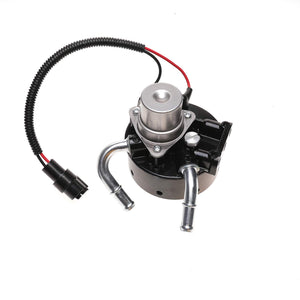 12642623 Fuel Filter Head + 1R-0750 Refit for 2005-2016 Duramax 6.6L
$87.99
12642623 Fuel Filter Head + 1R-0750 Refit for 2005-2016 Duramax 6.6L
$87.99
 FS1098 Fuel Water Separator w/ PCV for Cummins B6.7 ISL8.9 — 10 Micron
$79.99
FS1098 Fuel Water Separator w/ PCV for Cummins B6.7 ISL8.9 — 10 Micron
$79.99
 68394482AA Water Separator for 2014-2018 Ram 1500 3.0L EcoDiesel
$489.73
68394482AA Water Separator for 2014-2018 Ram 1500 3.0L EcoDiesel
$489.73