
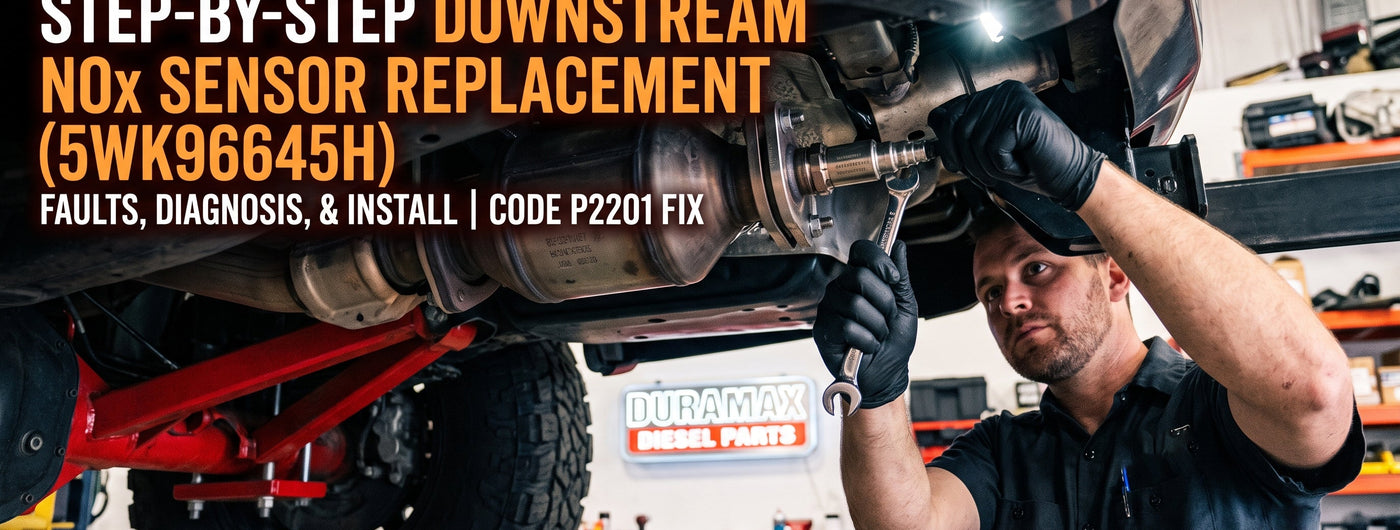
Duramax NOx Sensor Replacement: 5WK96645H Downstream Sensor Fix — Fault Codes, Diagnosis & Install
, by iFJF Direct, 8 min reading time
, by iFJF Direct, 8 min reading time

Check engine light on. Code P2201 staring back at you from the scanner. Your LML or L5P Duramax just threw a NOx sensor circuit fault and now you're looking at a $400+ dealership quote. Take a breath. This is a driveway job if you've got a 22mm wrench and about 45 minutes.
The 5WK96645H is the downstream NOx sensor — it lives behind the SCR catalyst, right after the DEF injection point. Its job is simple: tell the ECM whether the SCR system is actually cutting NOx like it's supposed to. When it lies (or quits entirely), your truck goes into reduced power mode and your DEF consumption goes haywire. Not fun on I-70 hauling 14,000 pounds.
Before you throw parts at it, make sure you're chasing the right problem. Here's what a failing downstream NOx sensor looks like on a Duramax:
One dead giveaway: if you clear the code and it comes back within 50-75 miles, that sensor is toast. Intermittent codes that take 300+ miles to return might be a wiring issue. Don't skip the visual inspection.
Step 1: Kill the engine and let the exhaust cool for at least 45 minutes. The downstream sensor sits right behind the SCR brick — that thing holds heat like a pizza stone.
Step 2: Crawl under the passenger side, look up at the exhaust pipe just behind the DPF/SCR assembly. You'll see a single sensor threaded into the pipe at roughly the 2 o'clock position. That's your downstream NOx sensor.
Step 3: Unplug the connector. Push the gray locking tab with a flathead, then pull the connector straight back. Don't twist it — the pins inside are tiny and they'll bend if you look at them wrong.
Step 4: Hit the sensor base with penetrating oil. Let it soak 5-10 minutes. These sensors go through heat cycles from ambient to 1,200°F, and they weld themselves in place over time.
Step 5: Break it loose with the 22mm wrench. If it's fighting you, don't force it — apply more penetrant and wait. A snapped-off sensor means pulling the exhaust section. Nobody wants that.
Step 6: Once it's out, compare the old sensor to your new iFJF 5WK96645H. Thread pitch, connector orientation, sensor tip length — all should match.
Step 7: Put a tiny dab of nickel anti-seize on the threads — just the threads, nowhere near the sensor tip. If anti-seize gets on the sensing element, the sensor reads wrong and you're back under the truck in a week.
Step 8: Thread it in by hand first. These are fine-pitch threads and cross-threading is too easy with a wrench. Once it's finger-tight, torque to 35-40 ft-lbs. The factory spec says 33-37 ft-lbs but real-world experience says 40 is fine. Don't go past 45 — you'll crush the crush washer and the sensor won't seal.
Step 9: Reconnect the harness. You should hear a solid click when the locking tab engages. Give the connector a gentle tug to confirm it's seated.
Step 10: Clear the codes with your scanner. Start the engine and let it idle for 5 minutes. Watch live NOx sensor data — you should see voltage readings cycling normally (0.1V to 4.5V range on most Duramax controllers).
The upstream sensor sits before the SCR catalyst and measures raw engine-out NOx so the ECM knows how much DEF to inject. The downstream sensor (5WK96645H) sits after the SCR and verifies the system actually cut NOx like it's supposed to. Different part numbers, different locations, different jobs. Don't mix them up.
Yes. The Duramax ECM will eventually trigger a 55 mph speed limiter if the downstream NOx reading doesn't make sense for too many drive cycles. Usually takes 2-3 drive cycles after the first CEL.
Short distance, yes. But every mile you drive with bad NOx data, the ECM is potentially overdosing DEF and running suboptimal combustion strategies. A 50-mile trip to the parts store is fine. A 500-mile road trip? Replace it first.
Factory sensors typically go 100,000-150,000 miles. Trucks that idle a lot or run high-ash oil tend to kill them faster — exhaust soot coats the sensor element. If you deleted the EGR but kept the SCR intact (and legal), you might see longer life since the exhaust stays cleaner.
For the downstream sensor on LML/L5P — typically no. Clear the DTCs and the ECM will start reading the new sensor immediately. Some 2017+ L5P trucks benefit from a "NOx sensor reset" procedure using a bidirectional scan tool. If your scanner supports it, do it. If not, 3-4 drive cycles will accomplish the same thing.
Shop our full Duramax parts lineup: Duramax Diesel Parts Collection
Related guides:
The TRUTH About EGR Deletes — Actual Science
Duramax CAT Oil Filter Adapter Install: 7791 Conversion Guide
iFJF Downstream NOx Sensor 5WK96645H — Shop Now