
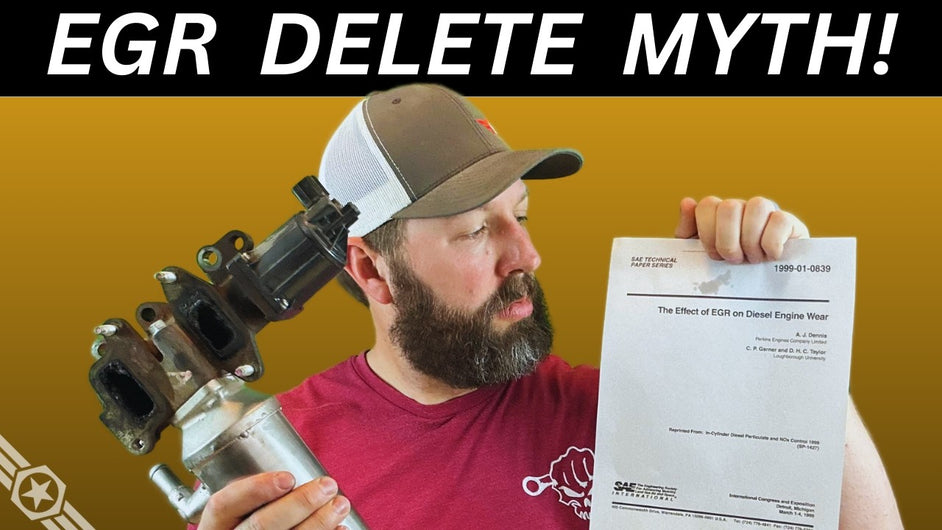
The TRUTH about EGR DELETES... Actual Science!
, by iFJF Direct, 12 min reading time
, by iFJF Direct, 12 min reading time

Home › News › EGR Delete: Complete Science Guide EGR Delete on Diesel Trucks: The Complete Science-Based Guide (2025) 🛒 Parts Used in This Guide 2013-2018 6.7L Dodge...
Should you delete the EGR system on your diesel truck? This is probably the most controversial topic in the diesel community — and for good reason. There are myths, misinformation, and outright lies floating around everywhere. So let's cut through the noise with actual science, peer-reviewed research, and real-world data.
EGR stands for Exhaust Gas Recirculation. It's a vehicle emissions system that recirculates a portion of your engine's exhaust gases back into the intake stream to be burned again. The stated goal: reduce NOx (nitrogen oxide) emissions, which are linked to acid rain, respiratory issues, and smog formation.
Here's the chemistry in 30 seconds: NOx forms whenever you have sufficient heat in the presence of oxygen and nitrogen. Your combustion chamber hits temperatures over 2,200°F during the combustion cycle — that's hot enough to create NOx. EGR reduces peak combustion temperatures and displaces oxygen with inert exhaust gas, which cuts NOx production by approximately 75–80% at full load. That's a significant reduction backed by real-world SAE and scientific testing.
Most people think EGR "burns off" NOx. That's wrong. EGR prevents NOx from forming in the first place, and it does this through two mechanisms:
Exhaust gas is inert — its oxygen has already been consumed in combustion. When recirculated back into the intake, it dilutes the oxygen content of the intake charge. In a diesel engine, this is less of a problem than you might think. The stoichiometric air-fuel ratio for diesel is 14.5:1, but diesels typically run at 20:1 or even 70:1 air-fuel ratios. There's always more oxygen than needed, so displacing some oxygen with inert gas barely affects power output.
This is where it gets interesting. You might expect pumping hot exhaust into the intake would make things hotter — but that's not what happens. The EGR gas has a higher heat capacity than ambient air. Think of it like this: if you drop a hot object into water versus oil (same mass, same temperature), the water's temperature rises less because water has a higher heat capacity. The same principle applies in the cylinder — the higher heat capacity exhaust diluting the intake charge means the combustion doesn't reach as high a peak temperature.
Lower peak temperature = less NOx formation. It's that simple.
Diesel combustion normally happens almost instantly — like speed dating for fuel molecules and oxygen atoms. This creates extremely high temperatures. EGR gas "buffers" the reaction, slowing it down and spreading the heat release over a longer period, keeping peak temperatures lower.
False. EGR reduces NOx specifically — not total emissions. If your diesel truck produces 25 pounds of exhaust per gallon of diesel without EGR, it produces 25 pounds with EGR. The volume is the same. Only the NOx content changes. Soot, carbon monoxide, and hydrocarbon emissions can actually increase with EGR.
False. EGR is not designed to reburn exhaust to eliminate pollutants. The slower, cooler combustion can incidentally burn some remaining hydrocarbons, but that's a byproduct — not the goal.
False. The EPA doesn't mandate EGR. It sets maximum NOx output limits. OEMs then choose the most economical strategy to meet those limits, which is typically EGR. Some manufacturers, like Cummins with the 2004.5–2007 5.9L, used internal EGR built into the camshaft at no extra cost. If you're wondering why your 2006 Cummins only gets 16 MPG, now you know.
Based on peer-reviewed research from SAE and the journal Energies, here's the full picture:
| Effect | Description | Severity |
|---|---|---|
| Reduced Power | EGR lowers cylinder pressure and temperature, reducing torque and horsepower output | Moderate |
| Lower Fuel Efficiency | Brake specific fuel consumption increases as EGR rate increases (less complete combustion) | Moderate |
| Increased Soot | EGR introduces unburned carbon back into the combustion chamber, increasing soot, CO, and HC | Significant |
| Faster Oil Degradation | Soot from EGR contaminates engine oil faster, requiring more frequent oil changes | Moderate |
| EGR Cooler Leaks | EGR coolers can fail and spill coolant into the intake manifold (costly repair) | High |
| Increased Engine Wear | Soot in oil increases wear on piston rings and cylinder liners, especially under heavy loads | Context-dependent |
| Turbo/VGT Issues | Sticky vanes in variable geometry turbos from carbon buildup (EGR + PCV oil vapor) | Moderate |
This is the $64,000 question: does EGR actually destroy your engine?
According to SAE technical paper 1999-01-0839 ("The Effects of EGR on Diesel Engine Wear") and peer-reviewed studies in the journal Energies, here's what controlled testing shows:
The research conclusion is nuanced: EGR can increase engine wear in worst-case scenarios, but the difference is unlikely to be meaningful for most owners. The engine with a functioning EGR will likely outlast your desire to keep driving the truck anyway.
Regardless of where you stand on the EGR debate, here are your actual options — ranked from least to most aggressive:
For most truck owners, this is the most practical choice. Keep the EGR system maintained, use quality oil and filters, and change oil at reasonable intervals. Consider running used oil analysis (UOA) every few changes to monitor soot content in your oil — that's the real indicator of how EGR is affecting your oil. Any API-certified diesel oil (including budget options from Walmart) meets the necessary specifications.
Many tuners and aftermarket performance companies offer tunes that reduce EGR demand or disable EGR entirely through the ECU. Some OEM manufacturers (looking at you, Volkswagen and Cummins) have done exactly this — and faced millions in EPA fines. Tuned-out EGR can improve fuel economy and reduce soot accumulation, but it affects your emissions compliance status.
Block-off plates prevent exhaust gases from flowing through the EGR system. The EGR hardware remains physically on the engine (appears stock), but the system is effectively disabled. This eliminates EGR flow without making dramatic visible changes. The downside: you're still carrying around dead weight, and the EGR cooler remains a potential coolant leak point.
This is a unique case. The 2004.5–2007 5.9L Cummins uses internal EGR — built into the camshaft profile via valve overlap. Swapping to an aftermarket camshaft eliminates internal EGR without removing any external components. Benefits include better fuel economy, less smoke, and potentially longer engine life — though your transmission will still need attention every 100,000 miles (that's just the 48RE life expectancy).
Remove all EGR hardware: EGR valve, EGR cooler, piping, hoses, and associated sensors. An EGR system can't produce NOx if it doesn't exist. This is the most aggressive option and provides the most performance benefit.
Since you're already working on your truck, these maintenance items take minutes to swap while everything's apart:
It can, yes. Removing emissions equipment may void warranties related to emissions components. However, many states protect your right to repair and maintain your own vehicle. Check your local laws.
Most owners report a 0.5–2 MPG improvement after a proper EGR delete with tuning. Your results will vary based on driving style, load, and tune quality.
EGR delete kits for common diesel trucks (Cummins, Duramax, Power Stroke) range from $150 to $600 for parts. If you need a shop to install it with a tune, budget $800–1,500 total.
In most U.S. states, no. However, Alaska, and many counties in other states don't require emissions testing. If you live in a state with no emissions requirements, this is a non-issue.
Properly tuned EGR deletes don't cause overheating. If you delete EGR without retuning the engine, you may see higher exhaust gas temperatures (EGT). A good tuner will address this in the calibration.
Full emissions deletes on 2013+ trucks are significantly more complex and expensive because you need to address EGR, DPF (Diesel Particulate Filter), and SCR (Selective Catalytic Reduction) systems. The costs and complexity are much higher, and these systems are heavily monitored by the OEM's engine control systems.
Browse our selection of EGR delete kits, block-off plates, and performance tuning products for Cummins, Duramax, and Power Stroke engines at ifjf.net.
Related Performance Part: 2013-2018 Dodge Ram 6.7L Cummins Exhaust DPF Delete Pipe — Ram 2500... - 4 inch mandrel-bent tubing, direct bolt-on for 2013-2018 Ram 2500/3500. Check Fitment
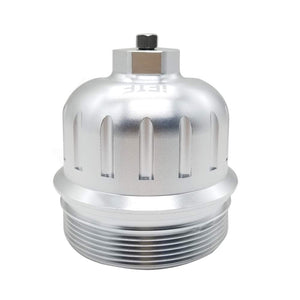 134001 Fuel Filter Housing Cap for 6.6L Duramax L5P 2017-2023 | iFJF
$69.99
134001 Fuel Filter Housing Cap for 6.6L Duramax L5P 2017-2023 | iFJF
$69.99
 FS1003 Fuel Water Separator for Cummins ISB ISC ISL ISM N14 — 10 Micron
$57.99
FS1003 Fuel Water Separator for Cummins ISB ISC ISL ISM N14 — 10 Micron
$57.99
 FD4615 Fuel + FL2016 Oil Filter Combo for 2017-2019 Ford 6.7L Powerstroke
$69.99
FD4615 Fuel + FL2016 Oil Filter Combo for 2017-2019 Ford 6.7L Powerstroke
$69.99
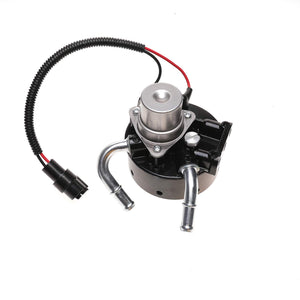 12642623 Fuel Filter Head + 1R-0750 Refit for 2005-2016 Duramax 6.6L
$87.99
12642623 Fuel Filter Head + 1R-0750 Refit for 2005-2016 Duramax 6.6L
$87.99


