
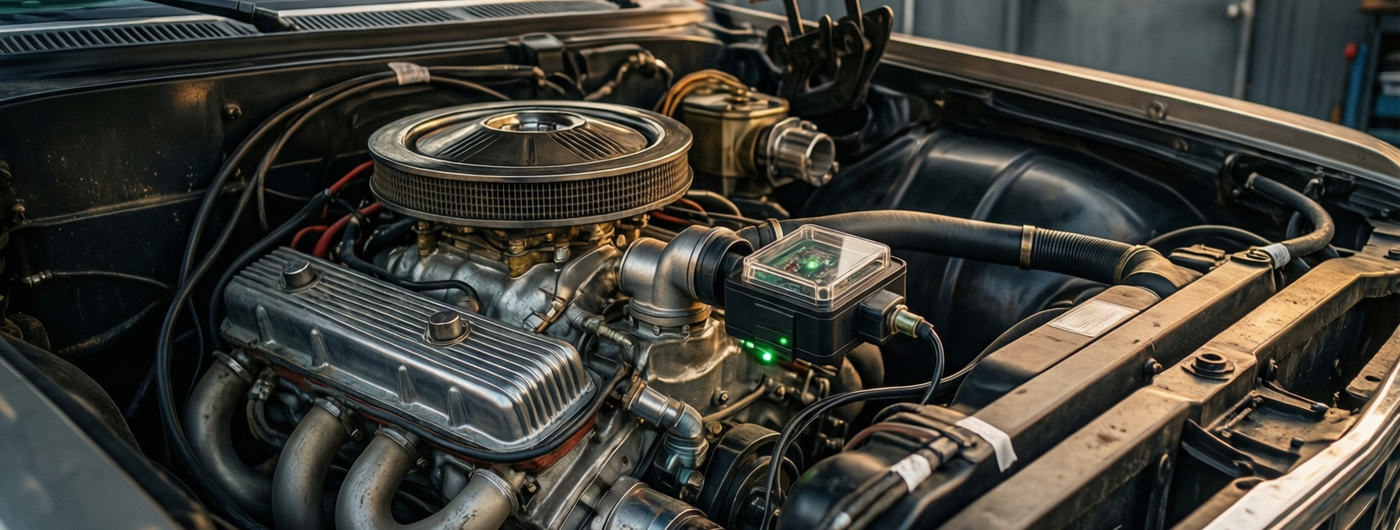
EGR Simulator or Block-Off Plate? Stop Guessing — Here's What Your Ford Actually Needs
, by iFJF Direct, 8 min reading time
, by iFJF Direct, 8 min reading time

Here's a scene I've watched play out a hundred times on the forums: guy buys an '87-95 F-150 or Bronco with the 302 or 351W. Truck runs okay but the idle hunts, it stumbles off the line, and the check engine light's been on since Nixon was in office. He pulls the codes — EGR fault. Shops quote him $400 for a new EGR valve and sensor. So he goes online and discovers two things: EGR block-off plates for $20, and EGR simulators for about the same money. Now he's confused. Which one actually fixes the problem without making things worse?
Let me save you three hours of forum scrolling.
The EGR system on these trucks is simple in theory, finicky in practice. Exhaust gas gets routed back into the intake to lower combustion temps and reduce NOx. The EGR valve opens and closes based on vacuum from the EVR solenoid, and the EGR Valve Position (EVP) sensor tells the computer whether the valve is where it's supposed to be.
After 30+ years, here's what usually fails:
Replacing the EGR valve, sensor, and vacuum lines with OEM parts runs about $180-250. That fixes the problem... but only until the carbon builds up again. And on a high-mileage 302 or 351W, that carbon comes back fast.
A block-off plate does exactly what it sounds like: it's a flat piece of metal that goes between the EGR valve and the intake manifold, physically blocking the EGR passage. Exhaust gas can't get through. Done. Cost you $15 and 20 minutes with a wrench.
The upside: no more carbon getting into your intake. Smoother idle. Cleaner intake air. Simpler vacuum routing.
The downside nobody mentions until they've done it: your check engine light stays on. Forever. The computer is still looking for EGR flow and not finding it. On OBD1 Ford EEC-IV systems (1986-1995), there's no way to "tune out" the EGR function without chipping the ECU. And chipping an EEC-IV isn't like flashing a modern PCM — you're sending your computer to a specialist or buying an aftermarket ECU.
So now you've got a CEL that's always illuminated. That means you won't know when a different code pops up. Transmission fault? Ignition problem? You'll never see it because the EGR light is already on. That's like driving with your check engine light taped over.
Also — if you live in a state with emissions testing, a block-off plate is an automatic fail. The visual inspection alone will catch it. And on OBD1 trucks, they check for the CEL to illuminate at key-on and then go out. Yours won't go out. Fail.
An EGR simulator takes a different approach. Instead of blocking the passage, it plugs into the EGR valve position sensor connector and sends the computer a clean, correct signal — as if the EGR system were working perfectly. The computer sees the right voltage at the right time, checks the box, and moves on with its day. No codes. No CEL. No limp mode.
How it works: the simulator contains a circuit that mimics the resistance curve of a functioning EVP sensor. When the computer sends the EGR command signal, the simulator responds with the expected position feedback. The PCM thinks the EGR valve opened and closed normally. It never throws a code because it never sees a problem.
Here's the practical comparison:
| What You Get | Block-Off Plate | EGR Simulator |
|---|---|---|
| Check engine light off? | No — permanently on | Yes — PCM sees normal EGR signal |
| Passes visual smog inspection? | No — obvious block-off is visible | Yes — EGR valve stays in place |
| Detects other engine codes? | No — CEL already lit | Yes — CEL only comes on for real problems |
| Install difficulty | Remove EGR valve, install plate | Plug into EVP connector, zip-tie |
| Reversible? | Yes — but you need a new gasket | Yes — unplug and reconnect original sensor |
| Carbon in intake? | Blocked permanently | EGR still functional if valve left connected |
The setup I run and recommend to customers: block-off plate for the mechanical side, simulator for the electrical side.
Install the block-off plate between the EGR valve and intake manifold to physically stop exhaust gas from entering the intake. This keeps your intake clean and your idle smooth. Then plug the EGR simulator into the EVP sensor connector so the computer stays happy and your CEL stays off.
This combo gives you the best of both: clean intake air, no codes, and you still get alerted if your truck throws a real problem code. The EGR valve stays bolted on so a visual inspection sees a complete-looking system. The block-off plate is hidden between the valve and intake where nobody looks.
One note: on the 7.5L (460) and some 5.8L intake manifolds, the EGR passage bolt pattern is slightly different. Our block-off plate fits the standard 2-bolt Ford EGR flange used on the 302, most 351W, and the 300 inline six. Double-check your bolt spacing before ordering — it should be 3-1/4" center-to-center.
Pro Tip: If you still get an EGR code after installing the simulator, check two things: (1) the EVP connector pins — these get corroded after 30 years, clean them with electrical contact cleaner; (2) make sure you plugged into the EVP sensor connector, not the EVR solenoid connector. They look similar. The EVP is on top of the EGR valve; the EVR is on the valve cover or fender with vacuum lines attached.
No EGR modification is CARB-legal. If you're in California or a state that follows CARB rules, neither the block-off plate nor the simulator will pass smog. This kit is for off-road use or states without emissions testing.
The EGR simulator works on the 4.9L/300 as well — same EVP sensor, same connector. The block-off plate requires a different bolt pattern though; check your specific intake manifold. The 300's EGR is mounted on a spacer between the upper and lower intake.
Maybe slightly. A properly functioning EGR system actually improves highway fuel economy by reducing pumping losses. If your EGR was already stuck or malfunctioning, blocking it off won't change anything. If it was working, you might see a 0.5-1 mpg drop on the highway. Around town, no difference.
Unplugging the vacuum line prevents the EGR from opening, which stops exhaust flow — but the EVP sensor still reports "valve didn't move" to the computer, and you get a code. Plus you've got an open vacuum line creating a leak. Don't do it. Do it right.
Yes. The simulator doesn't care whether the EGR valve is there or not — it just sends the right signal to the harness. But for visual inspection purposes, keep the valve bolted in place. It looks stock and nobody's the wiser.
Related: Ford Shift Linkage Bushing Fix — 141792 Kit | FF266 Fuel Filter Guide for Cummins | Shop All iFJF Parts