
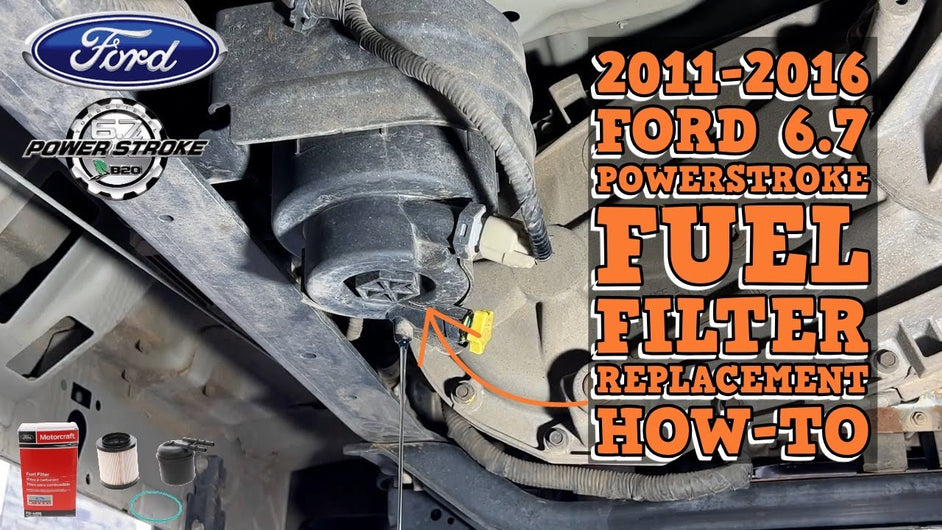
Ford 6.7 Powerstroke Fuel Filter Replacement: 2011-2016 DIY Guide (Save $150)
, by iFJF Direct, 12 min reading time
, by iFJF Direct, 12 min reading time

Replace both fuel filters on your 2011-2016 Ford F-250/F-350 6.7L Powerstroke in 30 minutes. Frame-mounted & engine bay locations, Motorcraft part numbers (FD-4615/FD-4616), water separator drain procedure.

If you own a 2011–2016 Ford F-250 or F-350 with the 6.7L Powerstroke diesel, replacing the fuel filters is one of the most important routine maintenance tasks you can perform. The 6.7 Powerstroke uses two separate fuel filters — a primary water separator mounted on the frame rail under the driver's door, and a secondary fuel filter located under the hood near the transmission dipstick. Both need to be replaced at the same time during every service interval.
Contaminated fuel is one of the leading causes of injector failure on the 6.7L Powerstroke. Diesel fuel from the pump can carry water, debris, and microbial growth that will wreck your high-pressure fuel system if it isn't filtered out. Replacing both filters yourself takes about 30–45 minutes, saves you a shop visit, and gives you confidence that the job was done right with quality parts.
In this guide, we'll walk through the complete process based on a real-world demonstration on a 2015 Ford F-350. You'll learn the exact tools needed, the correct part numbers, the step-by-step removal and installation procedure for both filters, how to properly prime the system, and how to reset the fuel filter maintenance light on the dash.
| Item | Details |
|---|---|
| Primary fuel filter (Motorcraft FD-4615) | Frame-rail water separator; includes filter cartridge |
| Secondary fuel filter (Motorcraft FD-4609) | Under-hood fuel filter; cartridge only |
| Water separator O-ring | Comes with the FD-4615 kit; pre-lubricated |
| 32mm socket | For removing the water separator cap |
| Drain pan | To catch fuel during water separator drain |
| Rag or shop towels | For cleaning up spilled fuel and line connections |
| Pick tool or small flathead | For removing the old O-ring from the housing |
| Brake cleaner | Optional, for cleaning the area after assembly |
Tip: The video source specifically recommends Genuine Motorcraft filters (FD-4615 and FD-4609). Aftermarket filters may fit, but Motorcraft is the OE spec for the 6.7 Powerstroke fuel system and is widely considered the safest choice.
Here are the exact filters you'll need for this job — plus the air filter to complete your maintenance session:
Crawl underneath the truck on the driver's side, just below the door. You'll see the water separator housing mounted on the frame rail. This is the primary fuel filter — the first line of defense against water and large debris in your diesel fuel.
⚠️ Critical: This cap must be completely tight. If the cap is even slightly loose, the truck will draw air into the fuel system and will not start after the filter change. This is one of the most common mistakes on the 6.7 Powerstroke.
Open the hood and locate the secondary fuel filter near the transmission dipstick area on the driver's side of the engine bay.
After replacing both filters, the fuel system will be full of air. You must prime the system before attempting to start the engine. The 6.7 Powerstroke has an electric fuel pump that handles priming when you cycle the ignition.
⚠️ If the engine cranks but won't start after 6 key cycles: Get back under the truck and check the water separator cap — make absolutely sure it is fully tight. As mentioned earlier, even a slightly loose cap will prevent the truck from building fuel pressure and it will not start. This is the number-one cause of no-start after a fuel filter change on the 6.7 Powerstroke.
Once the engine is running, crawl back underneath and check around the water separator housing and under the hood around the secondary filter. Look for any fuel weeping from connections, the cap, or the line fittings. If everything is dry, you're good to go.
The 6.7 Powerstroke tracks fuel filter service intervals and displays a reminder on the dash. After replacing the filters, you'll want to reset this counter so it doesn't keep nagging you.
Using the steering wheel controls and the dash display:
That's it — the maintenance light is now reset and won't appear again until the next service interval.
| Tip | Why It Matters |
|---|---|
| Always use Motorcraft FD-4615 and FD-4609 | These are the OE-spec filters for the 6.7 Powerstroke. Aftermarket options exist, but Motorcraft is the proven standard. Fuel system repairs cost thousands — don't cheap out on filters. |
| Tighten the water separator cap fully | The #1 cause of no-start after this job. If the cap isn't completely tight, air enters the fuel system and the truck won't build pressure. Check it twice. |
| Don't skip the O-ring replacement | The O-ring seals the water separator housing. A worn or pinched O-ring will draw air and cause the same no-start issue. The new one comes pre-lubed — use it. |
| Do 6+ key cycles before cranking | The 6.7 fuel system holds a significant volume. Six cycles is the minimum to push all the air out. Rushing this step leads to extended cranking or no-start. |
| Change both filters at the same time | The primary filter catches water and large debris; the secondary catches fine particles. Replacing only one leaves the other compromised. Always do both together. |
While the video recommends Motorcraft, here are common part number cross-references for the 6.7 Powerstroke:
| Position | Motorcraft (OE) | Fleetguard | DONALDSON |
|---|---|---|---|
| Primary (Frame-Rail) | FD-4615 | FS19973 | P550278 |
| Secondary (Under-Hood) | FD-4609 | FS19974 | P550279 |
Note: The Fleetguard and Donaldson numbers shown are common aftermarket alternatives, but verify fitment for your specific year before purchasing. Part numbers can vary between early (2011–2013) and late (2015–2016) production runs.
Ford recommends replacing both fuel filters every 15,000 miles under normal operating conditions. If you frequently fuel at unknown or high-risk stations, tow heavy loads, or operate in dusty environments, consider reducing the interval to every 10,000 miles. Many diesel technicians recommend the 10,000-mile interval as a general best practice — fuel filters are cheap compared to injector replacement.
A clogged or worn fuel filter restricts fuel flow to the high-pressure fuel pump and injectors. This can cause rough idle, reduced power, poor fuel economy, and eventually trigger a check engine light. In severe cases, contaminated fuel bypassing a degraded filter can score injector nozzles, leading to misfires and costly injector replacement ($2,000–$4,000+ for a full set on the 6.7 Powerstroke).
Yes, but choose reputable brands (Fleetguard, Donaldson, Baldwin). Avoid cheap no-name filters — the 6.7 Powerstroke's high-pressure fuel system operates at up to 30,000 PSI, and a filter that fails structurally can send debris directly to your injectors. Motorcraft FD-4615 and FD-4609 remain the safest bet because they match Ford's original specifications.
This almost always comes down to two causes: (1) The water separator cap on the frame rail isn't tightened completely, allowing air into the system — crawl underneath and tighten it fully, then repeat the key-cycle priming process. (2) You didn't cycle the key enough times to fully prime the system — do a minimum of 6 cycles (ON for 30 seconds, OFF, repeat) before cranking.
Yes. The yellow drain knob on the water separator housing should be opened periodically — at every oil change at minimum — to drain any accumulated water. If you see significant water coming out, check your fuel source. Regular water draining extends filter life and prevents water from reaching the secondary filter and the high-pressure fuel system.


