
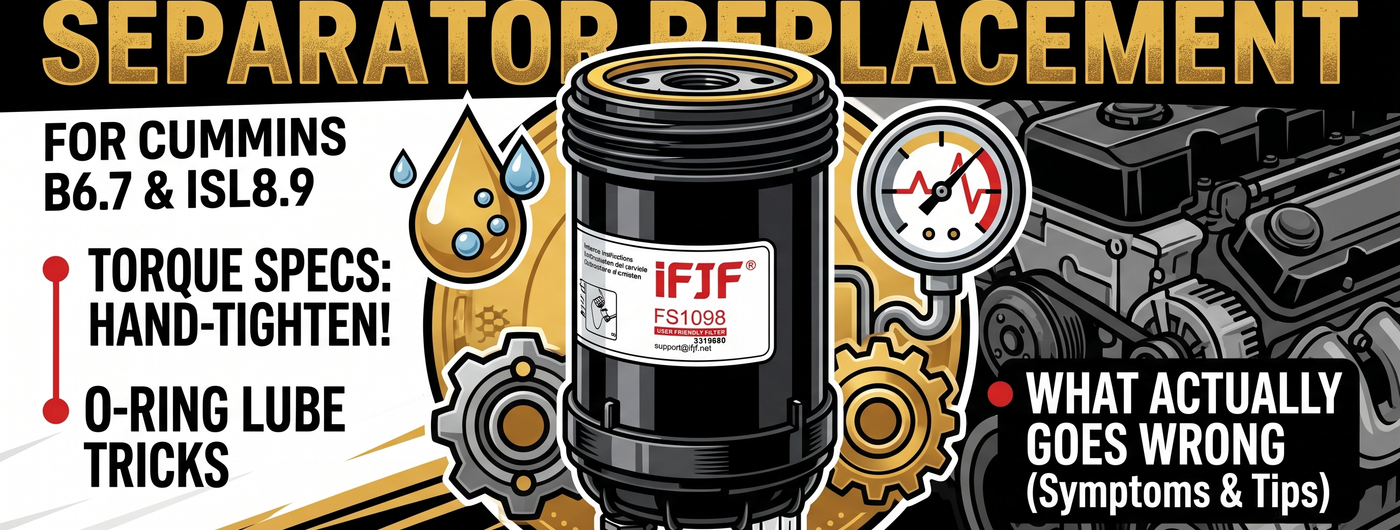
FS1098 Fuel Water Separator Replacement for Cummins B6.7 & ISL8.9: Torque Specs, O-Ring Tricks, and What Actually Goes Wrong
, by iFJF Direct, 7 min reading time
, by iFJF Direct, 7 min reading time

I've changed more fuel water separators on Cummins mid-range engines than I can count. The FS1098 crosses to Fleetguard 5319680 and fits everything from B6.7 pickups to L9 industrial engines. If you're doing this yourself, there are about four ways to mess it up and one dead-simple way to get it right. Here's the second one.
Your engine won't always throw a code before the separator gives you trouble. Look for these:
On B6.7 engines specifically, I've seen owners run these things 30,000 miles past the interval thinking "diesel fuel is clean." It ain't. Modern ULSD absorbs moisture like a sponge, and one bad fill-up at a low-volume station can dump a pint of water into your tank.
1. Drain the housing first. Every FS1098-compatible housing has a drain valve or petcock at the bottom. Crack it open with your drain pan underneath. What comes out will probably be ugly — brownish diesel with water beads. Let it drip until you get clean fuel. This step saves you from wearing diesel when the filter comes off.
2. Crack the filter loose. Spin it counterclockwise. The first quarter-turn is always tightest because the O-ring has heat-cycled into the housing. If it won't budge, tap the filter base gently with a dead-blow — don't use a screwdriver, you'll dent the housing.
3. Pull it straight down. There's about a half-pint of fuel trapped inside. Tilt it toward your drain pan as you lower it. Don't be the guy who splashes diesel into your armpit.
4. Clean the mounting surface. Wipe the housing threads and the O-ring landing with a clean rag. Any debris left here will cause a weep leak that'll drip fuel on your driveway for weeks. Check the old O-ring — if it's stuck to the housing (common in hot climates), pick it out with a plastic trim tool, not a screwdriver.
5. Lube the new O-ring. Dip your finger in clean diesel and run it around the O-ring on the new filter. This is non-negotiable — a dry O-ring will roll, pinch, or tear during tightening, and you'll be back under there tomorrow.
6. Pre-fill the new filter. Pour clean diesel into the center hole of the new FS1098 until it's about 3/4 full. Don't fill to the brim — you need room for the standpipe to displace fuel without overflowing. Pre-filling cuts your priming time by 80%.
7. Spin it on hand-tight, then 3/4 turn. Thread the new filter until the O-ring contacts the housing, then hand-tighten 3/4 turn. Do not use a wrench — over-tightening deforms the O-ring and can crack the plastic threads on aftermarket housings. The FS1098 seals on the O-ring, not on thread torque.
8. Prime the system. On B6.7: key-on (don't start) for 30 seconds, key-off, repeat 3-4 times. The lift pump will push fuel through the new filter. On ISL8.9 with manual primer: pump the hand primer until firm, usually 20-30 strokes. If your engine has an electric lift pump, just cycle the key.
9. Start it and check. Fire it up, let it idle for 60 seconds, then shut down and inspect beneath the filter with a flashlight. Any wetness = something's wrong. Redo the O-ring if you see drips.
Pro Tip 1: The FS1098 has a 10-micron rating. That's the sweet spot for B6.7/ISL — tight enough to protect your injectors, open enough to not starve your CP3. Don't "upgrade" to a 2-micron filter thinking you're doing the engine a favor. You're not. You'll just create a restriction.
Pro Tip 2: If your water-in-fuel light comes back within 100 miles of a fresh filter change, you don't have a filter problem — you have water in your tank. Drain the tank, don't keep throwing filters at it.
Pro Tip 3: Keep the old filter for a day. Cut it open with a filter cutter and check the pleats. If you see rust flakes or excessive sediment, your fuel tank or fuel lines have corrosion issues you need to address.
Pro Tip 4: The PCV (pressure control valve) on the FS1098 housing is a wear item. If you're getting random P0087 (low rail pressure) codes after filter changes, and your filter is fresh, the PCV may be sticking. Swap it — it's cheaper than an injector set.
Fleetguard says every 15,000 miles or annually for on-highway. I say: 10,000 miles if you're running farm diesel or filling from bulk tanks. 15,000 is fine for highway-only with trusted fuel stops. If you're in a humid climate (Gulf Coast, Pacific Northwest), lean toward 10K — condensation in diesel tanks is real and relentless.
For off-highway and industrial L9s running long hours at steady load, 500 hours is my personal rule of thumb. The FS1098 isn't expensive. Injectors are.
Q: Does the FS1098 fit my 2018 Ram 2500 with the 6.7 Cummins?
A: If your truck has the FS1098-style spin-on housing (typically the under-hood filter on chassis-cab models), yes. Pickup models with the cartridge-style filter under the hood use a different setup. Check your housing threads — 1-14 UNS is standard.
Q: Cross-reference numbers?
A: Fleetguard FS1098, Cummins 5303743 / 5319680, Baldwin BF46031, Donaldson P550941, WIX 33683. The iFJF FS1098 is a direct-fit replacement at about half what the truck stop charges.
Q: Can I use the same filter on an ISL8.9 and a QSB6.7?
A: Yes. The thread pattern and can dimensions are identical across the B6.7, ISB6.7, QSB6.7, ISL8.9, ISL9, QSL9, and L9 platforms. One filter fits all.
Q: What if I can't get it to prime after changing?
A: Double-check the drain valve is fully closed (I've done this). If it's closed and still won't prime, crack the outlet fitting loose at the filter head, cycle the pump until fuel appears, then tighten. Air-locked lines are common on ISL engines with manual primers.
Q: Is the PCV valve included with this FS1098?
A: The iFJF FS1098 comes with the integrated PCV valve. Many aftermarket filters don't include it — that's a dealbreaker, because a worn PCV will bleed rail pressure.
Related Reads:
Need the FS1098? Pick up the iFJF FS1098 Fuel Water Separator with PCV Valve — ships same-day from our warehouse.