
GM 4.2L Atlas Serpentine Belt Replacement: 6PK2320 DIY Guide for Trailblazer, Envoy & Rainier
, by iFJF Direct, 13 min reading time
, by iFJF Direct, 13 min reading time

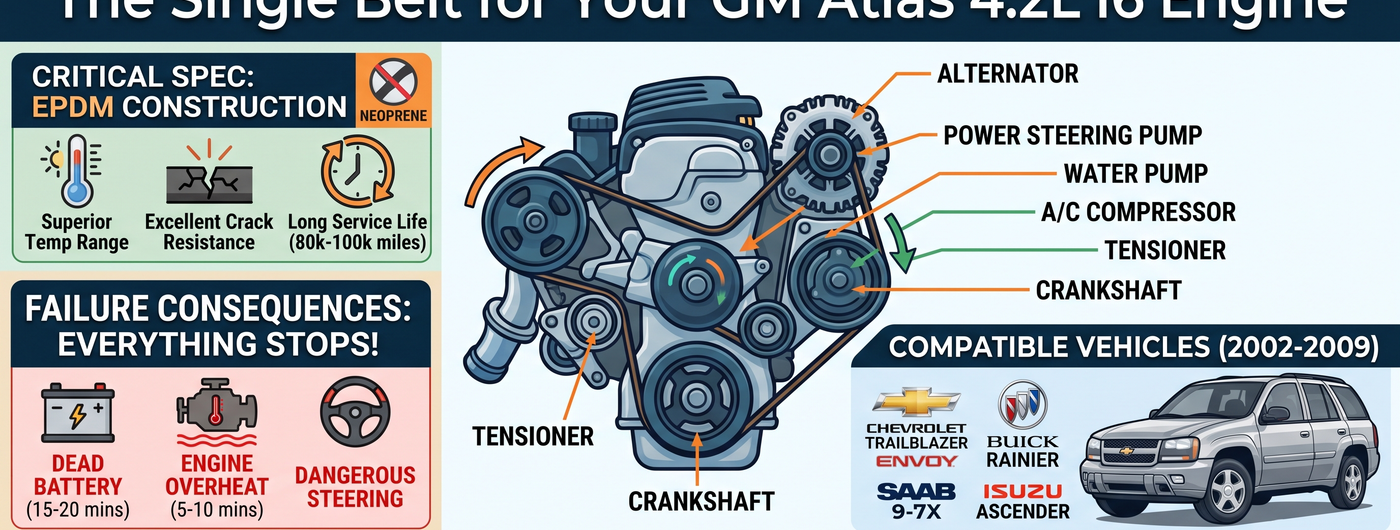
The 6PK2320 is a 6-rib serpentine belt measuring 91.34 inches (2,320 mm) in effective length, built to EPDM (ethylene propylene diene monomer) rubber specification. It's the single drive belt responsible for powering every accessory on GM's Atlas 4.2L inline-six engine — alternator, power steering pump, water pump, and A/C compressor all depend on this one belt transferring crankshaft rotation.
When this belt fails, everything stops. No alternator means a dead battery within 15-20 minutes of driving. No water pump means engine overheat within 5-10 minutes. No power steering means heavy, dangerous steering at low speeds. The 6PK2320 is, without exaggeration, the $28 part that keeps your entire engine bay functioning.
GM used the Atlas 4.2L (RPO LL8) from 2002 through 2009 across five nameplates, making this one of the most common serpentine belt applications in the GMT360 platform. With millions of these SUVs still on the road — the Trailblazer alone sold over 1.5 million units — belt replacement is routine maintenance that every DIY owner should know.
The 6PK2320 fits every GMT360/370 platform vehicle equipped with the 4.2L Atlas I6 engine. Here's the full compatibility list:
| Make | Model | Years | Engine | Notes |
|---|---|---|---|---|
| Chevrolet | Trailblazer | 2004-2009 | 4.2L LL8 | Includes EXT (long wheelbase) and SS trims |
| GMC | Envoy | 2004-2009 | 4.2L LL8 | Includes XL, Denali trims; same belt routing |
| Buick | Rainier | 2004-2007 | 4.2L LL8 | Upscale Trailblazer sibling; identical accessory layout |
| Oldsmobile | Bravada | 2004 | 4.2L LL8 | Final model year for Oldsmobile; same belt |
| Saab | 9-7X | 2005-2009 | 4.2L LL8 | Swedish-badged Trailblazer; same engine/accessories |
| Isuzu | Ascender | 2003-2008 | 4.2L LL8 | Rebadged Envoy; 5-passenger and 7-passenger versions |
Important Fitment Note: The 5.3L V8 (RPO LH6) Trailblazer and Envoy Denali models use a different belt — the 6PK2320 is for the 4.2L I6 only. The V8 models use a shorter belt (typically 6PK2235 or equivalent). Always verify your engine code on the RPO sticker in the glovebox before ordering.
If you're ordering a replacement, the iFJF 6PK2320 Serpentine Belt covers every vehicle in this table with a direct-fit, EPDM construction backed by US-based stock and shipping.
Serpentine belts rarely fail without warning. They telegraph their condition for weeks or months before snapping — if you know what to look for. Here are the five definitive signs:
1. Squealing or Chirping on Cold Start: The most common early warning sign. A high-pitched squeal that lasts 2-5 seconds after startup indicates the belt is slipping on the pulleys. On the Atlas 4.2L, cold-start squeal typically originates from the tensioner pulley area on the passenger side of the engine. This isn't just annoying — every slip event wears the belt ribs microscopically, accelerating failure.
2. Visible Cracking or Glazing on the Rib Side: With the engine off and cool, reach down and feel the ribbed side of the belt (the side facing the pulleys). Run your thumb across 3-4 ribs — if you feel cracks perpendicular to the ribs, the EPDM compound is breaking down. Glazing (a shiny, hardened surface) means the belt has been slipping excessively and can no longer grip pulleys effectively. A glazed belt is a ticking clock.
3. Battery Light Flickering at Idle: The alternator pulley is the smallest in the system, demanding the most grip from the belt. As belt tension drops with age, the alternator pulley slips first. You'll see the battery warning light flicker at idle (especially with headlights and A/C on), then go out when you rev past 1,500 RPM. This is the belt losing grip on the alternator pulley specifically.
4. Power Steering Stiffness at Parking Speeds: The power steering pump demands the highest torque from the belt at low RPM. If your steering feels noticeably heavier when parking or making tight turns — but normal at speed — suspect belt slip on the PS pump pulley. This symptom often precedes complete belt failure by 1-2 weeks.
5. A/C Performance Drops at Idle: The A/C compressor clutch engages cyclically, creating shock loads on the belt. A worn belt that can handle steady loads may still slip when the compressor clutch engages. You'll notice the A/C blowing warm at stoplights, then cooling again when moving. Belt grip on the A/C pulley is failing.
Not all serpentine belts are created equal. The material choice directly impacts service life, noise, and reliability:
| Property | EPDM (6PK2320) | Neoprene (Older Belts) |
|---|---|---|
| Temperature Range | -40°F to +275°F | -30°F to +220°F |
| Typical Service Life | 80,000-100,000 miles | 50,000-60,000 miles |
| Crack Resistance | Excellent — does not visibly crack with age | Poor — surface cracking is the primary failure mode |
| Ozone/UV Resistance | Superior — EPDM is inherently ozone-resistant | Moderate — requires anti-ozonant additives that deplete over time |
| Wear Indicator | Rib depth loss (measured, not visible) | Visible cracking (easy to spot, but belt may already be degraded) |
| Noise | Quieter — EPDM compound damps vibration better | Louder — harder compound transmits more NVH |
The EPDM Paradox: EPDM belts are superior in every measurable way — except one: they don't crack visibly as they age. Neoprene belts telegraph their condition with obvious cracks, giving a clear visual "replace me now" signal. EPDM belts can look perfectly fine externally while the ribs have worn past their service limit. This is why mileage-based replacement (every 80,000-100,000 miles) is critical — you can't rely on visual inspection alone.
Rib Count & Length Precision: The "6PK" designation means 6 ribs with a PK profile (3.56mm rib pitch, automotive standard). The "2320" means 2,320mm effective length. Even a 5mm length deviation can cause tension problems — too short and the tensioner bottoms out; too long and the tensioner can't take up slack. The iFJF 6PK2320 is manufactured to ±2mm length tolerance, well within the GMT360 platform's tensioner travel range.
Price Reality Check: At $27.99, the iFJF 6PK2320 costs roughly the same as an OEM AC Delco 6K930 belt ($29-35 at dealerships) but ships from US stock with no dealer markup. Budget belts from national auto parts chains run $18-25 but typically use lower-grade EPDM compounds that sacrifice heat resistance. Given the Atlas 4.2L's known tendency to run warm (thermostat opens at 195°F, under-hood temps easily exceed 220°F in summer traffic), the compound quality directly impacts how long your belt lasts.
This is a 45-minute job for a first-timer, 20 minutes if you've done it before. No special tools required beyond a basic socket set and a serpentine belt tool (or long-handled 3/8" ratchet). The Atlas 4.2L has excellent front-end access compared to transverse V6 engines.
Tools Needed:
Step 1: Locate the Belt Routing Diagram
Open the hood and look at the plastic fan shroud or the radiator support crossmember. GM placed a belt routing diagram sticker here from the factory. If your sticker is missing or illegible (common after 15+ years), snap a photo of your existing belt routing before removal. The Atlas 4.2L routing follows a specific pattern: crankshaft → water pump → idler pulley → power steering → alternator → A/C compressor → tensioner → back to crankshaft.
Step 2: Release Belt Tension
The tensioner is on the passenger side of the engine, near the top. It's a spring-loaded arm with a 3/8" square drive hole in the casting. Insert your ratchet (or serpentine belt tool) into the square drive and rotate the tensioner counterclockwise (toward the driver's side). You'll feel strong spring resistance — this is normal. Rotate until the tensioner arm moves far enough to create slack in the belt (typically 30-45 degrees of rotation). Hold it there.
Step 3: Remove the Old Belt
While holding tension off, slip the belt off the alternator pulley (top-left, easiest to reach). Slowly release the tensioner back to its rest position — do not let it snap back, as this can damage the tensioner spring. Remove the belt from the remaining pulleys by hand. Inspect the old belt: excessive rib wear (flat-topped ribs), missing chunks, or oil contamination all point to additional issues beyond normal wear.
Step 4: Inspect Pulleys and Tensioner
With the belt off, spin each accessory pulley by hand. They should rotate smoothly with no grinding, wobbling, or resistance. Pay special attention to:
Step 5: Route the New Belt
Starting at the crankshaft pulley (bottom center, largest pulley), route the new belt following your photo or the diagram sticker. Work counterclockwise: crankshaft → around the water pump pulley → over the idler → around power steering → around alternator → around A/C compressor. Leave the tensioner pulley for last — it should be the final pulley you loop the belt around.
Step 6: Engage the Tensioner and Seat the Belt
With the belt routed around every pulley except the tensioner, rotate the tensioner counterclockwise again. Slide the belt over the tensioner pulley. Slowly release the tensioner — the spring will take up all slack automatically. Verify the belt is centered on every pulley and seated in all 6 ribs on grooved pulleys. A misaligned belt will shred within miles.
Step 7: Final Inspection & Test Start
Start the engine and let it idle. Listen for any chirping or squealing — there should be none on a fresh belt. Watch the belt track on each pulley for 30 seconds; it should run true without wandering. Turn the A/C on max and the steering to full lock — these load conditions will reveal any belt slip immediately. Shut it off, re-check belt alignment, and you're done.
The serpentine belt doesn't work in isolation. While you have the belt off and the front of the engine exposed, consider these related maintenance items:
Drive Belt Tensioner Assembly: The spring-loaded tensioner on the Atlas 4.2L has a typical service life of 120,000-150,000 miles. A failing tensioner can't maintain proper belt tension even with a new belt — causing the same slip and squeal you were trying to fix. If your Trailblazer or Envoy has over 120,000 miles on the original tensioner, replace it during the belt job. The part costs $35-55 and adds 10 minutes to the procedure.
Idler Pulley: The smooth idler pulley routes the belt between the water pump and power steering. Its bearing is sealed and non-serviceable — when it fails, it seizes, and the belt snaps. Replacement cost is $15-25. Given the labor overlap (zero additional steps beyond removing one bolt), it's false economy to skip this.
Cooling System Inspection: Since belt failure can cause immediate overheating, check your cooling system while you're under the hood. Look for coolant leaks at the water pump weep hole (under the pump pulley), radiator end tanks, and hose connections. The Atlas 4.2L's thermostat housing (plastic, driver's side of engine) is a known failure point — any white crusty residue around the housing means it's seeping and needs replacement.
Power Steering System: The serpentine belt drives the power steering pump. If you've been experiencing steering noise or stiffness, the belt may not be the only issue. Installing a 3/8" Magnetic Inline Power Steering Filter catches debris before it damages the pump or rack — a $20 safeguard against a $600+ steering rack replacement.
1. Replace the Belt Every 80,000 Miles — Not Just When It Looks Bad: EPDM belts don't crack visibly. By the time a 6PK2320 looks worn, it's been past its service limit for 20,000+ miles. Mileage-based replacement is the only reliable strategy. Set a reminder at 80,000-mile intervals and stick to it.
2. Check Belt Tension at Every Oil Change: The tensioner has a wear indicator — a mark on the stationary base and a corresponding mark on the moving arm. When these marks align (or the moving mark passes the stationary one), the tensioner has reached its wear limit. This 10-second check takes no tools and catches tensioner failure before it catches you.
3. Keep the Engine Bay Clean: Oil leaks from the valve cover gasket (common on high-mileage Atlas 4.2L engines) drip directly onto the serpentine belt. Oil-soaked EPDM swells, softens, and loses structural integrity. Fix oil leaks promptly — a $25 valve cover gasket is cheaper than a tow bill when your shredded belt leaves you stranded.
4. Listen to Your Belt: A properly tensioned, healthy 6PK2320 is silent. Any noise — chirp, squeal, or rhythmic scraping — means something is wrong. Diagnose belt noise immediately: misalignment, pulley bearing failure, or tensioner weakness won't fix themselves.
5. Keep a Spare Belt in the Vehicle: Trailblazer and Envoy owners who venture off-pavement or tow boats/campers should carry a spare 6PK2320 and a ratchet in the cargo area. A belt change in a parking lot takes 20 minutes. Waiting for a tow truck takes hours. At $27.99 for the iFJF 6PK2320, a spare is cheap peace of mind.
For a complete preventive maintenance schedule covering all your vehicle's systems, don't miss our Diesel Truck & RV Maintenance Schedule Guide — the principles apply to gas engines too. And if you're comparing filtration options during a maintenance overhaul, our Fuel Filter Buyer's Guide helps you make informed decisions about every filter in your vehicle.
Browse our complete engine belts & pulleys collection for all GMT360 and other platform belt applications.