

How to Choose the Right Fuel Filter for Your Diesel Truck: A Complete Buyer's Guide
, by William Lee, 7 min reading time
, by William Lee, 7 min reading time

Updated: June 12, 2026
Walk into any auto parts store and you'll see a wall of fuel filters — different sizes, shapes, micron ratings, and price points. Grab the wrong one, and you're not just wasting $20. You're gambling with a $8,000+ injector replacement on a modern common-rail diesel.
Modern diesel fuel systems — especially the Bosch CP4.2 found in 2011+ Powerstrokes and 2019+ Cummins — run at 30,000+ PSI. At those pressures, even microscopic debris acts like sandblasting inside your injectors. The right fuel filter is your engine's only line of defense.
This guide breaks down exactly what to look for when choosing a fuel filter — so you buy once, install right, and protect the engine you depend on.
The single biggest mistake diesel owners make: assuming any filter that threads on is the right filter. It's not.
Every diesel platform uses a specific filter specification — not just thread pitch and gasket diameter, but bypass valve pressure, burst strength, and flow rate. Here's what a proper filter match looks like by platform:
| Platform | Primary Filter (Engine Bay) | Secondary (Frame Rail) |
|---|---|---|
| 6.7L Cummins (2013–2018) | Mopar 68157291AA | Mopar 68197867AA (water separator) |
| 6.7L Cummins (2019+) | Mopar 68436631AA | Mopar 68498720AA |
| 6.7L Powerstroke (2011+) | Motorcraft FD-4615 | Motorcraft FD-4616 (DFCM) |
| 6.6L Duramax L5P (2017+) | ACDelco TP1015 | N/A (single filter system) |
| 6.6L Duramax LML (2011–2016) | ACDelco TP1018 | N/A |
Pro tip: If the box says "fits multiple applications" without listing specific OEM part numbers, put it back on the shelf. Quality aftermarket filters (like iFJF) include explicit OEM cross-reference numbers on the packaging.
Micron rating tells you the smallest particle size the filter can catch. This is the single most important spec on the box — and the one most buyers ignore.
Critical distinction: "Nominal" vs "Absolute" micron rating. A "nominal 10-micron" filter might catch 50% of 10-micron particles. An "absolute 10-micron" filter catches 98.7%+. When it's your injectors on the line, absolute rating is the only one that counts.
Gasoline engines don't worry about water in fuel. Diesel engines absolutely do. Water in diesel fuel causes:
What to look for: Filters labeled "Fuel Water Separator" or "2-stage filtration." The best diesel fuel filters combine a hydrophobic media layer (repels water) with a particulate media layer (catches debris). Ram and Ford trucks have a dedicated frame-rail water separator — always replace it at the same interval as the engine-bay filter.
Not all filter paper is created equal. The media inside the can determines everything: flow rate, dirt-holding capacity, and cold-weather performance.
| Media Type | Filtration Efficiency | Cold Weather | Best For |
|---|---|---|---|
| Cellulose (paper) | ~25 micron | ⚠️ Can swell/wax | Budget, pre-2007 diesels |
| Synthetic (micro-glass) | 2–5 micron | ✅ Excellent | Modern common-rail, tuned engines |
| Composite (blended) | 5–10 micron | ✅ Good | Daily drivers, fleet trucks |
iFJF filters use composite media — cellulose for dirt-holding capacity, reinforced with synthetic fibers for finer filtration and cold-weather durability. You get 5-micron absolute performance without the premium price of full synthetic.
The dealership will tell you "only Mopar / Motorcraft / ACDelco filters are safe." They're half right.
When OEM makes sense: If you're under warranty and the dealer is doing the work. OEM filters are perfectly adequate for stock trucks on factory maintenance schedules. At $45–65 each from the dealer, they're expensive but harmless.
When aftermarket makes more sense:
The key is buying from a brand that publishes its specs. If a filter manufacturer won't tell you the micron rating, media type, or OEM cross-reference numbers — walk away. That's exactly why we publish full specifications for every iFJF filter.
The owner's manual says every 15,000–30,000 miles. Reality is more nuanced:
The cheapest maintenance schedule: Buy a 3-pack, keep one in the truck. The moment you notice longer cranking times, slight hesitation under load, or water-in-fuel warning light — swap it. A $12 filter is cheaper than a tow truck.
Choosing the right fuel filter boils down to three numbers: OEM part number match, absolute micron rating, and change interval. Get those right, and your injectors and CP4 pump will outlast the rest of the truck.
Browse our complete fuel filter collection for your specific platform — every filter includes published micron ratings and OEM cross-reference numbers. Or contact us for fleet and bulk pricing.
 Fuel Filter Assembly for 1992-2002 Chevy GMC 6.5L Diesel — Suburban Tahoe Silverado Sierra Yukon Hummer H1 — Replaces 10226035
$177.99
Fuel Filter Assembly for 1992-2002 Chevy GMC 6.5L Diesel — Suburban Tahoe Silverado Sierra Yukon Hummer H1 — Replaces 10226035
$177.99
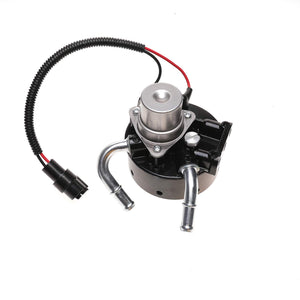 12642623 Fuel Filter Head + 1R-0750 Refit for 2005-2016 Duramax 6.6L
$87.99
12642623 Fuel Filter Head + 1R-0750 Refit for 2005-2016 Duramax 6.6L
$87.99
 FS1098 Fuel Water Separator w/ PCV for Cummins B6.7 ISL8.9 — 10 Micron
$79.99
FS1098 Fuel Water Separator w/ PCV for Cummins B6.7 ISL8.9 — 10 Micron
$79.99
 68394482AA Water Separator for 2014-2018 Ram 1500 3.0L EcoDiesel
$489.73
68394482AA Water Separator for 2014-2018 Ram 1500 3.0L EcoDiesel
$489.73