
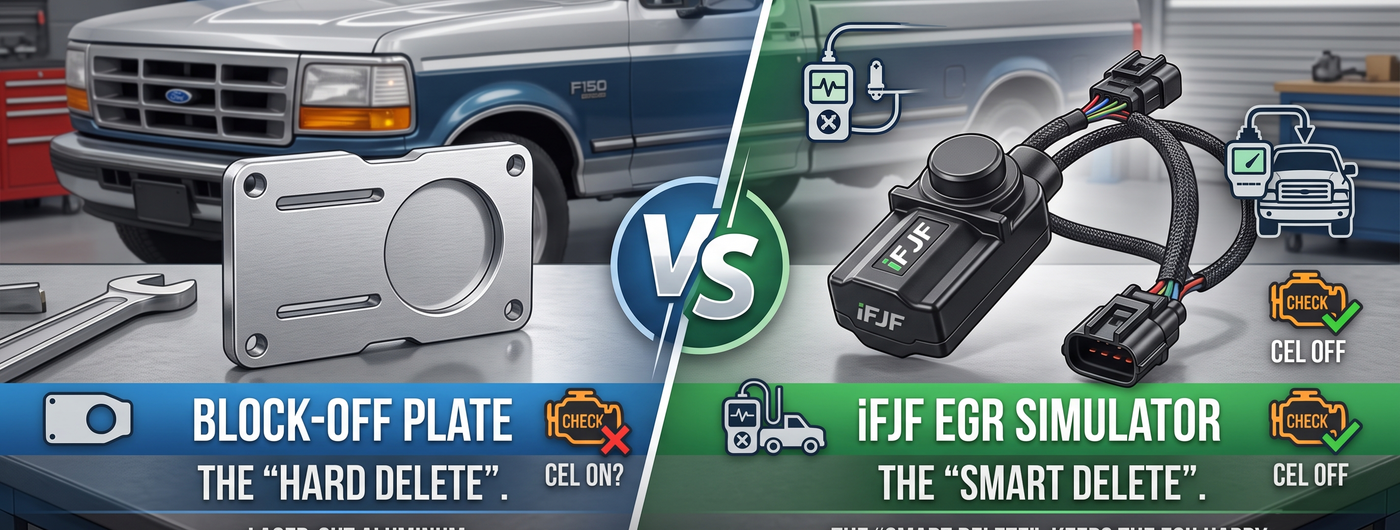
iFJF EGR Simulator Eliminator vs Block-Off Plate: Which One Does Your Ford Actually Need?
, by iFJF Direct, 19 min reading time
, by iFJF Direct, 19 min reading time

If you own a 1986–1995 Ford F-150, F-250, or Bronco with the 4.9L inline-six, 5.0L, or 5.8L Windsor V8, you've probably wrestled with the EGR system. The check engine light won't stay off. Rough idle comes and goes. Fuel economy dips for no obvious reason. And every forum thread you read gives you a different answer: "Block-off plate — 20 minutes, done." "No, you need a simulator eliminator or the ECU will freak out." "Just delete everything and tune it." Here's the truth: they're both right — and they're both wrong — depending on your truck, your state, and what you're actually trying to accomplish. This guide breaks down exactly what each solution does, when to use each one, and why the iFJF EGR Simulator Eliminator might be the middle ground you didn't know existed.
Exhaust Gas Recirculation (EGR) was Ford's answer to NOx emissions regulations that came into force in the mid-1970s. The concept is elegant in theory: route a small amount of inert exhaust gas back into the intake manifold during part-throttle cruise conditions. This exhaust gas — already burned and oxygen-depleted — dilutes the incoming air-fuel charge, lowering peak combustion temperatures by 200–400°F. Since NOx formation is exponentially temperature-dependent, that temperature drop translates to a 50–70% reduction in NOx emissions. Clean air, happy EPA, end of story.
Except the system was designed to last maybe 100,000 miles in an era when most vehicles were scrapped at 120,000. Your 1987 F-150 with the 300ci inline-six is now 39 years old. Here's what three decades of heat, carbon, and neglect have done to the EGR system:
Before we discuss solutions, let's make sure EGR is actually your problem. Here are the tell-tale symptoms, mapped to specific failure modes:
| Symptom | Most Likely Cause | Diagnostic Test |
|---|---|---|
| Rough idle, stalling at stoplights | EGR valve stuck open or carbon on seat | Apply vacuum to EGR at idle — if idle worsens, valve is opening; if no change, valve is stuck open |
| Check engine light, Code 31/32/33 | EVP sensor out of range or EGR flow insufficient | Backprobe EVP signal wire (brown/light green) — should read 0.24–0.67V at closed, 4.0–4.5V at full open |
| Pinging/detonation under load | EGR not flowing (plugged passages or stuck closed valve) | Check intake manifold EGR passage — remove valve and probe passage with a wire |
| Fuel smell, poor MPG | EGR stuck closed — combustion temps too high, ECU pulls timing | Road test with vacuum gauge on EGR line — should see 3–8 inHg at cruise |
| Hesitation on light acceleration | EGR opening too early or too much | Check EGR control solenoid and vacuum regulator (located on passenger fender) |
If you've confirmed EGR is the culprit, the next question is: which fix?
A block-off plate is exactly what it sounds like: a flat piece of steel or aluminum, typically 1/8" thick, laser-cut to the EGR valve mounting flange pattern, with a gasket on the intake side. You remove the EGR valve, sandwich the block-off plate between the valve and the intake manifold (or between the EGR pipe and the exhaust manifold, depending on kit design), and bolt everything back together. The plate physically blocks exhaust gas from entering the intake. The EGR valve can remain mounted (looking "stock") or be completely removed and capped.
Typical cost: $12–$25 for a basic plate, $35–$50 for a kit with gaskets and block-off plugs for the exhaust manifold port.
Here's what most block-off plate marketing doesn't tell you: on a 1986–1995 Ford with EEC-IV engine management, the ECU is actively monitoring EGR flow. It knows the EGR valve should be open during part-throttle cruise based on a stored map of RPM vs. load vs. EGR duty cycle. It checks this via the EVP sensor — which reports valve position, not actual gas flow — and via the manifold absolute pressure (MAP) sensor, which detects the slight enrichment that occurs when EGR dilutes the intake charge.
When you install a block-off plate:
An EGR simulator eliminator is an electronic module that plugs into the EGR valve position (EVP) sensor connector. It replaces the variable-voltage signal from the EVP potentiometer with a fixed, ECU-friendly voltage that tells the computer "EGR is closed, everything is normal, no need to throw a code." The iFJF EGR Simulator Eliminator takes this a step further: it also includes the necessary vacuum cap fittings to seal the EGR vacuum lines and intake manifold port, creating a complete plug-and-play kit.
The module contains a simple voltage divider circuit (or, in higher-end units, a microcontroller that simulates the full EVP voltage sweep in sync with the EGR vacuum solenoid signal). The key outputs are:
| Feature | iFJF EGR Simulator | Generic eBay Simulator | DIY Resistor Trick |
|---|---|---|---|
| Plug Type | Vehicle-specific connector | Often universal (requires splicing) | Wire cut + solder |
| Vacuum Caps Included | Yes — complete kit | No — source separately | No |
| Voltage Output | Calibrated to Ford EEC-IV spec | Often incorrect (can trigger codes) | Fixed resistor — no sweep simulation |
| Waterproofing | Potted/sealed module | Typically unsealed | Heat shrink only |
| Reversible | Yes — plug-in, no cutting | Usually requires wire cutting | Permanent modification |
| Price | $19.99–$29.99 | $8.99–$15.99 | $0.50 in parts |
| Success Rate (CEL Off) | 95%+ on EEC-IV Fords | 60–70% — hit or miss | 30–40% — often triggers Code 35 (EVP out of range) |
The DIY resistor trick deserves a special mention because it's the most common "forum fix" discussed. The idea: cut the EVP signal wire, solder in a 5K ohm resistor between signal and ground to produce a fixed voltage. The problem: the EEC-IV ECU doesn't just look for a voltage in range — it looks for a specific closed-throttle voltage AND expects to see the voltage change (sweep) when the EGR solenoid is energized. A fixed resistor fails the sweep test, and after enough drive cycles, Code 35 (EVP circuit above maximum voltage) or Code 31 appears. Some trucks tolerate it, most don't.
| Criterion | Block-Off Plate | iFJF EGR Simulator |
|---|---|---|
| Parts Cost | $12–$50 | $19.99–$29.99 |
| Install Time | 30–90 min (depends on valve accessibility) | 5–10 min (plug in, cap vacuum lines) |
| Tools Required | Socket set, gasket scraper, torque wrench | None (hand-plug) |
| Reversible? | Yes, but requires new gasket and reinstall | Yes, just unplug in 30 seconds |
| Check Engine Light | Will trigger CEL on most EEC-IV systems | CEL stays off (95%+ success rate) |
| Emissions Compliance | No — will fail OBD1 plug-in test | Passes OBD1 code check; tailpipe test may still detect elevated NOx |
| Intake Cleanliness | Excellent — no exhaust gas enters | Excellent — EGR system completely bypassed |
| Performance Impact | Negligible (EGR is off at WOT anyway) | Negligible (EGR is off at WOT anyway) |
| Legal | Off-road/trail use only | Off-road/trail use only |
Important legal note: Neither solution is EPA-legal for on-road vehicles. EGR systems are federally mandated emissions equipment, and tampering with them violates the Clean Air Act. Both the block-off plate and simulator eliminator are marketed and sold for off-road, racing, and restoration purposes only. Know your local laws.
Let's ground this in a real-world example. A customer brought us a 1993 F-150 XLT with the 5.0L Windsor V8, 145,000 miles on the clock. Symptoms: persistent Code 33 (EGR valve opening not detected), rough idle that worsened when the engine warmed up, and fuel economy that had dropped from a typical 15–16 MPG highway to 12 MPG. The owner had already replaced the EGR valve and EVP sensor (OEM Motorcraft parts, $140 total from the dealer), cleared the codes, and the CEL came back within 50 miles.
Diagnosis: We pulled the EGR valve and probed the intake manifold passage with a bore scope. The EGR passage in the intake was approximately 85% blocked with carbon — the valve could open, but almost no gas could flow. The MAP sensor was reporting lean conditions because the diluted mixture the ECU expected wasn't arriving, and the ECU was richening the fuel trim to compensate — hence the 12 MPG.
Solutions considered:
Result: CEL stayed off after 3 drive cycles. Fuel economy returned to 15 MPG (the ECU stopped adding fuel to compensate for phantom lean conditions). The truck passed the state OBD1 plug-in test (no stored codes). Total cost: $24.99 and 5 minutes. Is it the most "correct" repair? No — the intake manifold is still full of carbon, and eventually that carbon will cause other problems. But for a daily-driver work truck where the alternative was a $500 repair on a $3,000 vehicle, the simulator was the pragmatic choice.
There are scenarios where you should fix the EGR system properly rather than delete or simulate it:
Q: Will the simulator work on my 1996 F-150 with OBD2?
A: No. The iFJF EGR simulator is designed for 1986–1995 Ford EEC-IV (OBD1) systems. 1996 models use OBD2 (EEC-V), which monitors EGR flow through a DPFE (Differential Pressure Feedback EGR) sensor, not the EVP potentiometer. OBD2 systems require a different approach entirely.
Q: Does an EGR delete improve horsepower?
A: No — at least not in any meaningful way. The EGR system is only active during part-throttle cruise. At wide-open throttle, the EGR valve is commanded closed by the ECU. Deleting EGR will not increase peak horsepower. What it may improve is throttle response and idle quality, especially if your EGR was malfunctioning and introducing exhaust gas at the wrong times.
Q: Will my fuel economy improve?
A: It might — but only if your EGR was malfunctioning. A properly functioning EGR system actually improves fuel economy slightly at cruise by reducing pumping losses (the throttle opens wider to compensate for the diluted charge, reducing intake vacuum). A malfunctioning EGR system that's stuck open at idle or triggering rich fuel trim compensation will hurt MPG. In that case, a simulator will restore normal economy — not by improving over stock, but by eliminating the malfunction.
Q: Can I use the simulator AND a block-off plate together?
A: Yes, and this is actually the ideal combination for a permanent, clean delete. The simulator keeps the ECU happy; the block-off plate seals the intake and exhaust ports. This is the setup we recommend for dedicated trail rigs and farm trucks where you want maximum reliability and zero maintenance.
Q: Does this fit the 2.8L V6 or 7.5L (460ci) big block?
A: The iFJF EGR simulator is compatible with all 1986–1995 Ford F-150, F-250, and Bronco models with the 2.8L V6, 4.9L I6, 5.0L V8, 5.8L V8, and 7.5L V8 engines. The EVP sensor connector is the same across all these engines because they all use the Ford EEC-IV engine management system.
If your 1986–1995 Ford truck has EGR problems and you:
For the vast majority of daily-driven, inspection-required, or resale-conscious trucks, the iFJF EGR Simulator Eliminator is the smart middle ground — it solves the EGR headache without creating an ECM headache, it's completely reversible, and at under $30, it's one of the cheapest "quality of life" upgrades you'll ever make to an old Ford.
Get the iFJF EGR Simulator Eliminator: Shop Now →