
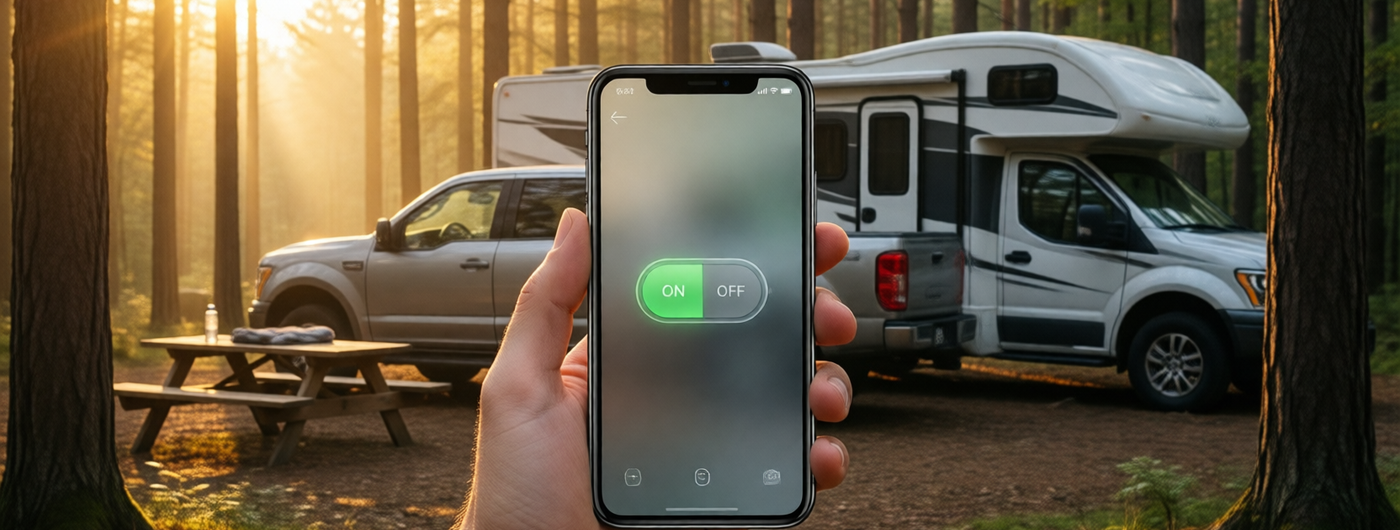
Why You Need a Bluetooth Kill Switch for Your RV or Truck
, by iFJF Direct, 7 min reading time
, by iFJF Direct, 7 min reading time

RV and truck owners: a Bluetooth kill switch protects against theft, prevents battery drain during storage, and gives you remote power control from your phone. Here's why it's essential.
If you own an RV, camper, or truck that sits for weeks between trips, you already know the problem: dead batteries. Parasitic drain from alarms, clocks, GPS trackers, and infotainment systems slowly kills your battery. You come back to a rig that won't start — and now you're jumping it in a parking lot or campsite.
A Bluetooth kill switch solves this permanently. And it does a lot more than just save your battery.
At its simplest, a Bluetooth kill switch is a heavy-duty relay that sits between your battery and the vehicle's main power cable. You control it from your smartphone — tap a button, and the battery is physically disconnected. Tap again, and power is restored.
No key fob to lose. No manual switch to crawl under the hood for. No parasitic drain while you're parked. And — critically — no way for a thief to start your vehicle, even with the keys.
Modern vehicles never truly shut off. Even when parked, your truck's ECU, alarm system, radio memory, GPS tracker, and telematics module draw power. On a diesel truck with dual batteries, this adds up to 50–100mA of constant draw — enough to kill both batteries in 3–4 weeks.
With a kill switch: Disconnect the battery from your phone when you park. Zero drain. Zero dead batteries. Come back a month later and it fires up on the first crank.
Professional car thieves can bypass ignition locks, defeat alarms, and clone key fobs in under 2 minutes. But they can't bypass a physical disconnect between the battery and the starter.
When the kill switch is OFF, the entire vehicle is electrically dead. No dash lights. No fuel pump. No starter. Even hot-wiring the ignition does nothing — there's no power anywhere in the system.
For RV owners parked at trailheads, boat ramps, and remote campsites where a break-in could go unnoticed for hours, this is genuine peace of mind.
Unlike old-school RF remote switches (which use a separate key fob with a coin battery that dies at the worst possible moment), a Bluetooth kill switch pairs directly with your smartphone. Your phone is the remote.
Range is typically 15–30 feet, and the connection is encrypted — your neighbor's phone can't randomly connect to your kill switch. You can also pair multiple phones for shared vehicles.
If you smell burning electrical insulation, see smoke from under the dash, or get into a collision, disconnecting the battery instantly from your phone is faster than popping the hood and wrenching off a terminal in a panic.
For off-roaders and overlanders, this is especially valuable — electrical fires from damaged wiring harnesses are one of the most common causes of total vehicle loss on the trail.
Winterizing your RV? Store your truck for deployment? Instead of disconnecting battery terminals (and losing your radio presets and ECU memory each time), just tap "OFF" in the app. The Bluetooth module draws less than 3mA in standby — essentially nothing. A healthy battery will still be at 90%+ charge after 6 months.
| Feature | Why It Matters |
|---|---|
| 250A peak / 125A continuous rating | Diesel trucks with dual batteries need serious current capacity. A 100A switch will weld its contacts under cranking load |
| Weather-resistant enclosure | Under-hood mounting means exposure to heat, water, mud, and road salt. Look for IP65-equivalent sealing |
| Encrypted Bluetooth connection | Without encryption (AES-128 or better), anyone nearby with a Bluetooth scanner could potentially connect |
| Low standby current (<5mA) | If the module itself draws 50mA, you've defeated the purpose. Quality units draw <3mA |
| Universal 12V compatibility | Should work with any 12V system — cars, trucks, RVs, boats, UTVs, tractors |
| Stainless steel hardware | Mounting bolts under the hood rust fast. Stainless hardware is a small detail that makes a big difference over time |
Most Bluetooth kill switch kits install in 45–60 minutes with basic hand tools. The relay mounts near the battery, the control module goes somewhere dry (under the dash or in the glovebox), and you connect 4 wires: two heavy-gauge power cables and two thin control wires.
No special skills required beyond basic crimping and wire routing. If you've ever installed a car stereo or auxiliary lights, you can handle this.
Pro tip: Mount the control module inside the cabin if possible. While the relay and module are weather-resistant, keeping the electronics out of direct engine bay heat extends their lifespan significantly.
| Solution | Pros | Cons |
|---|---|---|
| Bluetooth Kill Switch | Phone control, encrypted, no fob to lose, 250A rating | Higher upfront cost ($50-60) |
| RF Remote Kill Switch | Cheap ($15-30) | Separate fob (easy to lose), fixed code (can be intercepted), usually 100A max |
| Manual Battery Disconnect | Cheapest ($10), dead simple | Must open hood every time, no remote control, no anti-theft while driving |
| Kill Switch (Hidden Toggle) | Hidden, simple | Requires drilling dash, only disables ignition (not full battery), thief can bypass |
Q: Will this work with a dual-battery diesel truck?
A: Yes — as long as it's a 12V system. The 250A peak rating handles dual-battery cranking current. Install on the main starting battery's positive cable. For dual-battery setups with an isolator, connect the kill switch between the main battery and the vehicle's main power distribution — both batteries will be disconnected.
Q: What happens if my phone dies or I lose Bluetooth connection while driving?
A: The relay maintains its last state — it does NOT disconnect if you lose the Bluetooth signal. If it was ON when you lost connection, it stays ON. You can continue driving normally. When your phone is charged or back in range, reconnect and resume control.
Q: Can I install this on a boat?
A: Yes, for 12V marine systems. The weather-resistant enclosure handles the marine environment. But for saltwater use, we recommend mounting the control module inside the cabin or helm compartment — not in the bilge or exposed on deck.
Q: Does disconnecting the battery reset my ECU and radio?
A: Yes — same as disconnecting the battery terminals. The ECU will relearn fuel trims after a few drive cycles. Radio presets, clock, and seat memory will need to be reset. If preserving settings is important, use the kill switch only for anti-theft (OFF when parked overnight or at trailheads) and keep it ON during daily driving.

250A peak / 125A continuous rating — handles diesel trucks, RVs, and heavy equipment. Bluetooth smartphone control with AES-128 encryption. Weather-resistant, bolt-on installation with stainless steel hardware.
Includes control module, heavy-duty relay, wiring harness, and mounting kit. Free shipping from our US warehouse.
Shop Now → 3106996022 RV AC Control Relay Board for 579/590/595/600 Series
$49.99
3106996022 RV AC Control Relay Board for 579/590/595/600 Series
$49.99
 FS1022 Fuel Water Separator for Cummins ISL ISB ISC ISM — 10 Micron
$47.99
FS1022 Fuel Water Separator for Cummins ISL ISB ISC ISM — 10 Micron
$47.99
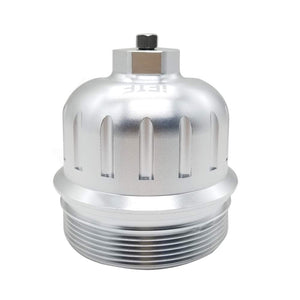 134001 Fuel Filter Housing Cap for 6.6L Duramax L5P 2017-2023 | iFJF
$69.99
134001 Fuel Filter Housing Cap for 6.6L Duramax L5P 2017-2023 | iFJF
$69.99
 FS1003 Fuel Water Separator for Cummins ISB ISC ISL ISM N14 — 10 Micron
$57.99
FS1003 Fuel Water Separator for Cummins ISB ISC ISL ISM N14 — 10 Micron
$57.99