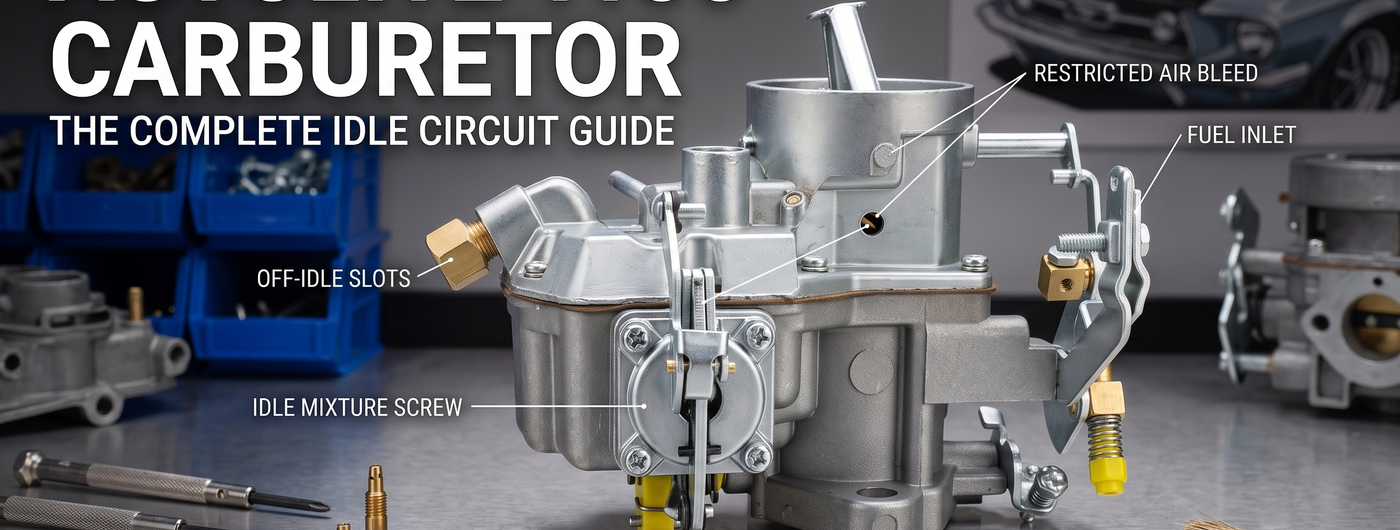
Autolite 1100 Idle Circuit
, by iFJF Direct, 16 min reading time
, by iFJF Direct, 16 min reading time

Autolite 1100 Carburetor Idle Circuit: The Complete Guide Every Restorer Needs Published: July 30, 2026 Category: Carburetor Technical Guide Reading Time: ~8 min If you're tuning, rebuilding, or troub...
The idle circuit on an Autolite 1100 carburetor is a precision-engineered fuel delivery system designed to supply a properly atomized air-fuel mixture when your engine is running at idle or just above idle speed. Unlike the main metering circuit that handles mid-range and high-RPM operation, the idle circuit operates independently and has its own dedicated set of passages, jets, and adjustment points.
Located on the bowl side of the carburetor, the idle circuit on the Autolite 1100 is a single-barrel, downdraft design used extensively on 1963–1967 Ford vehicles equipped with the 200cid 3.3L six-cylinder engine. The same basic design carried over to the Autolite 1101, which served the 170cid and 200cid engines in Falcons, Mustangs, Fairlanes, Mercurys, and Ford trucks.
Understanding this circuit is critical because roughly 40–60% of normal street driving happens at or near idle speed. A poorly tuned idle circuit translates directly to hard starts, rough idle, stalling, poor throttle response, and decreased fuel economy — even when the rest of your carburetor is in perfect condition.
The idle circuit on the Autolite 1100 consists of four interconnected components. Each one plays a specific role in delivering the right mixture at the right time. Here's a breakdown of each:
The idle mixture screw (sometimes called the idle air mixture screw) is the primary tuning device for the idle circuit. On the Autolite 1100, this screw regulates how much air-fuel mixture can pass through the idle circuit at idle speed. Threading it in reduces flow; threading it out increases it.
Location: On the bowl/body side of the carburetor, near the throttle plate. On the 1100, you'll find a brass or nickel-plated screw with a tapered needle tip that seats into a fixed brass seat.
Factory setting: Most Autolite 1100 carbs left the factory with the mixture screw set between 1 to 2 turns out from lightly seated. However, after rebuilding or cleaning, you should always treat this as a starting point and re-tune by ear or with a tachometer.
This is the feature that sets the Autolite 1100's idle circuit apart from the absolute simplest designs. The off-idle circuit consists of one or two small passages positioned just above the idle mixture hole. As the throttle begins to open from idle, these passages become uncovered and begin injecting additional air-fuel mixture into the venturi.
Without the off-idle circuit, there would be a noticeable "flat spot" or hesitation the moment you tap the accelerator — the accelerator pump hasn't yet activated, and the main circuit hasn't started flowing. The off-idle slots bridge that gap smoothly.
The restricted air bleed is a precision-machined nozzle that introduces atmospheric air into the idle circuit's fuel pathway. This is not a wide-open passage — it is intentionally sized to restrict airflow, which serves two critical functions:
The restriction is tight enough that you can blow through it by mouth, but you'll feel the resistance. If you cannot blow through it, the passage is clogged.
Fuel travels from the main jet well up through a small vertical passageway, mixes with air at the restricted air bleed nozzle, then flows down to the idle mixture screw port. The entire channel from the bowl to the idle discharge point is a continuous brass-passage network cast into the carburetor body. Any debris, varnish, or corrosion here can disrupt idle quality without triggering any other symptoms.
Understanding the actual fuel path demystifies a lot of idle tuning problems. Here's the complete flow:
As you crack the throttle open slightly — not enough to activate the accelerator pump — the throttle plate uncovers the off-idle holes above the idle mixture hole. This is when the off-idle circuit kicks in. The off-idle holes are fed from the same air-fuel mixture source, but they start contributing additional fuel precisely when the idle mixture alone is no longer sufficient. This prevents the flat spot that drivers experience on many poorly tuned carburetors.
Before adjusting your Autolite 1100 idle circuit, confirm the following prerequisites are met. Adjusting mixture on a carburetor with other problems (throttle shaft wear, float level issue, vacuum leaks) will not yield accurate results.
Never adjust the mixture screw with the engine off and hot — you cannot judge mixture quality without the engine running under load. Also, do not force the idle mixture screw against its seat. If it bottoms out with significant resistance before reaching a lean stall, stop and investigate a clogged idle circuit rather than cranking harder on the screw, which can damage the brass seat.
| Condition | Screw Position | Signs |
|---|---|---|
| Too lean (screwed in too far) | Less than 1 turn out | Engine stalls, stumbles, overheating, sooting |
| Optimal (street) | 1 to 2 turns out | Steady idle, smooth transition, good response |
| Slightly rich | 2 to 3 turns out | Smooth but slight black smoke, strong smell |
| Too rich (screwed out too far) | More than 3 turns out | Fouled plugs, hard starting, flooding, sooting |
Because the idle circuit operates under different principles than the rest of the carburetor, its failure modes are distinctive. Here's how to diagnose the most common issues:
Possible cause: Stuck-open idle mixture screw (fuel flowing constantly through idle circuit) or deteriorated needle-and-seat in the bowl allowing overfill.
Diagnosis: With the engine off and cold, remove the air cleaner and watch the throttle bore. If raw fuel is visibly dripping or pooling in the bore or on the Venture, the float level is too high or the needle/seat is worn.
Possible cause: Clogged idle mixture screw port, restricted air bleed, or air leak in the intake manifold gasket area.
Diagnosis: Spray a small amount of carburetor cleaner or WD-40 around the base of the carburetor and intake manifold while the engine idles. If the idle smooths out when spray hits a particular area, you have an air leak — not a clogged idle circuit. If the spray doesn't help, the problem is likely clogged idle passages.
Possible cause: The off-idle holes are clogged with varnish, or the restricted air bleed is blocked, preventing the off-idle circuit from delivering additional mixture as the throttle opens.
Diagnosis: Blown carburetor cleaner through the small off-idle passages (above the throttle plate). If compressed air passes through freely but the cleaner doesn't budge them, the passages are clogged with hardened varnish. Professional ultrasonic cleaning or soaking in carburetor dip solvent is required.
Possible cause: Idle circuit appears to work fine, but the restricted air bleed is partially blocked — restricting idle circuit flow enough to maintain idle, but not enough to feed the circuit properly as manifold vacuum changes at higher engine speeds.
Diagnosis: This is a tricky one. Check the restricted air bleed by blowing gently through it. You should feel air passing through with noticeable resistance but not total blockage. If in doubt, have the carburetor professionally cleaned and flow-tested.
When rebuilding an Autolite 1100, pay special attention to the idle circuit passages. Here's what the experienced restorers do differently:
Professional carburetor restorers increasingly use ultrasonic cleaners for the Autolite 1100. The high-frequency vibrations shake loose varnish and debris from tiny passages that soaking alone can't reach — including the critical restricted air bleed and off-idle circuit ports. If your rebuilt carb still idles poorly, ultrasonic cleaning before final assembly is often the answer.
The Autolite 1100 and 1101 carburetors are virtually identical in idle circuit design. The differences are primarily in throttle bore diameter and jet sizing for different engine displacements. Here are the common vehicle applications:
| Vehicle | Engine | Year Range | Carburetor Model |
|---|---|---|---|
| Ford Mustang | 200cid 3.3L I6 | 1964–1967 | Autolite 1100 / 1101 |
| Ford Falcon | 170cid / 200cid I6 | 1963–1967 | Autolite 1100 / 1101 |
| Ford Fairlane | 200cid 3.3L I6 | 1963–1967 | Autolite 1100 / 1101 |
| Mercury Comet | 170cid / 200cid I6 | 1964–1967 | Autolite 1100 / 1101 |
| Ford F-Series Truck | 170cid / 200cid I6 | 1963–1967 | Autolite 1100 / 1101 |
When sourcing a replacement Autolite 1100 for your project, verify that the idle circuit components (idle mixture screw, off-idle jets, restricted air bleed) match your application. Mixing 1100 and 1101 internal parts can change idle circuit characteristics.
Signs of a clogged idle circuit include hard starting (especially when hot), rough idle that doesn't improve with mixture screw adjustment, flat spots on acceleration, and the engine stalling when you come to a stop. A visual inspection of the idle mixture screw hole with a flashlight should reveal a clear circular opening. If you can't see light through it clearly, the passage is likely restricted. The restricted air bleed can be tested by blowing gently through it — you should feel some resistance but not total blockage.
You can set a baseline starting position with the engine off, but you must fine-tune the idle mixture screw with the engine running and at operating temperature. The engine's combustion process, load, and temperature all affect what constitutes a "correct" air-fuel ratio at idle. Setting it by ear with a running engine is the only reliable method. A wideband O2 sensor with a gauge display can give you real-time air-fuel ratio data if you want to get very precise.
The idle circuit — specifically the idle mixture screw and idle hole below the throttle plate — delivers the air-fuel mixture needed to keep the engine running at idle speed. The off-idle circuit is a separate set of small holes just above the throttle plate edge. These holes are uncovered as soon as you begin cracking the throttle open. The off-idle circuit supplies additional fuel during the transition from idle to part-throttle, preventing a lean stumble. Both circuits draw from the same fuel source (the main jet well), but they feed into the bore at different points.
The restricted air bleed is pressed or cast into the carburetor body on the Autolite 1100 and is not a replaceable part in the same sense as the idle mixture screw. If it's clogged, attempt ultrasonic cleaning first. If cleaning doesn't restore flow, the carburetor body may need replacement or machine work. Never drill out the restricted air bleed to make it flow more — doing so will enrichen the entire idle circuit and ruin your metering characteristics.
This symptom often points to a float level set too high. When the float is set above specification, the increased fuel pressure in the bowl forces more fuel through all circuits — including the idle circuit. At idle, the main circuit isn't active yet, so the excess seems manageable. But at higher RPM when the main circuit engages, the excessive fuel volume from the overfilled bowl creates a very rich condition. Check and reset the float level per factory specifications before blaming the idle circuit.
The idle circuit on the Autolite 1100 is one of the finest examples of engineering simplicity meeting real-world driving demand. Four components — idle mixture screw, off-idle holes, restricted air bleed, and the idle passage network — work together seamlessly when clean and properly adjusted.
The most common mistake made by first-time restorers is either ignoring the idle circuit's complexity or over-complicating the adjustment. The reality is straightforward: clean passages, a functional mixture screw, and a patient ear for tuning will get you 95% of the way to a perfect idle on any Autolite 1100 or 1101 carburetor.
If you're working on one of the classic Ford, Mercury, or Mustang vehicles powered by the 170cid or 200cid inline-six between 1963 and 1967, understanding this circuit isn't optional — it's the foundation of keeping that engine running right, year after year.