CB Radio Antenna Spring Mount Guide: Stainless Steel vs Standard — Which SS-3H Is Right for Your Rig?
, by iFJF Direct, 14 min reading time
, by iFJF Direct, 14 min reading time

Every trucker who's snagged a 4-foot Firestik on a low-hanging branch at a truck stop, or watched their SWR meter spike after clipping a bridge overpass, understands the value of a quality antenna spring mount. The SS-3H CB Antenna Spring Mount absorbs impacts that would otherwise snap your antenna at the base or tear the mount clean off your mirror bracket. But not all spring mounts are created equal — the material choice between stainless steel and chrome-plated standard steel, and the spring rate decision between heavy-duty and medium-duty, directly affect your antenna's survival rate and radio performance. This guide breaks down everything you need to know before you buy.
A CB antenna is a precision-tuned length of conductor — cut to a specific fraction of the 11-meter wavelength — and any mechanical damage changes its electrical length. Bend it, kink it, or snap the base, and your SWR goes through the roof. At that point, you're not just replacing a $20 whip; you're offline until you can get to a truck stop with a replacement in stock.
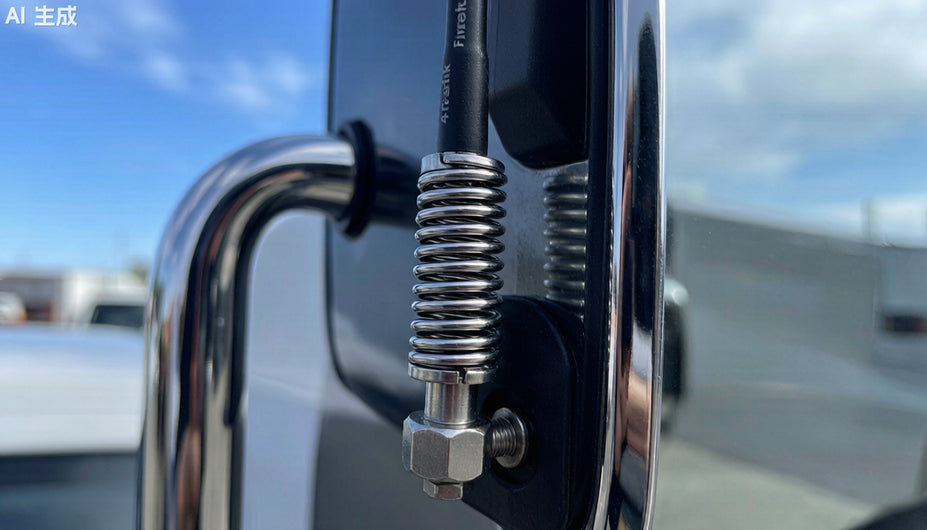
The spring mount sits between the antenna stud and the antenna itself, acting as a mechanical fuse. When the antenna strikes an object — an overhanging tree branch on a logging road, a low clearance bar at a fuel island, or even a strong crosswind gust at 70 mph across the Oklahoma plains — the spring flexes to absorb the impact rather than transmitting the force directly into the antenna's fiberglass core or the mount's threaded stud.
Without a spring, three things happen:
1. The antenna's internal copper winding fractures, changing the electrical length and ruining SWR.
2. The 3/8×24 threaded stud shears at the mount, leaving you with no antenna at all.
3. The mirror bracket or body panel the mount is attached to bends or tears — a much more expensive repair.
Beyond impact protection, a spring mount damps the high-frequency vibration transmitted from the truck's chassis through the mirror arm. Over thousands of highway miles, this constant micro-vibration loosens antenna set screws, fatigues the copper winding inside fiberglass antennas, and causes intermittent connections at the stud. A quality spring absorbs these vibrations, keeping your SWR stable trip after trip.
The single biggest factor separating a spring mount that lasts 10 years from one that's rusted solid after one winter is the metal it's made from.
Budget spring mounts — the kind you find for $8–12 at truck stops or in no-name Amazon listings — use plain carbon steel wire with a thin chrome plating. The chrome layer looks shiny on the shelf, but it's purely cosmetic. Here's what happens in the real world:
Corrosion Failure Mode: Road salt, rain, and humidity penetrate microscopic pores in the chrome plating almost immediately. Once moisture contacts the carbon steel underneath, rust begins. Because the spring coils are under constant tension (supporting the weight of the antenna), the combination of stress and corrosion accelerates — this is stress corrosion cracking, and it's why cheap springs snap at the coil rather than simply getting rusty.
Electrical Consequences: Rust is a poor conductor. As the spring corrodes, it introduces resistance between the antenna and the mount ground plane. Your SWR readings become inconsistent — measuring 1.2:1 one day and 2.5:1 the next — because the ground connection through the spring is degrading. This is a maddening problem to diagnose because the antenna and coax check out fine on the bench, but the system fails when assembled on the truck.
Lifespan: In the Northeast or Midwest, where winter road salt is a fact of life, a chrome-plated spring mount lasts 12–18 months before rust becomes a performance issue.
The iFJF SS-3H is manufactured from 304-grade stainless steel — the same alloy used in marine hardware and food processing equipment. There is no plating to flake off because the corrosion resistance is inherent to the metal.
Zero Rust, Zero Resistance: Stainless steel maintains consistent electrical conductivity throughout its lifespan. No rust means no intermittent ground faults and no mystery SWR drift. This matters especially for truckers running high-power setups — when you're pushing 100+ watts through a linear amplifier, even a fraction of an ohm of resistance can cause reflected power that damages your final transistors.
The Firestik Comparison: The Firestik SS-3H (branded "SS3H") is widely available at CB shops and retails for $21–$25. It's a solid product — Firestik has been in the CB antenna business since the 1970s — but buyers should note that many online listings mix up the SS-3H (heavy-duty) with the SS-3M (medium-duty), and the packaging doesn't always clearly state which spring rate you're getting.
The Hustler Alternative: Hustler's SSM3 stainless steel heavy-duty spring retails for $49.95–$54.95 — nearly double the price of comparable options. It's a well-made product, but at that price point, you're paying a significant premium for the Hustler brand name without any material or performance advantage over other 304 stainless steel springs on the market.
| Feature | Chrome-Plated Spring | Firestik SS-3H | Hustler SSM3 | iFJF SS-3H |
|---|---|---|---|---|
| Material | Carbon steel + chrome plate | Stainless steel | Stainless steel | 304 Stainless steel |
| Thread | 3/8×24 | 3/8×24 | 3/8×24 | 3/8×24 |
| Max Antenna Length | 48" | 60" | 102" | 60" |
| Price | $8–$12 | $21–$25 | $49.95–$54.95 | $29.99 |
| Corrosion Resistance | Poor (coating failure) | Good | Excellent | Excellent |
| Lifespan (salt-belt) | 12–18 months | 5–8 years | 8–10 years | 5–8 years |
At $29.99, the iFJF SS-3H delivers the same 304 stainless steel construction and 60-inch antenna capacity as the name-brand alternatives, with the corrosion resistance that keeps your setup running clean season after season.
The "H" in SS-3H stands for Heavy Duty, and the spring rate matters more than most installers realize. A spring that's too stiff won't flex when it needs to; a spring that's too soft lets the antenna flop around at highway speed, causing SWR flutter and eventually fatiguing the coax connection at the stud.
Heavy-duty springs use thicker wire and stronger coils, designed to support antennas up to 60 inches in length and up to approximately 2 pounds in weight. This is the correct choice for:
- 4-foot and 5-foot Firestik II or Firefly antennas
- Wilson 2000/5000 trucker series antennas
- Any fiberglass antenna 48 inches or longer
- Trucks that regularly operate on rough roads, logging routes, or in heavy brush
- Over-the-road truckers who can't afford downtime from antenna damage
The trade-off: a heavy-duty spring doesn't flex as readily under light impacts. Some users report that with a lightweight 3-foot Firefly antenna, the SS-3H barely moves at highway speed — meaning the (admittedly small) impact from bugs and rain is still transmitted into the fiberglass core. For very light antennas, this isn't a problem in practice, but it does mean you're carrying spring capacity you don't need.
Medium-duty springs use thinner wire and offer more compliance. They're rated for antennas up to 36 inches and are appropriate for:
- 2-foot and 3-foot Firestik or Firefly antennas
- Center-load and base-load mobile whips under 40 inches
- Roof-mount installations where height clearance is the primary concern
- Pickup trucks and SUVs used primarily on paved roads
The risk with a medium-duty spring: mount a 5-foot Firestik on an SS-3M, and at 70 mph the antenna will lean back 15–20 degrees from wind pressure alone. This changes the radiation pattern (a tilted vertical antenna no longer radiates omnidirectionally) and can cause the spring coils to bottom out against each other during a hard impact, defeating the purpose of having a spring at all.
Consider a 2022 Peterbilt 579 running a Cobra 29 LTD Classic paired with a 4-foot Firestik II antenna. The driver operates primarily in the Pacific Northwest — rain 200+ days a year, logging roads with branches at mirror height, and winter chain-up areas where clearance signs take a beating.
With a chrome-plated budget spring: the first winter's road salt started rust pitting within 3 months. By month 8, SWR had drifted from 1.3:1 to 2.7:1, and the spring snapped at the third coil when the antenna caught a branch outside a mill in Shelton, Washington. Total downtime: 4 hours to find a replacement at the nearest truck stop, plus $14 for another throwaway spring.
With the iFJF SS-3H: 18 months and counting, zero rust, SWR steady at 1.2:1 across all 40 channels. The same branches that killed the previous spring now just produce a satisfying "thwack" as the antenna rebounds. The driver now carries a spare SS-3H in the side box, not because he expects to need it, but because when you find a part that actually works, you buy two.
Installing a spring mount is a 10-minute job, but the SWR tuning afterward is where most installs go wrong. Adding a spring changes the antenna's electrical length — the spring itself is a small inductor — so you must re-tune after installation.
Adding approximately 3 inches of coiled steel (the spring) to your antenna system changes the overall electrical length. Here is the correct procedure:
Critical tip: Always tune with the doors closed and the truck in the configuration you'll be driving in — open doors change the ground plane reflection and give false SWR readings. If you have a headache rack or cab guard, the antenna should be mounted clear of it by at least 12 inches to avoid capacitive coupling.
For a complete walkthrough covering antenna selection, mount placement, and advanced tuning, see our CB Radio Antenna Setup Guide.
A stainless steel spring mount requires minimal maintenance, but a few habits will ensure it outlasts your truck.
Every 3 months (or at every oil change interval for OTR drivers):
1. Check that the spring is tight at both the stud and antenna connections. Vibration can slowly back out threaded connections.
2. Inspect the coils for any sign of deformation — if one coil gap is noticeably wider or narrower than the others, the spring has taken a hard hit and should be replaced.
3. Clean the spring with a damp cloth to remove road grime, diesel soot, and salt residue. While stainless steel resists corrosion, accumulated salt can still cause surface pitting over years of exposure.
4. Verify SWR readings — if they've drifted since the last check, investigate the ground plane connection at the mirror bracket.
The SS-3H is a wear item in the same category as wiper blades and mud flaps — it does its job by taking mechanical abuse so your antenna doesn't have to. Replace the spring if:
- Any coil shows a crack or fracture (replace immediately — a broken spring can drop your antenna onto the road)
- The spring has permanently deformed (antenna leans even when the mount is straight)
- SWR readings have become unstable and all other connections check out
- The spring has taken a severe impact (hit a bridge overpass, caught a low wire)
A CB antenna spring mount is one of the cheapest components in your radio setup — and one of the most important. The difference between a rusted $10 spring that fails in six months and a stainless steel SS-3H that lasts a decade is about $20 upfront and zero dollars in downtime. For over-the-road truckers, owner-operators, and anyone who depends on their CB for traffic reports, weather updates, and the camaraderie of the open road, that's not a gamble worth taking.
Match the spring rate to your antenna weight (heavy-duty for 4–5 foot whips, medium-duty for 2–3 foot antennas), tune your SWR after installation, and inspect your connections quarterly. A properly installed SS-3H is the kind of part you install once and forget about — until you hear that branch scrape across the cab roof and watch the antenna spring right back into position, ready for the next mile.
For antenna selection and complete system tuning, see our CB Radio Antenna Setup Guide. Browse our full selection of CB radio accessories to complete your mobile communications setup.