
FASS vs AirDog Lift Pumps: Which Duramax Fuel System Upgrade Actually Saves Your CP4 in 2026?
, by iFJF Direct, 11 min reading time
, by iFJF Direct, 11 min reading time

If you own a 2001–2016 Chevy or GMC Duramax equipped with the Bosch CP4.2 high-pressure fuel pump, you've probably already heard the horror stories. When the CP4 fails — and failure rates on unfiltered US diesel hover around 5–7% by the 150,000-mile mark — it sends metal shrapnel through the entire fuel system. Injectors, lines, rails, and the tank itself all become contaminated. The dealership repair bill? Anywhere from $8,000 to $12,000. That's not a typo. A lift pump upgrade with integrated air separation and filtration is the single most cost-effective insurance policy you can buy for your Duramax. But which one — FASS or AirDog — delivers the best protection for your specific truck and budget? Let's settle this once and for all.
The factory fuel system on every 2001–2016 Duramax was designed to pull fuel from the tank using the CP4 or CP3 injection pump itself. There is no factory lift pump. This pull-only design creates three critical problems that compound over time:
Real-world example: A customer with a 2008 LMM Duramax towing an 11,000-pound fifth-wheel RV through the Colorado Rockies noticed the fuel pressure gauge dipping from 8 psi to 2 psi on sustained grades — right on the edge of the CP4's danger zone. After installing an AirDog II-4G 165 GPH system, fuel pressure held steady at 15 psi under identical conditions. That's the difference between getting home and calling a flatbed from Eisenhower Pass.
FASS (Fuel Air Separation System) has been the dominant name in diesel lift pumps for over two decades, and the Titanium Signature Series represents their latest evolution. For the Duramax platform, the most common configurations are the FASS Titanium 100 GPH and 165 GPH systems.
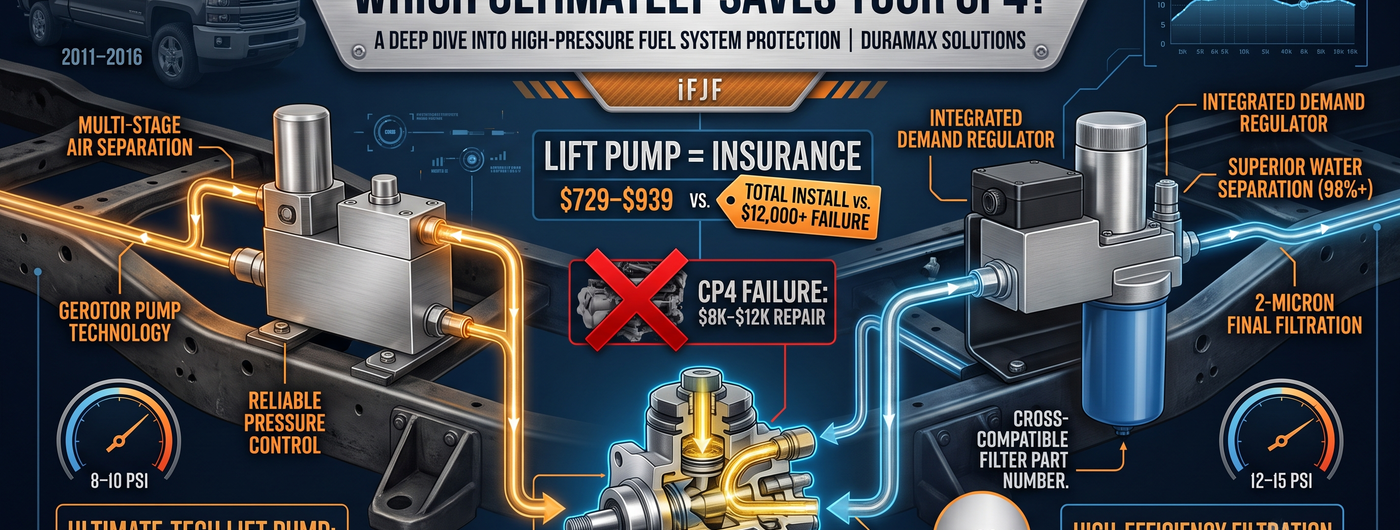
The FASS system uses a proprietary multi-stage filtration and air separation process. Fuel enters the pump assembly under negative pressure, passes through a 30-micron primary water separator that removes both free and emulsified water, then flows through the gerotor-style pump section. After pressurization, it moves through a secondary 3-micron absolute final filter before heading to the CP4. Any entrained air, vapor, or foam is separated and returned to the tank through a dedicated return port — meaning the CP4 sees only clean, air-free, positively-pressurized fuel.
The FASS Titanium has earned a reputation for dead-reliable pressure regulation. On Duramax forums and Facebook groups, owners consistently report holding 8–10 psi at the CP4 inlet across all RPM ranges — even on trucks running 150hp+ tunes. The "whisper" claim in FASS marketing is slightly overblown (you will hear it, especially on frame-rail mounts), but it's quieter than earlier FASS generations. The gerotor pump is rebuildable, and FASS sells individual seal and bearing kits for around $45–$65.
The primary complaint? The filter cost. FASS replacement filter sets run $45–$65 per pair, and they use a proprietary thread pitch. You cannot cross-shop a standard Cat or Donaldson filter onto a FASS head. At 15,000-mile filter change intervals (the recommended schedule for pre-2011 trucks), that adds roughly $180–$260 per year in consumables for a daily driver.
AirDog, manufactured by PureFlow Technologies, takes a slightly different design philosophy. Where FASS emphasizes pressure control, AirDog prioritizes water separation and air removal — the two contaminants that kill CP4 pumps fastest.
The AirDog II-4G (fourth generation) uses a demand-based pump system. Fuel passes through a large-capacity water separator first (rated at 98%+ efficiency at removing free and emulsified water), then through a gerotor pump section, and finally through a 2-micron rated final filter. AirDog's signature feature is the integrated air-vapor return: any entrained air is continuously bled back to the tank, ensuring the CP4 inlet sees pure liquid fuel 100% of the time.
The AirDog's 2-micron final filter is a genuine advantage over FASS's 3-micron absolute rating — it's a 33% tighter particle size cutoff. For CP4 pumps with their notoriously tight internal clearances (some roller-to-cam tolerances are measured in microns), that extra filtration matters. AirDog filters also use a more commonly available thread pitch; the FF100-2 replacement element cross-references with several Baldwin and Donaldson filters, keeping consumable costs at roughly $35–$50 per change.
The trade-off: AirDog systems run slightly louder, and the demand-based regulator on older II-4G units has been known to develop pressure creep after 50,000+ miles. AirDog addressed this with the 5G series, which uses an updated regulator design, but II-4G systems still dominate the used and discount market.
| Category | FASS Titanium 100/165 GPH | AirDog II-4G 100/165 GPH |
|---|---|---|
| Price (Complete Kit) | $659–$789 | $699–$829 |
| Final Filtration | 3-micron absolute | 2-micron rated |
| Water Separation | 96% efficiency (claimed) | 98%+ efficiency (claimed) |
| Filter Cost per Change | $45–$65 (proprietary thread) | $35–$50 (cross-compatible) |
| Noise Level | ~68 dB (quieter) | ~72 dB (slightly louder) |
| Pressure Regulation | Self-regulating | Adjustable 8–65 psi |
| Pump Rebuild Cost | $45–$65 (seal kit) | $75–$100 (motor assembly) |
| Warranty | Lifetime limited | Lifetime limited |
| Best For | Stock to mild builds, daily drivers | Modified trucks, towing rigs, high-water areas |
Both FASS and AirDog Duramax kits ship as frame-rail mount systems that install between the fuel tank and the CP4 inlet. The job is rated at 4–6 hours for a first-timer with basic mechanical skills, but here's what the installation tutorials leave out:
Compare that to the $8,000–$12,000 CP4 failure repair at a GM dealership — which typically includes a new CP4 pump ($1,200–$1,800 part alone), six new injectors ($400–$500 each), new high-pressure lines and rails, tank drop and cleaning, and 15–20 hours of labor. Even at the high end of the DIY lift pump install, you're paying roughly 8% of the failure cost for near-complete protection. That's not speculation; that's math.
Installing a $750 lift pump and calling it done is like putting premium tires on a car with a bent frame. The lift pump pressurizes and cleans the fuel — but the filtration downstream matters just as much:
There's no universal right answer, but the decision tree is straightforward:
Buy the FASS Titanium 100 GPH if: your Duramax is stock or has a mild tune (under 100hp over stock), you value quiet operation, and you want set-it-and-forget-it pressure regulation. The $659 entry price makes it the stronger value proposition for the daily-driver truck that tows occasionally.
Buy the AirDog II-4G 165 GPH if: your truck runs a 100hp+ tune, you tow heavy regularly, you live in a humid climate where water-in-fuel is a persistent concern, or you want the flexibility to adjust fuel pressure for future upgrades. The tighter final filtration (2-micron vs 3-micron) and superior water separation give it a measurable edge in CP4 protection.
Either one beats the alternative. The $729–$939 total install cost for a complete lift pump system is less than the sales tax on a CP4 failure repair in most states. If your Duramax is over 100,000 miles on the original fuel system, you're already past the point where the statistics say a lift pump is optional. Browse our comprehensive Fuel & Oil Filter Collection to complete your diesel maintenance kit.
Author: iFJF Direct | Last updated: August 2026