
iFJF Billet Aluminum vs OEM Plastic Fuel Filter Cap: L5P Duramax Comparison & Why It Matters
, by iFJF Direct, 13 min reading time
, by iFJF Direct, 13 min reading time

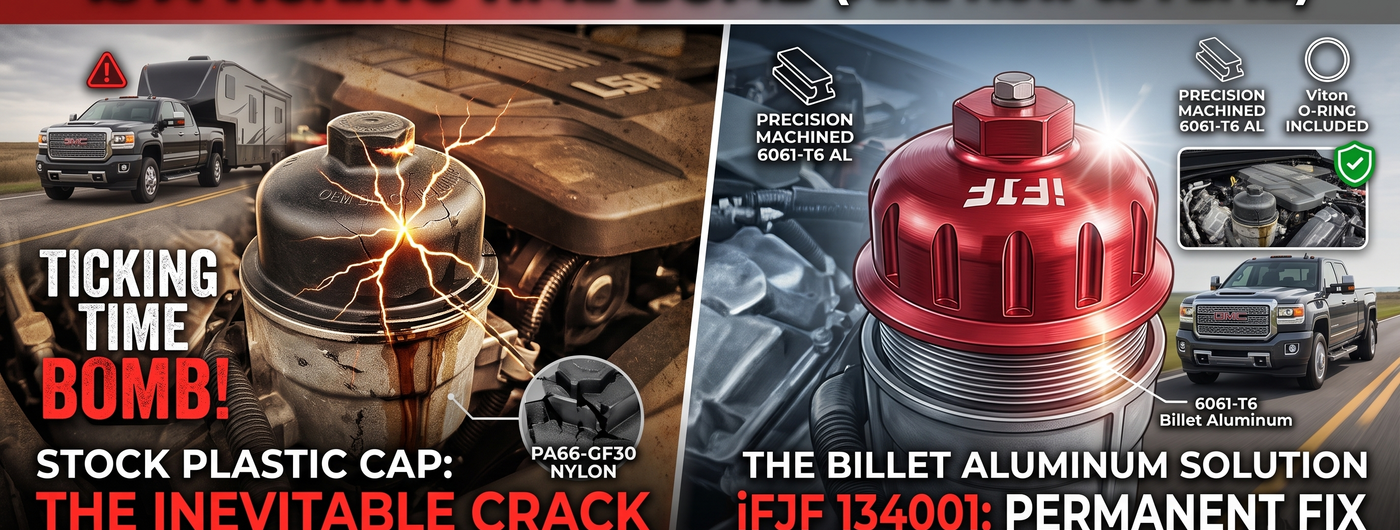
If you own a 2017–2026 Chevy Silverado HD or GMC Sierra HD with the 6.6L L5P Duramax, there's a $12 piece of plastic under your hood that can strand you on the side of the highway with zero warning. The OEM fuel filter cap — GM part number 12683593 — is molded from glass-filled nylon that was engineered to meet a cost target, not to survive a decade of heat cycling, vibration, and the gorilla-grip torque that most shops (and owners) apply during filter changes. When it fails, it doesn't leak slowly. It cracks, dumps fuel pressure instantly, and sends your truck into limp mode — or shuts it down entirely. In this guide, we're going to tear down exactly why the stock plastic cap fails, how the iFJF billet aluminum 134001 replacement solves the problem permanently, and why the math makes this one of the highest-ROI upgrades you can make to your Duramax.
The OEM L5P fuel filter cap is injection-molded from PA66-GF30 — a nylon 6/6 resin filled with 30% glass fiber reinforcement. On paper, this material has decent properties: tensile strength around 180 MPa at room temperature, heat deflection temperature of roughly 250°F under load, and reasonable chemical resistance to diesel fuel. But here's the problem: your L5P's engine bay isn't a room-temperature laboratory.
The L5P's fuel filter housing sits directly above the passenger-side exhaust manifold. Under sustained load — towing a 16,000-lb fifth wheel up a grade in July — surface temperatures at the filter housing can exceed 230°F. At those temperatures, PA66-GF30 loses roughly 40% of its tensile strength. The glass fibers that provide reinforcement begin to debond from the nylon matrix. And the cap's threads — the structural weak point — experience thermal expansion at a different rate than the aluminum filter housing they thread into.
Every heat cycle is a micro-damage event. After 50,000 miles (roughly 300–400 heat cycles for a daily-driven truck), the cumulative effect is measurable: thread root cracking, surface micro-fractures, and a permanent reduction in burst strength. The cap that left the factory tested to 300 PSI burst pressure may now fail at 180 PSI. Your L5P's fuel system operates at roughly 60–70 PSI at the lift pump — but pressure spikes during priming and cold starts can momentarily push that to 100+ PSI. That's dangerously close to a compromised cap's failure point.
Scouring Duramax forums, Facebook groups, and service bulletin databases, the failure pattern is remarkably consistent. Here are the three most common scenarios:
Let's put numbers on this. If your plastic cap cracks and strands you:
That's a worst-case cost of $3,500+ for a problem that a $29.99 billet aluminum cap prevents entirely. The math doesn't require an engineering degree to understand.
The iFJF 134001 cap is machined from a solid billet of 6061-T6 aluminum — the same alloy used in AR-15 upper receivers, aircraft structural components, and high-pressure hydraulic fittings. The material properties tell the story:
| Property | OEM Plastic (PA66-GF30) | iFJF 134001 (6061-T6) |
|---|---|---|
| Tensile Strength | 180 MPa @ 73°F, ~108 MPa @ 200°F | 310 MPa (temperature-stable to 400°F+) |
| Burst Pressure Rating | ~300 PSI (new), degrades with age | 1,500+ PSI (effectively unlimited lifespan) |
| Thread Integrity | Prone to stripping above 25 ft-lbs | Handles 50+ ft-lbs without deformation |
| UV/Chemical Resistance | Moderate — embrittlement over 5+ years | Excellent — anodized finish resists corrosion |
| Thermal Expansion | 80 × 10⁻⁶ m/m·K (mismatch with AL housing) | 23.6 × 10⁻⁶ m/m·K (matches housing) |
The thermal expansion match is particularly important and almost never discussed. The OEM plastic cap expands at more than three times the rate of the aluminum housing during heat cycling. This differential expansion is why O-ring sealing pressure varies wildly between cold start and operating temperature — and why some caps "weep" fuel only when the engine is hot. The billet cap, being the same aluminum alloy family as the housing, expands and contracts at the same rate. O-ring compression stays consistent across the entire operating temperature range.
The aftermarket has recognized the plastic cap problem, and there are now three notable billet cap options on the market. Here's how they stack up:
| Feature | iFJF 134001 | DmaxStore Billet Cap | Fleece FFBA-20 |
|---|---|---|---|
| Material | 6061-T6 Billet Aluminum | 6061 Aluminum (unknown temper) | 6061-T6 Aluminum |
| Price | $29.99 | $42.99 (fuel cap only) | $249.00 (complete filter upgrade kit) |
| Finish | Clear anodized | Black anodized | Raw machined / black option |
| O-Ring Included | Yes (Viton, diesel-rated) | Yes | Yes (complete kit) |
| Hex Size | 1-1/4" (factory socket match) | 1-1/4" | Integrated wrench flats |
| Warranty | Lifetime | 1 year | 1 year |
| Compatibility | 2017–2026 L5P Duramax | 2020–2026 L5P (narrower range) | 2020–2024 L5P (full housing replacement) |
Key takeaway: The DmaxStore cap is a solid product, but at $42.99 for the cap alone (often $96+ bundled with a DEF cap), you're paying a premium for the brand name. The Fleece option is a different category entirely — it replaces the entire filter housing, filter element type, and mounting bracket. That's a $249 commitment that makes sense if you want a complete filtration upgrade, but is massive overkill if you just want to solve the plastic cap failure problem. At $29.99, the iFJF 134001 is the surgical solution — fix the weak link without over-engineering the whole system.
This is genuinely one of the easiest Duramax upgrades you'll ever do. No mechanical aptitude required beyond "can operate a ratchet."
Pro tip: If you're doing a filter change at the same time (recommended — do both while you're in there), fill the new filter element with clean diesel before installing. This cuts priming time dramatically and reduces strain on the CP4 high-pressure pump during the first start.
The billet cap doesn't change your filter interval — that's still dictated by the filter element, not the cap. GM recommends replacing the L5P fuel filter every 22,500 miles under normal conditions, or every 15,000 miles under severe service (frequent towing, dusty environments, biodiesel blends above B5). The iFJF cap's Viton O-ring should be inspected at every filter change and replaced if it shows signs of compression set (flattening) or cracking. Replacement O-rings are inexpensive and widely available — they use the same dimensions as the OEM O-ring (2-3/8" ID × 2-5/8" OD × 1/8" cross-section).
Billet aluminum filter caps have been on the market for the L5P platform since roughly 2019. Owners with 100,000+ miles on billet caps report zero failures, zero leaks, and zero thread degradation. The anodized finish holds up well to under-hood conditions — we've seen caps with 80,000 miles that still look nearly new after a quick wipe-down. Compare that to the OEM plastic cap, where a 3-year-old cap typically shows visible stress marks around the hex flats and thread roots under magnification.
Q: Will this cap fit my 2017 L5P?
A: Yes. The iFJF 134001 cap fits all 2017–2026 L5P Duramax engines (Silverado 2500HD/3500HD and Sierra 2500HD/3500HD). The fuel filter housing design has not changed across these model years.
Q: Does this replace the entire filter housing?
A: No. This is a direct replacement for the OEM plastic cap only. The aluminum filter housing itself remains in place. The iFJF 134001 cap is a drop-in swap — just remove the old plastic cap, install the billet cap with the included Viton O-ring, and torque to spec.
Q: Can I over-tighten the billet cap?
A: Technically yes, but it's much harder to do than with the plastic cap. The 6061-T6 aluminum cap threads can handle well above 50 ft-lbs, but the housing threads (also aluminum) are the limiting factor. Stick to 18–22 ft-lbs and you'll never have a problem.
Q: Does this affect my warranty?
A: Under the Magnuson-Moss Warranty Act, a manufacturer cannot void your warranty for using aftermarket parts unless they can prove the aftermarket part caused the failure. A billet fuel filter cap — which improves sealing and structural integrity — would be extraordinarily difficult to blame for any fuel system issue. That said, if you're concerned, keep your OEM plastic cap and swap it back before dealer visits.
Q: Is the anodized finish truly corrosion-resistant?
A: Yes. Clear anodizing (Type II, MIL-A-8625) creates an aluminum oxide layer that is harder than the base aluminum and chemically inert. Diesel fuel, road salt spray, and engine bay chemicals won't affect it. The only thing that will damage anodizing is strong acids or alkalis — neither of which should be anywhere near your fuel filter.
Q: How does the iFJF cap compare to the PPE billet cap?
A: PPE (Pacific Performance Engineering) also makes a billet cap for the L5P, typically priced around $45–$55. The PPE cap uses 6061 aluminum with a red anodized finish and laser-etched logo. Functionally, the iFJF 134001 and PPE cap are similar — both solve the plastic cap problem. The price difference is brand premium: iFJF at $29.99 vs PPE at $45+ for the same material, same fitment, and same lifetime durability.
The OEM plastic fuel filter cap on the L5P Duramax is a textbook example of cost-engineered compromise. GM saved maybe $3 per truck using injection-molded nylon instead of aluminum — and passed the long-term risk to you, the owner. The iFJF 134001 billet cap fixes that design compromise for $29.99 and 10 minutes of your time. When you consider that a single roadside breakdown costs 10x the price of the upgrade, this isn't really a purchase decision — it's insurance that pays for itself the first time it doesn't fail.
Get the iFJF 134001 Billet Fuel Filter Cap: Shop Now → — or get the TP1015 Filter + Cap Combo