
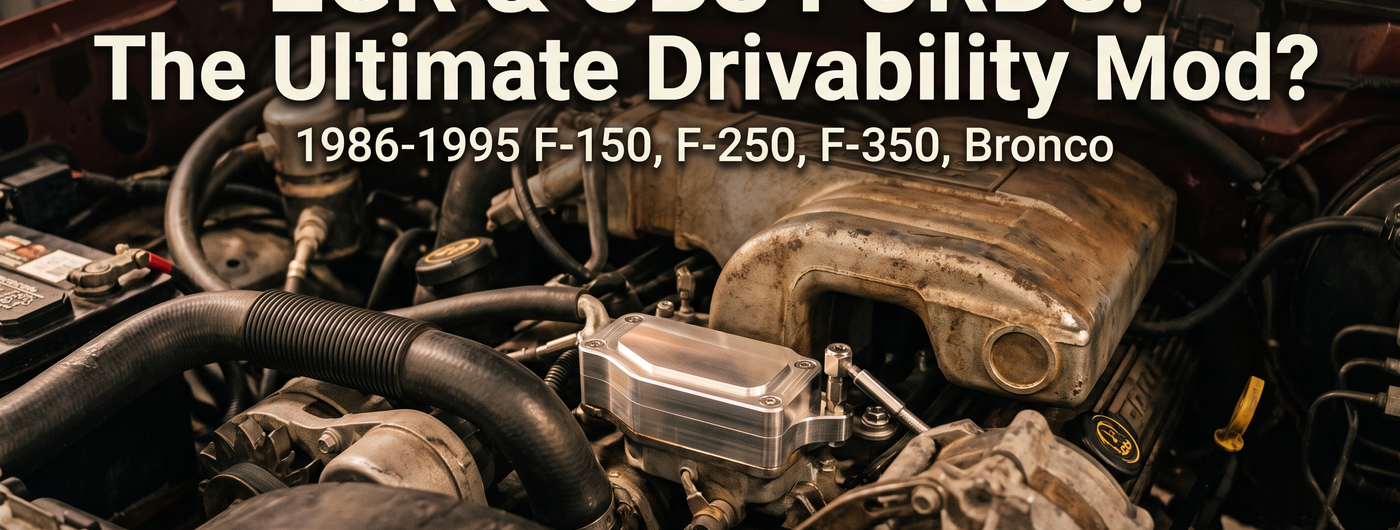
Ford F150 F250 Bronco EGR Delete: Complete Guide (1986-1995) — Cost, Benefits & Installation
, by iFJF Team, 16 min reading time
, by iFJF Team, 16 min reading time

If you own an OBS (Old Body Style) Ford truck — an F-150, F-250, F-350, or Bronco built between 1986 and 1995 — you've probably encountered the dreaded Check Engine Light (CEL) triggered by the Exhaust Gas Recirculation (EGR) system. These aging systems are notorious for clogging, sticking, and throwing error codes that can leave you stranded during emissions inspections or cause frustrating drivability issues.
The EGR system recirculates a portion of your exhaust gases back into the intake manifold. The idea is simple: by diluting the air-fuel mixture with inert exhaust gas, combustion temperatures drop, and NOx (nitrogen oxide) emissions are reduced. On paper, this sounds great. In practice — especially on 30+ year-old Ford trucks — it's a different story.
Over time, carbon deposits accumulate inside the EGR valve, EGR passages, and the intake manifold. The valve begins to stick — either partially open (causing a rough idle, hesitation, and stalling) or fully closed (triggering the check engine light). The most common diagnostic trouble codes you'll see are:
Owners of these trucks choose to delete the EGR system for several practical reasons:
For trucks that see off-road, show, or competition use, the EGR delete is one of the most common engine bay simplifications performed.
There's a lot of confusion about terminology in the EGR removal world. Let's clear it up. When you set out to remove or disable the EGR system on your Ford truck, you actually have three distinct approaches — each with different hardware, costs, and outcomes:
| Method | What It Includes | CEL Result | Price Range | Best For |
|---|---|---|---|---|
| EGR Delete Kit | Block-off plate + hardware | ⚠️ CEL stays on (unless tuned out) | $50–$60 | Custom-tuned trucks, pure off-road rigs |
| EGR Simulator / Eliminator | Block-off plate + electronic simulator module | ✅ CEL stays OFF | $70–$80 | Daily drivers, trucks in emissions-test states |
| Block-Off Plate Only | Just the plate — no simulator | ⚠️ CEL stays on | ~$15–$25 | Already-tuned trucks, race applications |
If you live in a state with annual emissions inspections (like California, Colorado, or parts of Texas): the EGR Simulator / Eliminator Kit is your best choice. It mechanically blocks off the EGR port and includes an electronic module that sends the correct signals to your ECU — keeping the check engine light off. When inspection time comes, your OBD-II port won't show any EGR-related codes.
If your truck has a custom ECU tune that already disables EGR monitoring: the simpler EGR Delete Kit with just the block-off plate and cap is all you need. Your tuner can disable the EGR readiness monitor, so no simulator is required.
If you're on an ultra-tight budget and don't care about the CEL: a standalone block-off plate is the cheapest route — but expect a permanent check engine light.
Our EGR delete kits are designed for the 1986–1995 OBS Ford F-Series and Bronco platform. Here's exactly which engines are compatible:
| Engine | Displacement | Configuration | Models | Years |
|---|---|---|---|---|
| 4.9L I6 (300ci) | 4,916 cc | Inline-6 | F-150, F-250, F-350, Bronco | 1986–1995 |
| 5.0L V8 (302ci) | 4,942 cc | V8 OHV | F-150, F-250, Bronco | 1986–1995 |
| 5.8L V8 (351W) | 5,752 cc | V8 OHV (Windsor) | F-150, F-250, F-350, Bronco | 1986–1995 |
| 7.5L V8 (460ci) | 7,536 cc | V8 OHV | F-250, F-350 | 1986–1995 |
Note: The 4.9L inline-6 was Ford's legendary workhorse — also found in many Econoline vans — and all four engines share the same EGR mounting pattern for the 1986–1995 model years. Our kits are manufactured from billet aluminum and include stainless steel hardware, ensuring they won't rust or warp after years of heat cycling.
Installing an EGR delete kit is a straightforward job that most DIYers can complete in 60–90 minutes with basic hand tools. Here's the simplified process:
Tools You'll Need:
Safety first. Disconnect the negative battery terminal. This prevents any accidental shorts and also resets the ECU, which you'll want after installation.
On the 5.0L and 5.8L V8 engines, the EGR valve is mounted on the passenger side of the intake manifold — typically near the throttle body. On the 4.9L inline-six, it's on the driver's side, mounted between intake runners 3 and 4. On the 7.5L big block, it's on the front of the intake plenum, near the distributor.
Spray penetrating oil on the bolts now — these fasteners have been heat-cycled for 30+ years and may be stubborn.
Disconnect the vacuum line from the EGR valve. Remove the two bolts securing the EGR valve to the intake manifold. If they're seized, work them gently back and forth — don't snap a bolt in the intake. Disconnect the EGR position sensor connector and remove the valve assembly.
Clean the mounting surface on the intake manifold thoroughly. Any remaining gasket material will cause a vacuum leak. Apply the included gasket (or a thin bead of high-temp RTV) to the block-off plate. Bolt it down using the supplied stainless steel hardware. Torque to approximately 12–15 ft-lbs — snug is sufficient; over-tightening can strip the aluminum intake threads.
If your kit includes an exhaust manifold cap (the full iFJF EGR Delete Kits include this), trace the EGR tube from the valve down to the exhaust manifold. Remove the tube — you may need to cut it if the fittings are rusted solid. Install the cap over the exhaust manifold port using the supplied bolt. Apply anti-seize to the bolt threads for future serviceability.
If you purchased the EGR Simulator / Eliminator Kit, plug the electronic simulator module into the factory EGR valve wiring harness connector. Mount the module to a cool location away from the exhaust manifold using zip ties or the included bracket. The module emulates the correct resistance and position feedback signals that the ECU expects — keeping your check engine light off.
Post-installation: Reconnect the battery. Start the engine and let it idle for 5–10 minutes while checking for vacuum leaks. Take a test drive to confirm everything is operating smoothly. If you installed the simulator kit, the check engine light should remain off. If you opted for the delete-only kit, the CEL will illuminate — this is expected and harmless unless you need to pass an OBD-II scan.
This is the #1 question we get from OBS Ford owners. Let's address it head-on.
When you physically remove the EGR valve and block off the port, the ECU will detect that the EGR system is no longer functioning. On 1986–1995 OBD-I Fords, the ECU runs a self-test that checks for the presence of the EGR valve position sensor signal. Without it, you'll see a steady check engine light.
You have two ways to handle this:
The iFJF EGR Simulator / Eliminator Kit includes a purpose-built electronic module that connects directly to your factory EGR valve wiring harness. It generates the correct voltage signals that mimic a properly functioning EGR valve, essentially telling the ECU: "Everything is normal, no codes to set." This is the plug-and-play solution — no tuning, no software, no specialized equipment required. Install it, and your CEL stays off.
If your truck has an aftermarket ECU tune (common with performance builds), your tuner can disable the EGR readiness monitor in the calibration. With the monitor disabled, you can use the simpler block-off-only kit and never see a CEL. This approach requires a tuning device (like an SCT, Moates QuarterHorse, or Tweecer) and a custom calibration file — budget $200–$500 for tuning services.
For most daily-driven OBS Fords, the simulator kit is the smarter, more cost-effective route.
If you're driving a 1996–2004 Ford Mustang GT with the 4.6L 2V SOHC V8, there's a dedicated EGR delete solution for your platform. The iFJF Mustang EGR Delete Kit is designed specifically for the modular V8 engine family found in:
The Mustang kit includes a precision-machined block-off plate and exhaust manifold cap, both in billet aluminum. It's the same principle as the truck kit — just engineered for the SN95/New Edge Mustang intake and exhaust manifold geometry. If you're building a dedicated track Mustang or cleaning up a tired daily driver, this kit eliminates one of the most failure-prone systems on the modular V8.
Note that the Mustang uses a different EGR mounting pattern than the OBS truck engines, so the truck kits are not cross-compatible with Mustang applications.
No. Removing or disabling the EGR system is a violation of the federal Clean Air Act (42 U.S.C. § 7522) for vehicles operated on public roads. These kits are sold for off-road, racing, show, and competition vehicles only. If your truck is registered and driven on public roads, you should maintain a fully functional EGR system. Check your state and local laws before modifying your emissions equipment.
In states with visual emissions inspections (like California, New York, and Colorado), a missing EGR valve will cause an immediate failure — even if the CEL is off and the OBD-II scan is clean. In OBD-II-only inspection states, the simulator kit may allow you to pass a plug-in test, but there are no guarantees, and test procedures vary by state. Always check your local requirements.
An EGR delete does not directly add horsepower. The EGR system is dormant at wide-open throttle, so peak horsepower numbers remain unchanged. However, you may notice improved throttle response and smoother part-throttle acceleration because the ECU is no longer commanding EGR flow during tip-in and cruise conditions. The real benefits are drivability, reliability, and simplification — not dyno numbers.
Yes. All iFJF EGR delete kits bolt on using factory mounting points. If you ever need to reinstall the EGR system for an inspection or sale, simply remove the block-off plate, unbolt the exhaust manifold cap, and reinstall a factory EGR valve, gasket, and vacuum lines. No cutting, welding, or permanent modification is required — the install is 100% bolt-on and 100% reversible.
The EGR Delete Kit ($59.99) includes the block-off plate, exhaust manifold cap, gaskets, and hardware — but no electronic simulator. With this kit, your check engine light will illuminate (unless you have a custom tune that disables EGR monitoring). The EGR Simulator / Eliminator Kit ($74.58) includes everything the delete kit has, plus an electronic module that plugs into your factory EGR harness and prevents the CEL from coming on. If you need to keep your check engine light off, go with the simulator kit.
⚠️ OFF-ROAD USE ONLY
These products are designed and sold for off-road, racing, show, and competition use only. Removing or tampering with emissions control equipment on a vehicle operated on public roads is a violation of federal and state laws. It is the purchaser's responsibility to understand and comply with all applicable local, state, and federal regulations regarding vehicle emissions modifications. iFJF assumes no liability for any misuse of these products. Never operate a modified vehicle on public roads.
Not sure which kit fits your Ford? Contact the iFJF Team through our Contact page — we're happy to confirm compatibility for your specific year, engine, and model before you order.
🛒 Ready to Delete Your EGR?
Get the No-CEL EGR Simulator Eliminator Kit — plug-and-play, bolt-on install in under an hour.
Shop the Kit → $74.58 Edelbrock 1406 Performer 600 CFM 4-Barrel Carburetor — Electric Choke, for Chevy/GMC/Ford (Gold)
$419.99
Edelbrock 1406 Performer 600 CFM 4-Barrel Carburetor — Electric Choke, for Chevy/GMC/Ford (Gold)
$419.99
 AF55308 Air Filter for Cummins QSB6.7 QSL9 — Ford F560 F570 Case IH
$49.99
AF55308 Air Filter for Cummins QSB6.7 QSL9 — Ford F560 F570 Case IH
$49.99
 FD4615 Fuel + FL2016 Oil Filter Combo for 2017-2019 Ford 6.7L Powerstroke
$69.99
FD4615 Fuel + FL2016 Oil Filter Combo for 2017-2019 Ford 6.7L Powerstroke
$69.99
 134001 Fuel Filter Housing Cap for 6.6L Duramax L5P 2017-2023 | iFJF
$69.99
134001 Fuel Filter Housing Cap for 6.6L Duramax L5P 2017-2023 | iFJF
$69.99


