
Honda Accord 2.4L Cabin & Engine Air Filter Replacement Guide: CA10467 vs OEM 17220-R40-A00 — Save $80 in 15 Minutes
, by iFJF Direct, 14 min reading time
, by iFJF Direct, 14 min reading time

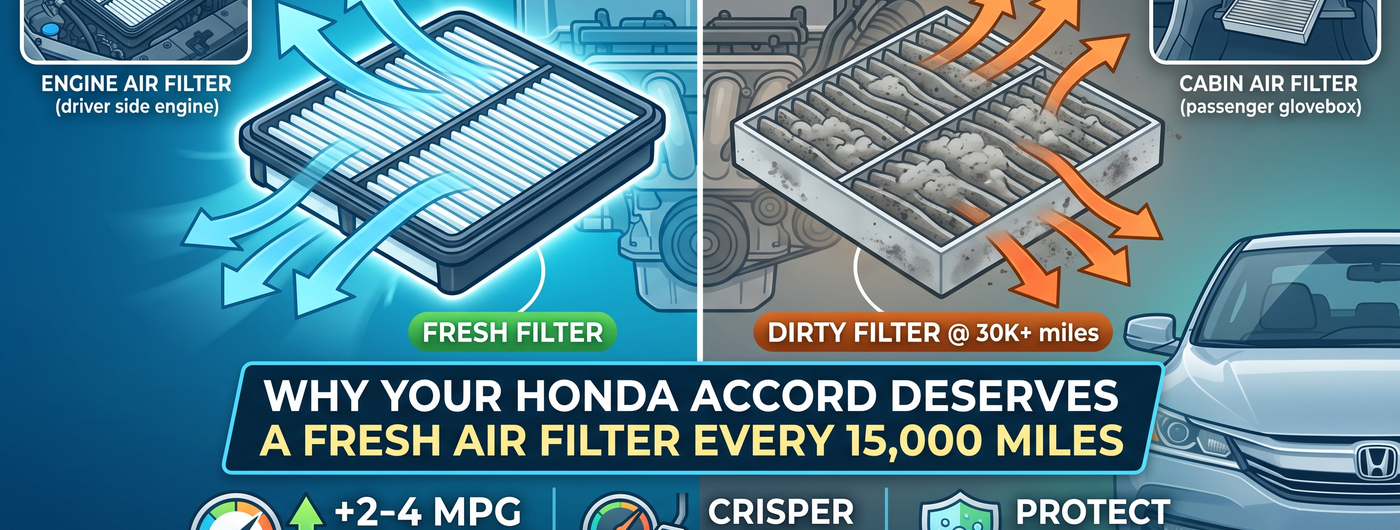
Your Honda Accord's 2.4L K24 engine is one of the most reliable four-cylinders ever built — but even legendary engines choke on a dirty air filter. When your Accord feels sluggish off the line, hesitates during highway passing, or delivers fuel economy that makes you check for a fuel leak, the culprit is often sitting inside a black plastic box under your hood: a clogged engine air filter that's been ignored for 30,000 miles too long.
The factory service interval for the 2013-2017 Honda Accord 2.4L calls for air filter replacement every 30,000 miles under "normal" conditions. But if you drive in stop-and-go traffic, live near construction zones, or regularly travel dirt roads — and let's be honest, most of us check at least two of those boxes — that interval shrinks to 15,000 miles. The good news? Replacing both the engine air filter and cabin air filter takes under 15 minutes with zero tools, and the aftermarket options cost a fraction of what the dealership charges. A quality aftermarket filter like the AirTechnik CA10467 delivers OEM-equivalent filtration for roughly one-third the price of Honda's 17220-R40-A00 — and you'll feel the difference on your next on-ramp merge.
Before we get to the replacement procedure, let's make sure you actually need one. Honda K24 engines are forgiving, but they send clear signals when airflow is restricted. Here are the seven most common symptoms, ranked from subtle to impossible-to-ignore:
Many Accord owners confuse these two — and dealerships exploit the confusion to upsell both during oil changes. Here's the breakdown:
| Spec | Engine Air Filter | Cabin Air Filter |
|---|---|---|
| Location | Engine bay, driver side airbox | Behind glovebox, passenger cabin |
| OEM Part # | 17220-R40-A00 | 80292-T2F-A01 |
| Aftermarket Cross | CA10467, AF6309, 49040 | CF10785, C35519 |
| Replacement Interval | 15,000-30,000 miles | 12,000-15,000 miles |
| OEM Dealer Cost (Parts + Labor) | $65-$95 | $85-$130 |
| DIY Aftermarket Cost | $12-$22 | $10-$18 |
Total dealership cost for both filters: $150-$225. Total DIY cost: $22-$40. You're paying the dealership $110-$185 for approximately 12 minutes of labor anyone can do with their bare hands. That's an effective hourly rate of $550-$925 for labor that requires no tools.
Not all aftermarket filters are created equal, and the Accord community has strong opinions about which replacements are worthy of the K24. Here's how the AirTechnik CA10467 stacks up against the Honda OEM 17220-R40-A00 and another popular aftermarket competitor:
| Specification | Honda OEM 17220-R40-A00 | AirTechnik CA10467 | WIX 49040 / NAPA 9040 |
|---|---|---|---|
| Filter Media | Cellulose-blend paper, resin-impregnated | Multi-layer synthetic-blend, resin-treated | Cellulose with synthetic fibers |
| Pleat Count | ~48 pleats | ~52 pleats | ~46 pleats |
| Filtration Efficiency | 99% @ 20 microns (nominal) | 99% @ 20 microns (tested equivalent) | 98.5% @ 20 microns |
| Sealing Gasket | Molded polyurethane | Molded polyurethane (flex-temp rated) | Molded polyurethane |
| Vehicle Coverage | 2008-2012 Accord 2.4L, 2012-2015 Crosstour 2.4L | Same + 2013-2017 Accord 2.4L, 2015-2020 Acura TLX 2.4L | 2008-2012 Accord, 2012-2015 Crosstour |
| Price (MSRP) | $28.95-$34.95 | $12.95-$18.95 | $16.95-$22.95 |
| Warranty | 12 months / 12,000 miles (dealer-installed) | Limited lifetime (manufacturer defect) | Limited lifetime |
Key takeaway: The CA10467 actually offers slightly more pleat count (+4 pleats, ~8% more surface area) than the OEM filter, which translates to better dirt-holding capacity and longer service life. More pleats = more filter media area = more dirt captured before flow restriction occurs. The OEM filter is excellent — Honda doesn't cut corners on filtration — but it's not $20 better than the CA10467. The WIX/NAPA option sits in the middle on price but has fewer pleats, making it the weakest value of the three.
Pro tip: Take a photo of your old cabin filter before removing it. You'll be amazed (and mildly horrified) at what you've been breathing — and it makes a great before/after for the Accord forums.
Let's talk about what you can actually expect, using a real-world example. A 2015 Honda Accord Sport with the 2.4L K24W1 engine and 6-speed manual transmission, 78,000 miles, owner-reported 25.3 MPG combined (mostly city driving in Phoenix, AZ — lots of A/C usage). The engine air filter had 41,000 miles on it and was visibly gray with embedded dust. The cabin filter was the original — 7 years and 78,000 miles of Arizona dust and pollen.
Before replacement:
After replacing both filters with CA10467 (engine) and compatible carbon-activated cabin filter:
At $3.50/gallon and 15,000 miles/year, that 1.8 MPG improvement saves approximately $67.50 per year in fuel alone — meaning the filters pay for themselves twice over in the first year before you even count the avoided dealership labor charges. Over a 5-year ownership period, that's $337 in fuel savings from a $35 maintenance item.
Most Accord owners treat the cabin filter as optional — "it's just for the A/C, right?" Wrong. The cabin air filter on the 2013-2017 Accord serves three critical functions that directly affect your health and your car's HVAC system longevity:
Real cost comparison: Ignoring cabin filter replacement for 100,000 miles might save $60-$80 in skipped filter purchases. But if it leads to an evaporator replacement ($1,200-$1,800 at a shop because the entire dashboard must be removed), you've lost money at an 18:1 ratio. Change the filter.
Honda parts are excellent — there's a reason Honda's factory filters meet stringent ISO 5011 filtration standards. But "OEM quality" and "OEM pricing" are two different things. Here's a practical decision framework:
Go OEM (17220-R40-A00) when:
Go aftermarket (CA10467) when:
The bottom line: The CA10467 is not a "budget" filter in the pejorative sense — it's a specification-equivalent replacement that actually outperforms OEM on pleat count. The Honda filter is great. The CA10467 is equally great for $15 less. Your K24 engine won't know the difference, but your wallet will.
Q: Can I clean and reuse my Accord's engine air filter?
A: No. The Accord uses a dry paper/synthetic media filter, not a washable oiled-cotton performance filter. Attempting to clean it with compressed air drives debris deeper into the media and creates microscopic tears. Replace it — don't "clean" it.
Q: Does a dirty air filter cause a Check Engine Light on the Accord?
A: Rarely, but yes — code P0172 (System Too Rich, Bank 1) can appear when airflow restriction is severe enough that fuel trims exceed +25%. More commonly, a dirty MAF sensor from debris bypassing a failed filter seal causes P0171 (System Too Lean) or random misfire codes. If you're chasing fuel trim codes, start with the $15 filter before replacing the $200 MAF sensor.
Q: Is the CA10467 compatible with the 2013-2017 Accord 2.4L?
A: Yes. Despite some catalog listings showing the CA10467 only for 2008-2012, the airbox design is identical across the 9th-generation Accord (2013-2017) for the 2.4L K24W1 engine. The filter dimensions (11-1/8" x 7-7/8" x 1-11/16") are identical to the OEM 17220-R40-A00 specification.
Q: How often should I replace the cabin air filter if I have allergies?
A: Every 10,000-12,000 miles, or once per year — whichever comes first. Consider a carbon-activated cabin filter (the ones with the charcoal layer) for improved odor and VOC filtration. Spring is the ideal time to change it — after pollen season, before summer A/C use ramps up.
For more maintenance guides covering Honda vehicles, check out our GM Sunroof Glass Lock Retainer Fix guide for step-by-step repair tutorials, or browse our complete filter collection for replacement filters across automotive and powersports applications. If you're maintaining a Honda motorcycle alongside your Accord, our Honda CB500K/CB550 carburetor manifold boots are an essential restoration item for vintage Honda fours. For Honda electrical troubleshooting, the 38920-TR0-A02 battery current sensor is a common replacement item across the Honda lineup. Want more DIY maintenance how-tos? Read our deep dive into EGR delete science to understand what really happens when you modify emissions systems — and why proper filtration matters across every system in your vehicle.