
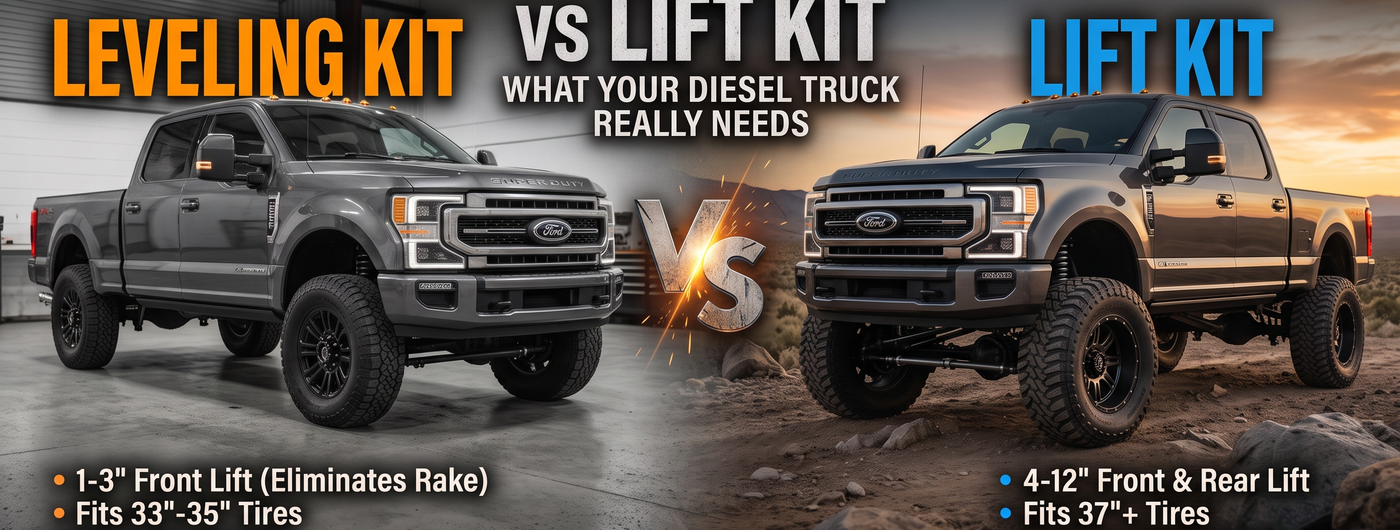
Leveling Kit vs Lift Kit: What Your Diesel Truck Really Needs
, by iFJF Direct, 11 min reading time
, by iFJF Direct, 11 min reading time

Leveling kit or lift kit? We break down cost, installation, tire clearance, ride quality, and towing impact so you can make the right call for your diesel truck.
Last updated: June 15, 2026
You just bought a diesel truck — or you've had one for years — and you're staring at that factory rake. The front sits lower than the rear, and you're wondering: do I need a leveling kit or a full lift kit? It's the most debated question in the diesel truck community, and the wrong choice can cost you thousands.
In this guide, we'll break down exactly what each kit does, how they differ, what it costs, and — most importantly — which one fits your actual needs. No marketing fluff, just straight answers from someone who's wrenched on more Duramax, Powerstroke, and Cummins trucks than we can count.
A leveling kit raises the front of your truck by 1 to 3 inches to match the rear ride height. From the factory, most diesel trucks have a "rake" — the rear sits 2-3 inches higher than the front — because manufacturers design them to squat level when loaded or towing. A leveling kit eliminates that rake.
Leveling kits typically come in two forms:
What leveling kits don't do: They don't increase ground clearance at the rear or allow for significantly larger tires without trimming.
A lift kit raises the entire truck — both front and rear — typically by 4 to 12+ inches. It's a more comprehensive suspension modification that changes the geometry of your truck's entire chassis.
Lift kits fall into two major categories:
What lift kits do: Significantly increase ground clearance, allow for 35" to 40"+ tires, and dramatically change the truck's stance and capability.
| Factor | Leveling Kit | Lift Kit |
|---|---|---|
| Height Gain | 1-3" (front only) | 4-12" (front + rear) |
| Parts Cost | $50-$500 | $800-$5,000+ |
| Installation Time | 2-4 hours (DIY friendly) | 8-20+ hours (professional recommended) |
| Installation Cost | $150-$400 | $800-$2,500+ |
| Max Tire Size | 33"-35" (may require trimming) | 35"-40"+ |
| Ride Quality | Near-stock (slightly firmer) | Varies — upgraded shocks can improve it |
| MPG Impact | Minimal (-0.5 to -1 MPG) | Noticeable (-2 to -5 MPG) |
| Towing Friendly? | ✅ Yes — maintains factory rake under load | ⚠️ Can cause squat — needs airbags or add-a-leaf |
| Warranty Risk | Low — dealer unlikely to flag | Moderate — some dealers push back |
This is the question that matters. Here's a decision framework based on how you use your truck:
If you have to ask which one you need, you probably need a leveling kit. 90% of diesel truck owners are perfectly served by a 2-2.5" leveling kit and 35" tires. Full lift kits are for people who know exactly why they need one — and they usually already know.
Ford's solid front axle makes leveling straightforward. A 2.5" leveling kit clears 35" tires on most Super Dutys. For 37"s, you'll want a 4-6" lift. Popular kits: ReadyLIFT, BDS, Rough Country.
Ram's coil spring rear (2500) and leaf spring rear (3500) have different leveling approaches. A 2" leveling kit with spacers works for 35"s. The 2014+ trucks with radius arm front suspension respond well to Carli and Thuren leveling systems.
IFS (independent front suspension) on GM HD trucks means leveling is more involved. Torsion keys on 2001-2010 models, spacer kits on 2011+. A 2-3" level can clear 33-35" tires. For 37"s, you need a 6" lift due to IFS geometry.
Leveling kit installation is a weekend driveway job for someone with basic mechanical skills. You'll need a floor jack, jack stands, basic sockets, and a torque wrench. The hardest part is usually compressing the strut to fit the spacer — many people buy pre-assembled strut/leveling combos to skip this step. Budget 2-4 hours plus $80-120 for a front-end alignment afterward.
Lift kit installation is a different animal. You're dropping the front differential, replacing control arms, modifying steering linkage, and potentially cutting frame brackets. Most reputable shops charge 8-20 hours of labor. Do not cheap out on lift kit installation — a poorly installed lift kit is dangerous at highway speeds.
A spacer leveling kit will make the ride slightly firmer because you're preloading the factory spring. It's noticeable but not harsh. A quality suspension lift with upgraded shocks (Fox, King, Bilstein) can actually improve ride quality over stock — but cheap lift kits with blocks and spacers will ruin it.
Every inch of lift increases aerodynamic drag. A 2" leveling kit with 35" tires typically costs 0.5-1.5 MPG. A 6" lift with 37"s can cost 3-5 MPG on the highway. The tires matter more than the lift — heavy mud-terrains are aerodynamic and rotational-mass disasters.
Under the Magnuson-Moss Warranty Act, a dealer cannot void your entire warranty just because you installed a leveling kit. However, they can deny a specific claim if they can prove the modification caused the failure. In practice: leveling kits rarely cause warranty pushback. Six-inch lifts? Some dealers look for any excuse. If you're under warranty, document everything and use quality parts.
Yes — and that's actually one of the best use cases. A leveled truck sits level most of the time, and when you hook up a heavy trailer, the rear squats slightly (like it would stock), giving you a level towing stance. If you tow very heavy (15,000+ lbs), add airbags or Timbren bump stops to the rear to prevent excessive squat with a leveled front.
No. Under the Magnuson-Moss Warranty Act, your dealer must prove the modification caused a specific failure to deny a claim. A 2" leveling kit on a stock truck is extremely unlikely to cause any drivetrain or suspension failure. Most dealers won't even mention it during routine service.
Spacer kits that go on top of the strut don't require new shocks, but it's smart to upgrade if you have more than 50,000 miles on your factory shocks. The factory shocks are now operating in a slightly different range of travel. Many leveling kit buyers choose strut + spacer combo assemblies (like Bilstein 5100 adjustable struts) to kill two birds with one stone.
Generally: 35x12.5" on most modern diesel trucks (2011+) with a 2-2.5" leveling kit. Some specific combos:
• Ford Super Duty (2017+): 35x12.5R20 on stock wheels — no trimming
• Ram 2500 (2014+): 35x12.5R20 — may require minor plastic trimming
• GM Duramax (2011+): 33x12.5" without trimming, 35x12.5" needs trimming or offset wheels
Body lifts are the budget option — they raise the body off the frame with blocks but don't improve ground clearance (your axles and frame are still at the same height). They're mostly for fitting bigger tires on a budget. For any serious off-road use, a suspension lift is the correct choice. Our take: skip body lifts entirely unless you're building a show truck on a tight budget.
Parts: $50-$500 depending on brand and type. Installation: $150-$400 at a shop. Alignment: $80-$120. Total all-in: $300-$1,000. The sweet spot for most diesel owners is a $200-$300 kit (Bilstein 5100, ReadyLIFT, Rough Country) plus $250-$350 install and alignment.
For the vast majority of diesel truck owners, a 2" to 2.5" leveling kit is the right call. It eliminates the factory rake, lets you run 33-35" tires, keeps your towing capability intact, costs well under $1,000 installed, and won't raise eyebrows at the dealership.
Save the full lift kit for when you know you need it — serious off-roading, 37"+ tires, or a build that's more about the destination than the daily commute. The diesel aftermarket is full of "bigger is better" thinking. Sometimes, level is plenty.
Have questions about leveling or lifting your specific diesel truck? We're here to help. Contact the iFJF team or browse our suspension and steering collection for parts that fit your build.
 134001 Fuel Filter Housing Cap for 6.6L Duramax L5P 2017-2023 | iFJF
$69.99
134001 Fuel Filter Housing Cap for 6.6L Duramax L5P 2017-2023 | iFJF
$69.99
 FS1003 Fuel Water Separator for Cummins ISB ISC ISL ISM N14 — 10 Micron
$57.99
FS1003 Fuel Water Separator for Cummins ISB ISC ISL ISM N14 — 10 Micron
$57.99
 1404 Performer 500 CFM 4-Barrel Carburetor Manual Choke NO EGR
$419.99
1404 Performer 500 CFM 4-Barrel Carburetor Manual Choke NO EGR
$419.99
 1403 Performer Carburetor 500 CFM 4-Barrel for Plymouth Chevy Camaro
$419.99
1403 Performer Carburetor 500 CFM 4-Barrel for Plymouth Chevy Camaro
$419.99