
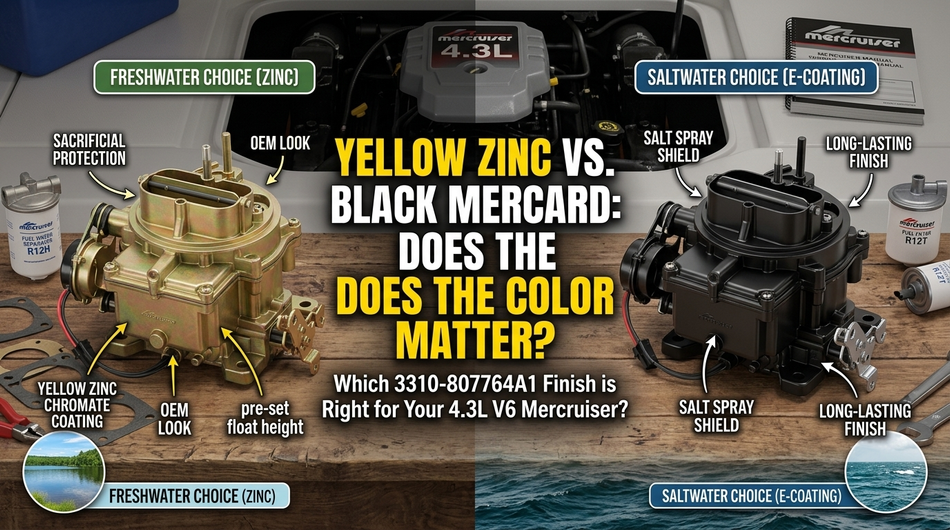
Mercruiser 807764A1 Carburetor: Yellow Zinc vs Black Coating — Which Finish Holds Up Better in Saltwater?
, by iFJF Direct, 6 min reading time
, by iFJF Direct, 6 min reading time

If you have been staring at two 3310-807764A1 Mercarb replacement carburetors — one with a yellow zinc chromate finish, the other in black — wondering if there is a real difference beyond the color, you are not alone. We get this question all the time from Mercruiser 4.3L V6 owners trying to decide which one to bolt onto their intake manifold.
Short answer: they are the exact same carburetor internally. Same venturi size. Same electric choke. Same float bowl. Same jetting. The difference is the external coating — and depending on where you boat, that difference matters more than you might think.
This is a direct OEM-spec replacement for the Rochester 2-barrel Mercarb found on basically every Mercruiser 4.3L V6 from the late 80s through the mid-2000s. It fits the 262ci (4.3L) with the stock intake manifold and comes pre-assembled with an electric choke. No adapter plates, no drilling, no messing with throttle cable brackets. Four bolts, a fuel line, a wiring pigtail for the choke, and you are back on the water.
Both our yellow zinc version and black coated version share identical specs: 2-barrel, 500 CFM rated, electric choke (12V), and factory-set float height at 9/16". Both come with a new base gasket and mounting hardware.
The gold-ish finish is a zinc chromate conversion coating. It has been used on marine carbs since the 1960s. The zinc layer acts as a sacrificial anode — if moisture gets through, the zinc corrodes before the cast aluminum underneath does. This is the same principle behind zinc anodes on your outdrive.
In freshwater, yellow zinc holds up fine for years. The coating is thin, maybe 0.0003", so it does not add any significant thickness to mating surfaces. One thing to know: the yellow tint will fade over time with fuel spillage and heat cycling. That is normal — the protection is still there even when the color looks dull.
The black version uses an electrophoretic deposition coating — think of it as a paint job applied with electrical current, then baked on. It is thicker than zinc chromate (about 0.001" to 0.002") and provides a more complete seal against salt spray and humidity.
For saltwater boats — anything parked in a marina slip or launched off a saltwater ramp — the black coating is the smarter choice. It will not stop corrosion forever, but it buys you noticeably more time before the carb body starts showing white oxidation around the gasket surfaces. The downside: if the coating chips (say from a wrench slip during install), that bare spot is more vulnerable than a scratched zinc-plated surface, because the surrounding coating does not provide sacrificial protection the way zinc does.
| Condition | Recommendation |
|---|---|
| Freshwater only, trailer stored | Yellow zinc — save the $10, coating is plenty |
| Brackish or saltwater use | Black e-coating — extra corrosion resistance is worth it |
| Boat lives in a wet slip | Black — humidity alone will eat a zinc finish over time |
| You care about OEM look | Yellow — matches what Mercruiser shipped from factory |
| Budget is the main factor | Yellow — $227.99 vs $237.99, same carb inside |
No matter which color you pick, the install is the same. Here is what the Mercruiser service manual will not tell you:
Do not just order the carb. Get everything you need in one shot:
Yes. Both the yellow and black versions are wet-flow tested before packaging. The idle mixture screws are preset at 1.5 turns out. You may need a slight tweak for your specific engine, but it will start and run on the factory setting.
No. The 807764A1 is for the 4.3L V6 only. The 5.0L and 5.7L V8 engines use a different Mercarb with larger venturis. Using a V6 carb on a V8 will starve it for fuel at anything above idle.
Maybe. Volvo Penta used the same GM 4.3L block but sometimes used Holley carbs instead of Rochester/Mercarb. Check your existing carb — if it has "Mercarb" cast into the side or a Rochester part number, this will bolt up. If it has "Holley" on the bowl, you need a different replacement.
The heating element inside the choke housing typically lasts 3-5 seasons. It is a wear item — when it fails, the choke stays closed and the engine runs pig-rich. Replacement elements are available separately for about $35.
Probably. Set curb idle to 650-700 RPM in gear (in the water, not on a hose). The idle air bleed is pre-set from the factory but you may need 1/8 to 1/4 turn of adjustment once the engine is at operating temperature.