
R12T Fuel Filter: Replacement, Cross Reference, and Installation Guide
, by iFJF Direct, 19 min reading time
, by iFJF Direct, 19 min reading time

Everything an R12T owner needs in one place: what the 10-micron spin-on fuel-water separator actually does, the M18 × 1.5 thread that decides compatibility, when to replace it, the verified cross-reference numbers, and a step-by-step replacement procedure.
Short answer: the R12T is a 10-micron spin-on fuel-water separator with an M18 × 1.5 centre thread and a rated flow of 15 GPH (57 LPH). It is the common aftermarket replacement for the Racor S3240 / 120AT family, it is disposable and cannot be cleaned, and it should be replaced on your engine maker’s schedule — or immediately if the bowl keeps refilling with water.

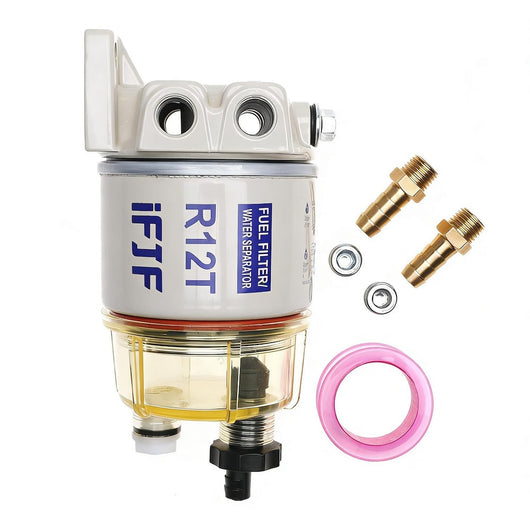
The R12T in one picture: M18 × 1.5 centre thread, NPT ZG1/4-19 ports, a 10-micron spin-on element and a clear bowl for water inspection.
On this page
If you searched for “r12t fuel filter,” you are probably trying to solve one of three problems: the existing fuel-water separator needs to be replaced, you have a Racor S3240 or 120AT head and want to check whether an R12T replacement will fit, or the engine is running poorly and you suspect water or contamination in the fuel. The R12T is a 10-micron spin-on fuel-water separator used across a wide range of marine and small-engine applications. Knowing the thread size, gasket dimensions and related part numbers makes replacement straightforward.
Below we cover the R12T filter itself, how a fuel-water separator removes water and debris, when the filter should be changed, and which commonly referenced part numbers cross over. There is also a step-by-step replacement procedure and a troubleshooting section. Torque values and service intervals vary by engine and filter manufacturer, so check the applicable service manual before doing the job.
The R12T is a spin-on fuel filter and water separator. The disposable canister does two jobs at the same time:
| Specification | Value |
|---|---|
| Type | Spin-on fuel water separator (element + clear bowl) |
| Micron rating | 10 µm (nominal) |
| Rated flow | 15 GPH (approx. 57 LPH) |
| Centre thread | M18 × 1.5 |
| Ports | Four ports — NPT or ZG1/4-19 (BSPP) tapered |
| Typical applications | Marine gasoline inboards/sterndrives, outboard remote filter heads, small diesel engines, generators |
Two specifications are especially important when choosing a replacement. First, a “10-micron” rating in this filter category is generally a nominal rating, and manufacturers may use different test methods. A 10-micron filter from one brand should not be assumed to have the same efficiency as another. Second, check the flow rating. If the separator cannot keep up with the engine’s fuel demand, restriction becomes a problem under load. Compare the filter rating with the engine manufacturer’s requirements before making a substitution.
An R12T-type separator is designed to remove solid contamination and free water before they reach the engine. Knowing what happens inside the separator also makes routine inspection and maintenance easier.
Fuel moves through the filter media, where particles are trapped as the fuel passes through the fibres. Dirt and rust can damage pumps and injectors, so the primary separator provides an important first stage of protection before fuel reaches any finer secondary filter on the engine.
Water can be present as dissolved moisture, larger free droplets, or very small emulsified droplets. A mechanical separator is intended to remove undissolved water. In a typical separator that happens through several steps:
Industry test procedures distinguish between free-water and emulsified-water separation. SAE J1839, for example, is used for coarse or free water removal, while SAE J1488 addresses emulsified water. That distinction matters when comparing published performance figures; a percentage without a stated test method is difficult to evaluate.
Free water causes corrosion, reduces fuel-system lubrication in diesel applications, contributes to ice formation in cold weather, and creates conditions where microbial growth can develop. Regularly draining the bowl is therefore important. Once the collection area becomes full, there is little room left for additional water to separate and settle.
Replacement intervals vary by engine, fuel quality, operating conditions and the filter manufacturer. The figures below are general reference points rather than universal service intervals.
| Application | Typical replacement interval |
|---|---|
| Marine gasoline engines (inboard/sterndrive) | Every 100 hours of operation or annually, whichever comes first |
| Outboards with remote separator | Inspect/drain every trip or every 25 hours; replace the element per the outboard OEM schedule |
| Small diesel engines / generators | Every 200–500 hours per the equipment manual |
Marine conditions shorten filter life. Salt-air exposure, moisture, fuel contamination and long periods of storage all affect the separator. For seasonal boats, many owners replace the filter during spring commissioning even when the hour-based interval has not been reached.
Cross-reference numbers are useful when the original filter is no longer available, but they need to be checked carefully. An R12T is not defined by its brand name — it is defined by its M18 × 1.5 centre thread. Get that one number right and the compatible list is short and unambiguous.
| Reference part number | Description | Relationship to the R12T |
|---|---|---|
| Racor / Parker S3240 | Marine head + bowl assembly | Replaced by the R12T-pattern spin-on |
| Racor 120AT | Complete kit (head + barbs + plugs) | Same head casting as the S3240 |
| Sierra 18-7947 | Replacement element | Direct interchange |
| Sierra 18-7987 | Complete marine separator | Same 10-micron element |
| WIX 33583 (NAPA 3583) | Replacement element | Interchange |
| Baldwin BF1380 · Fleetguard FS19802 | Replacement elements | Interchange |
| AC Delco TP1416 · RK10222 | Element / aftermarket kit number | Interchange |
| Baldwin BF1258 · Fleetguard FF5320 · Donaldson P551313 | 1-14 UN heavy-truck filters | Do not fit — wrong thread |
Replacing an R12T-type spin-on separator is usually a straightforward job with basic tools. The steps below describe a typical remote-mounted marine filter head; the exact procedure can vary by engine and installation.
| Symptom | Likely cause | Fix |
|---|---|---|
| Hard starting after replacement | Air lock — system not bled, or pre-fill skipped | Re-prime 15–20 strokes / cycle the lift pump; re-crank |
| Leak at the base of the canister | Cross-threaded installation, damaged gasket, or over/under-torque | Remove, inspect threads and gasket seat, reinstall correctly |
| Engine dies at speed but restarts later | Clogged element restricting flow under load | Replace the element; sample tank fuel for contamination |
| Water keeps reappearing in the bowl | Ongoing ingress: leaking tank cap, condensation from a half-empty tank in humid weather, or a bad fuel source | Drain, trace the source, treat with a fuel biocide if microbial growth is suspected |
| Rough idle / power loss with the bowl drained | Element media collapsed or clogged beyond the service limit | Replace immediately; avoid over-tightening on the next install |
| Repeat failures every few weeks | Bypassing a contamination problem — sludge stirred up by ethanol gasoline cleaning the tank, or diesel bug | Clean the tank; shorten the inspection interval; address the fuel source |
One problem that is easy to miss is air entering the system on the suction side. A small leak at a fitting or gasket may draw air inward without producing an obvious fuel leak, leading to hard starting or rough running. If those symptoms appear after a filter change, check the hose connections, fittings, gasket and drain valve. Also keep up with bowl draining so collected water does not remain in the separator — see our guide to draining and maintaining an R12T fuel-water separator.
Many aftermarket R12T filters are sold as replacements for applications associated with the S3240 / 120AT family. That does not mean every R12T listing is identical. Check the centre thread, gasket dimensions, port configuration and overall dimensions before ordering. An aftermarket R12T is not an original Racor part.
There is no universal interval for every engine. A commonly cited marine service practice is annual replacement or replacement by operating hours, together with regular inspection and draining. Use the engine and filter manufacturer’s published schedule when it differs.
Use the micron rating specified by the engine or fuel-system manufacturer. A 10-micron separator is common in many marine applications, but the correct choice depends on the system. A finer element increases restriction, while a coarser element provides less protection.
R12T-pattern filters are commonly used in marine gasoline and small-engine applications, and many listings also target diesel systems. Diesel installations can have different requirements for flow, water separation, bowl construction and fire safety. Check the engine and installation requirements rather than assuming a match.
No. Spin-on separators are disposable. The media loads up with contaminant and the water-stripping surface degrades; cleaning cannot restore either. Replace it.
A small amount of water can appear depending on fuel quality, storage conditions and moisture exposure. If a large amount returns after draining, look for a source of water entry, such as the tank fill, vent or contaminated fuel.
The R12T is a straightforward spin-on fuel-water separator, but choosing the right replacement still requires care. Check the thread, gasket, port configuration, micron rating and flow requirements rather than relying on the part number alone. During installation, follow the filter and engine manufacturer’s procedure, prime the system correctly, and inspect for leaks before returning the boat or equipment to normal operation.
Still deciding between the kit, the element and the bowl? Our R12T Buying Guide compares the complete kit against the options and shows what is included in each box, so you can match the right configuration to your engine before you order.
Not sure which R12T replacement fits your engine?
The iFJF R12T fuel filter water separator combo kit is a 10-micron spin-on filter rated 15 GPH with NPT ZG1/4-19 ports — a direct replacement for Racor S3240 and 120AT. It ships with the aluminium filter head, clear water bowl, four brass fittings and two port plugs. Compare the dimensions and part numbers on the R12T product page to confirm the fit before ordering.
Ships from the US · browse all marine fuel water separators
Related reading
Part numbers from Racor/Parker, Sierra, WIX, Baldwin, Fleetguard, AC Delco, Honda, Suzuki and Mallory are used solely for cross-reference identification. Aftermarket replacement filters described here as “replacement,” “interchange” or “replaces” are not genuine or OEM products of those manufacturers.
 Fuel Filter Assembly for 1992-2002 Chevy GMC 6.5L Diesel — Suburban Tahoe Silverado Sierra Yukon Hummer H1 — Replaces 10226035
$177.99
Fuel Filter Assembly for 1992-2002 Chevy GMC 6.5L Diesel — Suburban Tahoe Silverado Sierra Yukon Hummer H1 — Replaces 10226035
$177.99
 FS1098 Fuel Water Separator w/ PCV for Cummins B6.7 ISL8.9 — 10 Micron
$79.99
FS1098 Fuel Water Separator w/ PCV for Cummins B6.7 ISL8.9 — 10 Micron
$79.99
 68394482AA Water Separator for 2014-2018 Ram 1500 3.0L EcoDiesel
$489.73
68394482AA Water Separator for 2014-2018 Ram 1500 3.0L EcoDiesel
$489.73
 FS20081 Fuel Water Separator for EPA 2017 Cummins ISX15 X15
$47.99
FS20081 Fuel Water Separator for EPA 2017 Cummins ISX15 X15
$47.99