
R12T vs R12H Fuel Water Separator: Real Customer Review (20K+ Views) + Installation Guide
, by iFJF Direct, 13 min reading time
, by iFJF Direct, 13 min reading time

A real iFJF customer's 20,000-view YouTube review of the R12T fuel water separator — installed on a 1978 Jeep in under 10 minutes. Full walkthrough, R12T vs R12H comparison, installation pro tips, and why both diesel and gas engines benefit from a fuel water separator.
One of our customers just dropped a 20,000-view review of the iFJF R12T fuel water separator — and it's one of the most honest, practical walkthroughs we've ever seen. No script, no studio lighting, just a guy in his garage tackling a real problem: water in his carburetor on a 1978 Jeep that he was tired of fighting.
📊 Related: See the full picture — our best water separator fuel filter buying guide ranks the Top 5 filters of 2026 including the R12T.
What makes this review special isn't the production value — it's the fact that he installed it on a gasoline engine, tested it, and proved what we've been saying all along: the R12T/R12H platform works on anything that burns fuel and might have water in it. Diesel trucks, marine boats, old Jeeps, tractors, generators — if it has a fuel tank, this unit belongs in the line.
Here's the full breakdown: what he discovered unboxing, how he installed it in under 10 minutes, and why the upgraded R12H version saves you even more money long-term.
When the R12T arrived, the first thing he noticed was the packaging: nicely wrapped in foam, no rattling, no damage. Inside, you get the complete kit — aluminum housing, filter element, water collection bowl, fittings, plugs, O-rings, and even business cards.
His first impression of the unit itself:
"It's got a really nice aluminum housing with what appeared to be a very fine pleated filter and a water cap for separating the water out."
Here's exactly what comes in both the R12T and R12H kits:
| Component | R12T (Classic) | R12H (Upgrade) |
| Aluminum Housing | ✅ Sealed unit | ✅ Detachable base |
| Filter Element | 1 (non-removable) | 3 cartridges (1 installed + 2 spares) |
| O-Rings | 2 | 4 (2 installed + 2 spares) |
| Fittings | 2 × NPT/ZG1/4-19 | 2 × NPT/ZG1/4-19 |
| Plugs | 2 | 2 |
| Water Drain Bowl | ✅ Transparent nylon | ✅ Transparent nylon |
| Replacement Cost | Replace entire housing | Cartridge only (~60% cheaper) |
This is the #1 question we get. Here's the short answer:
Bottom line: If you're running a boat, fleet truck, or equipment that sees regular service, buy the R12H. If you're a once-a-year recreational user, the R12T is perfectly fine. Both filter down to 10 microns at 15 GPH — the filtration performance is identical.
The video walkthrough surfaced several pro-level tips that you won't find in generic instruction manuals. Here's what the 20K-view reviewer wants you to know:
This was his #1 emphasis point — and he's absolutely right:
"What you want to do after you unbox this is to lube these O-rings. I like to use O-ring lubricant, you could also use motor oil. O-ring lubricant seems to work better for me, but do not put it together dry."
A dry O-ring will bind, tear, and leak. A light coat of O-ring grease or clean motor oil ensures a smooth seal and makes future disassembly possible by hand. Skip this step and you'll be fighting it with tools next service.
"You don't want to over-tighten things, as you'll never get it back apart by hand."
The O-ring does the sealing, not brute force. Hand-tight plus a quarter turn is all you need. Overtightening deforms the O-ring, crushes the threads, and turns a 5-minute filter swap into a wrestling match.
Before you screw in any fittings or plugs, physically position the unit on your vehicle. Know where your fuel-in and fuel-out lines will connect, then decide:
He opted to plug two ports and use the other two for flow-through — one side in, one side out. Simple, clean routing.
For the NPT fittings, thread sealant (Teflon tape or paste) is mandatory. NPT threads are tapered — they need sealant to make a fuel-tight connection. Skip this and you'll have a slow weep that attracts dirt and eventually leaks.
This might be the most time-saving tip in the entire video:
"The instructions say to fill this filter up with fuel. I'm gonna do it before I put it on a vehicle so I don't have to struggle getting a fuel filter off and then fighting it back underneath there and spilling it everywhere."
Fill the housing on the bench, not under the truck. You'll avoid air-lock on startup, prevent fuel spills, and save yourself a frustrating 15 minutes of priming. If you're installing on a boat or tight engine bay, this tip alone is gold.
Here's where this review gets really interesting. The R12T/R12H was originally designed for diesel fuel systems — marine diesel, truck diesel, generator diesel. But this customer installed it on his 1978 Jeep with a gasoline carbureted engine because he was fighting water contamination:
"I believe they designed this for diesel engines, but it'll certainly work on gasoline. It'll work on anything with fuel that had water in it."
And he's right. The 10-micron filter media and water-separating coalescer element don't care whether the fuel is diesel, gas, or kerosene. If there's water in your tank, this unit strips it out.
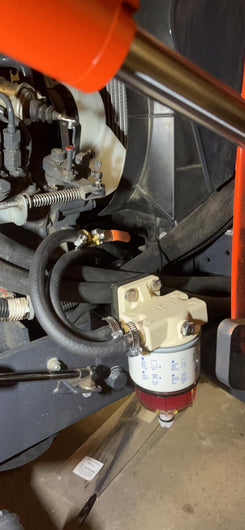
This also means the R12H platform works for:

Click image to view full size
Speaking of tractors — we've seen Kubota BX series owners adopt the R12H for their compact diesels. Small engine bays, tight clearances, and the constant threat of condensation in stored fuel make a fuel water separator essential equipment. The transparent bowl lets you see water accumulation at a glance — no guesswork, no pulling the filter to check.
In the follow-up segment, he shows the completed install. Total time: about 10 minutes. He chose to rivet the mounting bracket to the frame rather than use nuts and bolts:
"I chose to rivet it so I didn't have to try to reach around and put some nuts on the back of the bolts. Some people bolt it, some people rivet it. But there you go. Took about 10 minutes to install it, very simple job."
He also added a drain hose extension to the water drain valve — a smart addition that routes any drained water away from the vehicle instead of dripping onto the frame or engine components.
This review didn't come from us. It came from a paying customer who bought the R12T on Amazon, installed it on his personal vehicle, and filmed the whole process — unscripted, unsponsored, and genuinely useful. When a product earns a 20,000-view walkthrough from a real user, that tells you something about how well it works.
Key takeaways from his experience:
A: Both use the same NPT/ZG1/4-19 port size and mounting pattern. The R12H is the newer version with replaceable cartridges. If you already have an R12T, you can upgrade to R12H — same mounting, better long-term value. Compatible with Racor S3240 and Sierra 120AT filter systems.
A: Yes — diesel or gas. The R12T/R12H is designed as a pre-filter/water separator. Install it between your fuel tank and the factory fuel filter for maximum protection. Popular on Ram Cummins, Ford Powerstroke, and GM Duramax platforms as an auxiliary filter.
A: Two signs: (1) the engine hesitates or loses power under load (restriction), (2) the transparent bowl shows visible sediment or water that doesn't drain clear. Replace every 100 hours of operation or annually — whichever comes first.
A: If you can use a drill, a wrench, and Teflon tape, you can install this. No welding, no fuel line flaring, no special tools. The video reviewer did it in 10 minutes — and he was filming at the same time.
A: The engine will crank longer while the fuel pump fills the empty housing. For mechanical fuel pumps (like on older Jeeps and tractors), this can take 30+ seconds of cranking. Pre-filling eliminates this entirely. For electric pump systems, it's less critical but still recommended to avoid air in the lines.
The R12H Complete Combo Kit includes everything you need — aluminum housing, 3 filter elements (1 installed + 2 spare), O-rings, fittings, plugs, and installation instructions. One purchase covers your next three service intervals.
20,000 viewers can't be wrong. Protect your engine from water-contaminated fuel — whether it's a marine diesel, a farm tractor, a classic Jeep, or a heavy-duty truck. The iFJF R12T/R12H platform does the job, and does it for a fraction of what the marine brands charge.
Shop R12H Fuel Water Separator — $39.99
Includes 3 filter cartridges, fittings, plugs & O-rings | Replaces S3240 • 120AT • 18-7987 • RK10222 • R12T
🔬 See also: How does the R12T compare to the OEM? Read our R12T vs Genuine Racor 120AT comparison for a detailed tear-down.
🔧 Related: Need step-by-step mounting instructions? Our R12T installation guide covers everything from bracket placement to priming.
 Fuel Filter Assembly for 1992-2002 Chevy GMC 6.5L Diesel — Suburban Tahoe Silverado Sierra Yukon Hummer H1 — Replaces 10226035
$177.99
Fuel Filter Assembly for 1992-2002 Chevy GMC 6.5L Diesel — Suburban Tahoe Silverado Sierra Yukon Hummer H1 — Replaces 10226035
$177.99
 FS1098 Fuel Water Separator w/ PCV for Cummins B6.7 ISL8.9 — 10 Micron
$79.99
FS1098 Fuel Water Separator w/ PCV for Cummins B6.7 ISL8.9 — 10 Micron
$79.99
 68394482AA Water Separator for 2014-2018 Ram 1500 3.0L EcoDiesel
$489.73
68394482AA Water Separator for 2014-2018 Ram 1500 3.0L EcoDiesel
$489.73
 FS20081 Fuel Water Separator for EPA 2017 Cummins ISX15 X15
$47.99
FS20081 Fuel Water Separator for EPA 2017 Cummins ISX15 X15
$47.99