
How Often Should You Drain a Fuel-Water Separator? The R12T Draining, Maintenance & Water-Diagnosis Guide
, by iFJF Direct, 17 min reading time
, by iFJF Direct, 17 min reading time

How often to drain an R12T fuel-water separator, how to read the collection bowl, how to spot diesel bug, how to chase the air leaks a half-closed drain valve creates, and the ABYC / USCG rules that apply when you open that valve on a boat.
Nobody loses an engine to the water they can see. They lose it to the water that sat in the collection bowl for three months because nobody looked — or to the dissolved water that no filter on earth can pull out, quietly corroding a lift pump from the inside.
This guide covers the half of fuel-water separator ownership that most write-ups skip: how often to drain, how to read what the bowl is telling you, how to spot diesel bug before it spreads through the tank, how to chase the air leaks a half-closed drain valve creates, and the legal rules that apply the moment you open that valve on a boat. Fitting the unit is the easy part — if you haven't done that yet, start with our R12T installation guide, then come back here.

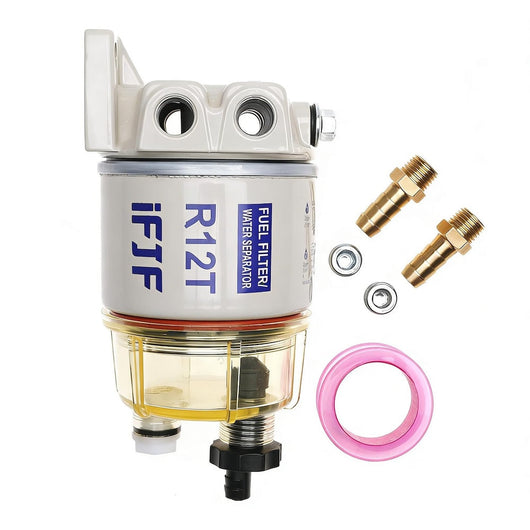
The R12T: anodized aluminium head, 10-micron spin-on element and a clear nylon bowl with a self-venting drain at the base. The bowl is the part that tells you what's happening in your fuel.
This is the part that gets marketed past, and it matters because it tells you exactly what your draining routine can and cannot accomplish.
Water in fuel exists in three states, and a mechanical separator only touches two of them:
So when a separator claims "99% water removal," that number applies to free and emulsified water only — and only while somebody is actually emptying the bowl. Treat any "100% water removal" claim as a marketing statement, not a specification.
As a reference point for how much is hiding in there: petroleum diesel typically holds up to 100–200 ppm of dissolved water even when it looks perfectly clear, and biodiesel can hold 1,500–3,000 ppm. That's not a defect — it's chemistry, and it's why draining is a habit rather than a milestone.
There is no single universal interval, which is why every answer you find online disagrees. The honest answer: drain on inspection, and inspect far more often than any published schedule suggests.
| Situation | Drain at this frequency |
|---|---|
| Default for everyone | Look at the bowl before every outing or every refuel — drain the moment you see a water interface. This beats every calendar schedule. |
| Volvo Penta D-series diesel propulsion | Every 50 hours, and at least once every 12 months |
| Volvo Penta 31-series | Every 14 days |
| Gasoline outboard with an external 10-micron separator | Every 50 hours, or immediately after taking on a bad tank of fuel |
| Severe service: E10 or biodiesel, mixed fuel sources, humid or salty air, big temperature swings, long idle or long storage | Shorten it — every return to port if that's what it takes |
Notice the spread: official schedules from major diesel builders run from every 14 days to every 50 hours to every 12 months, depending on the engine line. That's a 25× difference between manufacturers for functionally similar hardware. Use your engine builder's number as a floor, not a ceiling.
One more thing worth saying out loud: a separator bowl holds roughly 110 ml (3.7 oz) in this product class. That is not a lot of water. Once it's full, the separator stops collecting — and on some designs collected water can find its way back into the fuel path. A full bowl isn't a bigger buffer; it's a failure state.

Clear nylon bowl with the self-venting drain. A distinct interface line near the base is water; black specks or slime on the wall mean something else entirely.
The clear nylon bowl is a diagnostic instrument, not just a container. Here's what the different appearances actually mean:
If you want to test the fuel itself rather than the bowl, draw about 200 ml from the tank's low-point drain into a clear glass jar, let it stand for a few minutes, and read the layers from the bottom up.

Bottom view: the self-venting drain. Loosen it to discharge, tighten it fully to seal — and then check it a second time, because "looks closed" and "is closed" are different things.
If your bowl fills unusually quickly, one of these is almost certainly the reason:
"Diesel bug" is a microbial community — bacteria and fungi — that lives at the boundary between the water layer and the fuel. It needs water to survive, which means it only exists where your separator failed to keep the water out of the tank.
What it does, in order of how much it costs you:
How to deal with it: draining alone won't fix an established infestation — you're removing its habitat's symptoms, not the colony. You need to break the water supply (drain and dry the tank), treat the fuel with a diesel biocide dosed to the tank volume, and then change the filter element after the treatment has had time to circulate, because the dead biomass will load the media. In persistent cases, the tank needs to be cleaned rather than treated.
The preventive version is much cheaper: keep the water layer out of the tank in the first place, which is precisely what a properly drained separator does.

On the suction side, every joint you touched during a drain or element change is a potential air path. A leak here pulls air in without ever leaving a fuel drip.
You can do everything right with the drain and still create a problem, because the suction side of a fuel system is unforgiving: a leak there can pull air in without ever showing a fuel drip on the outside.
The usual suspects, all of them things you touched during a drain or element change:
The symptom set is distinctive: long cranking after the engine has sat overnight, rough running for the first minute, then fine once it's running. Fuel drains back to the tank overnight through the offending joint, and the first start of the day is spent refilling the system.
The fix that beats guessing: fit a vacuum gauge on the suction side and record the reading on a clean element. A comparable unit in this class reads roughly 0.3 PSI (1.7 kPa) clean. Keep that number. If the reading creeps up over time, your element is loading. If it stays low but starting gets hard, you have an air leak, not a clog — and you now know which to chase. Never let suction lift exceed 4 inHg.
If you own a boat, this section matters as much as the mechanical advice.
None of this is decoration. A fire on a boat from a $30 filter installed in the wrong place is a real claim scenario, and the requirements above are what the surveyor and the insurer will look at.
| Interval | Action |
|---|---|
| Every outing / refuel | Inspect the bowl; drain on sight of a water interface. Eyes on every hose connection in the bay. |
| Monthly | Check the head and bowl for corrosion spots; confirm the drain valve seats fully every time. Sample the fuel if anything looks off. |
| Every 100–250 hours, or annually | Replace the filter element — whichever limit arrives first. On a low-hour engine, media adhesives and elastomers still age on the calendar. |
| Annually | Inspect all hoses for cracking; re-check every fitting; replace the bowl O-ring. Vacuum-test the suction side. |
| After any contaminated fuel event | Replace the element immediately. A loaded element that's been through a water slug can shed what it caught back into the fuel path. |
Never reinstall a used element after dumping it out. Pouring fuel back through the can flushes captured water and contaminants onto the clean side — directly into your injection system.
No. Stop the engine, let it cool, ventilate the space, and drain into an approved container. You are opening a fuel system, and a partially-closed drain afterwards is a classic source of suction-side air ingestion.
Either you're taking on genuinely wet fuel, or condensation is outpacing your routine. Start by sampling the tank at the low-point drain. If the tank is clean and the bowl still fills, check whether the tank is being stored partly empty in a humid climate, and whether you're running E10 — both accelerate accumulation dramatically.
Probably not — dirt and rust settle as discrete particles. A dark film, black specks, or slime on the bowl wall is far more likely to be microbial growth. Draining helps, but established diesel bug needs a biocide treatment plus a tank clean, and the element replaced afterwards.
No. Micron rating governs particle capture, not water. Going finer increases differential pressure, reduces dirt-holding capacity and shortens service intervals — it does not address dissolved water, which no mechanical filter removes.
Baseline your vacuum gauge on a clean element and watch the trend. Rising vacuum under load is a loading element. Hard starting with low vacuum is an air leak. Those are different problems with different fixes, and the gauge is what separates them.
You need to look, always. Diesel water layers can be faint and the interface line easy to miss through a cloudy bowl. Inspect it, and drain on sight — the cost of looking is a few seconds; the cost of not looking is the failure mode this entire guide exists to prevent.
Everything needed for a first-stage water separator: 10-micron spin-on element, anodized aluminium head with NPT ZG1/4-19 ports, clear nylon collection bowl with self-venting drain, brass fittings and port plugs. Direct replacement for Racor 120AT / S3240 and Sierra 18-7947-type applications.
Shop the R12T Kit →Still deciding on the right configuration, or matching a separator to a specific engine? Send us the engine details and our team will confirm the correct element and thread standard before you order.
Always follow your engine manufacturer's service manual for maintenance intervals and procedures. Part numbers are provided for cross-reference only — verify compatibility with your specific engine before purchase.
 Fuel Filter Assembly for 1992-2002 Chevy GMC 6.5L Diesel — Suburban Tahoe Silverado Sierra Yukon Hummer H1 — Replaces 10226035
$177.99
Fuel Filter Assembly for 1992-2002 Chevy GMC 6.5L Diesel — Suburban Tahoe Silverado Sierra Yukon Hummer H1 — Replaces 10226035
$177.99
 FS1098 Fuel Water Separator w/ PCV for Cummins B6.7 ISL8.9 — 10 Micron
$79.99
FS1098 Fuel Water Separator w/ PCV for Cummins B6.7 ISL8.9 — 10 Micron
$79.99
 68394482AA Water Separator for 2014-2018 Ram 1500 3.0L EcoDiesel
$489.73
68394482AA Water Separator for 2014-2018 Ram 1500 3.0L EcoDiesel
$489.73
 FS20081 Fuel Water Separator for EPA 2017 Cummins ISX15 X15
$47.99
FS20081 Fuel Water Separator for EPA 2017 Cummins ISX15 X15
$47.99