
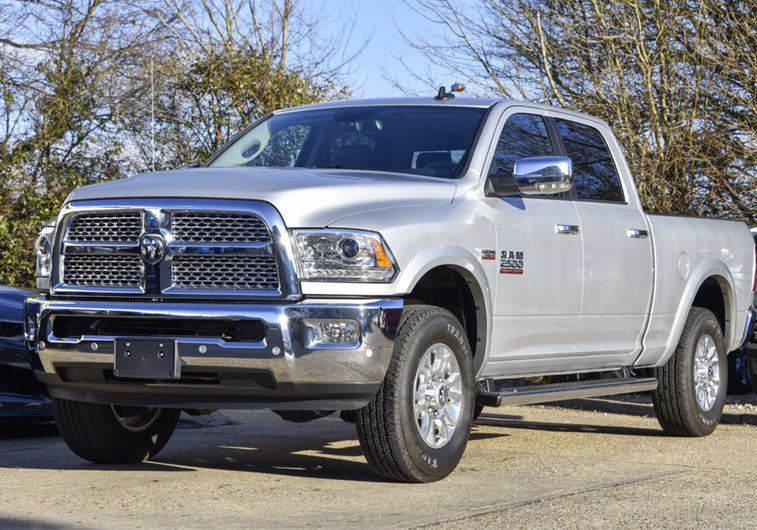
High-Performance Fuel Filters: Are They Worth the Upgrade for Your Diesel?
, by William Lee, 8 min reading time
, by William Lee, 8 min reading time

Updated: June 12, 2026
Factory fuel filters are adequate. They meet the minimum spec required to get your truck through the warranty period — typically 10-micron nominal filtration with basic cellulose media. For a stock daily driver on a normal maintenance schedule, that's... fine.
But if you've invested in your diesel — a tune, bigger injectors, a turbo upgrade — or if you simply plan to keep your truck past 200,000 miles, "adequate" isn't good enough. This is where high-performance fuel filters enter the conversation.
Here's what makes a filter "high performance," whether the upgrade is worth your money, and which platforms benefit most.
Walk into any parts store and you'll see filters labeled "premium," "heavy-duty," and "high-performance." Most of it is marketing. Here's what actually matters:
This is the difference between "trust me" and "trust the data."
OEM filters are typically 10-micron nominal. A true high-performance filter delivers 5-micron absolute or better. The difference in particle capture between 10-micron nominal and 5-micron absolute is measured in orders of magnitude, not percentages.
Cheap filters use 100% cellulose (paper). It's fine for capturing larger particles, but it has three fatal flaws for performance applications:
Synthetic media (micro-glass fibers) solves all three: consistent flow rate throughout the service interval, no cold-weather thickening, and natural hydrophobicity for better water separation.
Composite media — the approach iFJF uses — blends cellulose for dirt-holding capacity with synthetic fibers for fine filtration and durability. You get 5-micron absolute performance at a price closer to standard cellulose filters.
Tuned engines demand more fuel. A stock 6.7L Cummins flows roughly 40–50 gallons per hour at wide-open throttle. Add a 100HP tune and larger injectors, and that number climbs to 70+ GPH. A filter that flows fine at 50 GPH may create a pressure drop at 70 GPH — and the CP4.2 pump, already starved for lubrication, starts sucking against a restriction.
High-performance filters are rated for higher flow rates and higher burst pressures. Look for published GPH and PSI ratings — if the manufacturer doesn't publish them, they're not testing to performance standards.
The CP4.2 in Ford trucks has the worst reputation, and for good reason: it shares the same fundamental design as the Ram pump but runs at higher duty cycles due to Ford's more aggressive tuning. Powerstroke owners also tend to tune more aggressively than Cummins owners.
Recommendation: If you're running any tune on a 6.7L Powerstroke, upgrade to a 5-micron absolute fuel filter set. The iFJF 5-Micron Conversion Kit replaces the factory filter with an all-metal housing and 5-micron element. For stock trucks, composite media filters offer a meaningful improvement without the full conversion cost.
The 2019+ Ram Cummins uses the CP4.2 pump (earlier 2013–2018 trucks used the more robust CP3). 2019+ trucks should be treated with the same filter paranoia as Powerstrokes — the failure mode is identical, and the repair bill is the same.
Recommendation: Minimum 5-micron absolute filtration. Replace the frame-rail water separator at every engine-bay filter change, not every other. If you tow heavy or run a tune, add a lift pump with its own pre-filter (FASS or AirDog) to take load off the CP4.2.
The L5P Duramax uses the Denso HP4 pump, which has proven more robust than the CP4.2. However, the L5P's factory fuel filter housing cap is plastic — and at 30,000+ PSI fuel system pressures, a cracked housing cap is a known failure point.
Recommendation: Replace the factory plastic cap with a billet aluminum cap (iFJF 134001) before worrying about filter media upgrades. The cap addresses a more immediate failure risk. Once upgraded, move to a 5-micron filter element for long-term injector protection.
Let's run the numbers on a 6.7L Powerstroke owner who keeps the truck from 50,000 to 200,000 miles:
| Scenario | Cost Over 150,000 Miles | Risk of CP4 Failure |
|---|---|---|
| OEM filters, 15K interval | $440 (10 filter changes × $22/filter × 2 filters) | ~5–8% (industry estimates) |
| High-performance, 10K interval | $525 (15 changes × $18/filter × 2 filters, bulk 3-pack) | ~1–2% |
Difference: $85 more over the life of the truck — literally 0.6% of one CP4.2 repair. And you get 5-micron absolute filtration for all 150,000 miles instead of 10-micron nominal.
If the high-performance filters prevent even one injector set replacement at 120,000 miles (a common milestone for CP4.2-equipped trucks), the savings are $3,200 on a Cummins, $4,000+ on a Powerstroke. That's not "is it worth it" territory. That's "why wouldn't you" territory.
Fleetguard, Baldwin, and Donaldson dominate the heavy-duty filter market — and for good reason. They make excellent products. But their pricing reflects decades of brand equity, not necessarily superior filtration.
When evaluating alternatives to the big three, look for:
iFJF filters are manufactured in ISO 9001-certified facilities and publish all specifications — micron rating, media type, flow rate, and OEM cross-reference — on product pages and packaging. You shouldn't have to guess what you're putting on your $60,000 truck.
High-performance filters aren't always the right call:
A high-performance fuel filter costs $3–5 more per change than an OEM equivalent. Over the life of your truck, that adds up to roughly $85–150 in extra spending — against $8,000–$15,000 in potential CP4.2 repair costs. That's a return on investment that would make any financial advisor weep with joy.
For modern common-rail diesels — especially CP4.2-equipped trucks — upgrading your fuel filtration is the single highest-ROI maintenance decision you'll make. The math is simple, and the consequences of getting it wrong are devastating.
Shop our 5-micron absolute fuel filter collection. Filters for every major diesel platform with published specifications and OEM cross-reference numbers. Bulk and fleet pricing available.
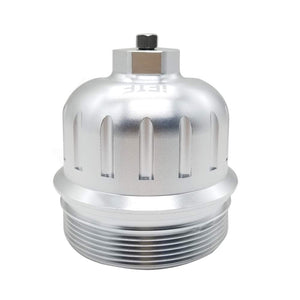 134001 Fuel Filter Housing Cap for 6.6L Duramax L5P 2017-2023 | iFJF
$69.99
134001 Fuel Filter Housing Cap for 6.6L Duramax L5P 2017-2023 | iFJF
$69.99
 Fuel Filter Assembly for 1992-2002 Chevy GMC 6.5L Diesel — Suburban Tahoe Silverado Sierra Yukon Hummer H1 — Replaces 10226035
$177.99
Fuel Filter Assembly for 1992-2002 Chevy GMC 6.5L Diesel — Suburban Tahoe Silverado Sierra Yukon Hummer H1 — Replaces 10226035
$177.99
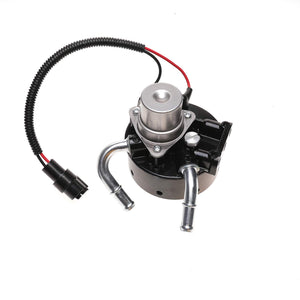 12642623 Fuel Filter Head + 1R-0750 Refit for 2005-2016 Duramax 6.6L
$87.99
12642623 Fuel Filter Head + 1R-0750 Refit for 2005-2016 Duramax 6.6L
$87.99
 FS1098 Fuel Water Separator w/ PCV for Cummins B6.7 ISL8.9 — 10 Micron
$79.99
FS1098 Fuel Water Separator w/ PCV for Cummins B6.7 ISL8.9 — 10 Micron
$79.99