
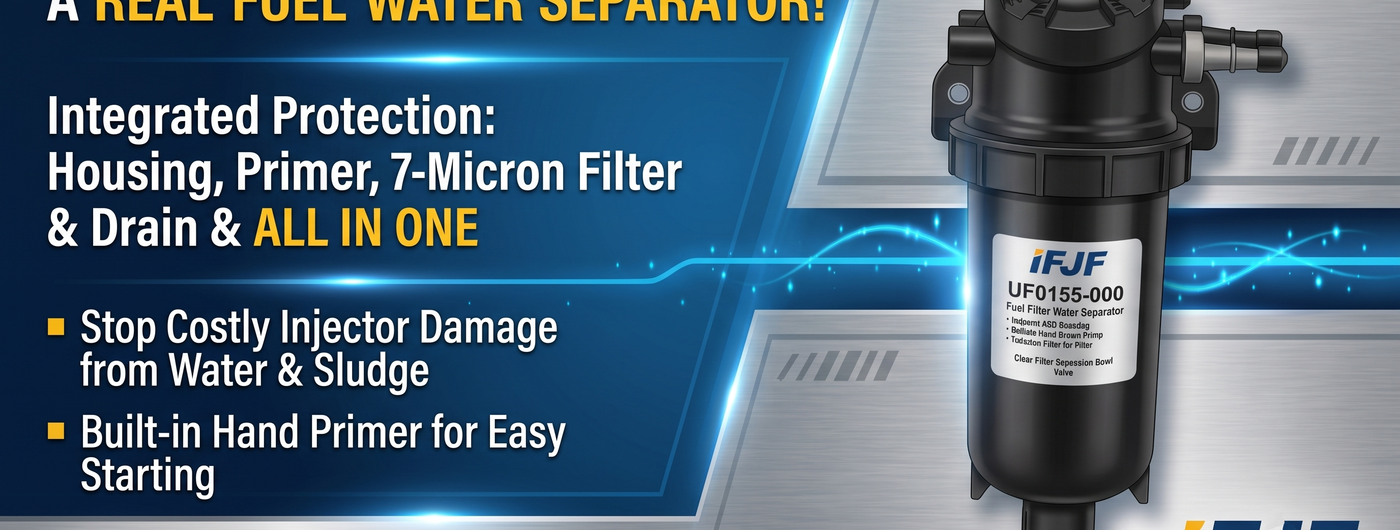
UF0155-000 Diesel Fuel Filter Water Separator Install: ABS Housing + Hand Pump for Truck & Marine Engines
, by iFJF Direct, 7 min reading time
, by iFJF Direct, 7 min reading time

Modern diesel fuel is garbage. Low-sulfur diesel absorbs water faster than the old stuff. Biodiesel blends break down in storage. Fill up at a sketchy truck stop or run off a transfer tank that's been sitting for six months and you're pumping water, algae, and sediment straight into your injection system. On a common-rail diesel, injector tips run at 30,000+ psi. A single water droplet hitting that tip at injection pressure pits the metal. Tolerances are in microns. Pitted tips spray crooked. Crooked spray means incomplete burn, washed cylinders, fuel in the oil.
That's the long way of saying: you need a real fuel water separator between your tank and your injection pump. The UF0155-000 Fuel Filter Water Separator is a complete assembly — housing, 7-micron element, hand primer pump, and water drain — in one unit. No piecing together a Racor head, a separate element, and a remote primer.
The UF0155-000 is sized for mid-range diesel engines — think 2.5L to 7L displacement range. Common applications:
If you're fitting this to a diesel filter system, the ABS housing pairs well with both steel and aluminum fuel tanks — no dissimilar metal problems.
Mount it between the tank and the lift pump/injection pump. On a truck, frame rail inside the driver's side is standard — protected from road debris, easy to reach for filter changes. On a boat, transom or engine compartment bulkhead, above bilge water. Vertical mount, bowl down — gravity does the water separation work.
Leave enough room above the housing that you can unscrew the filter cap with a strap wrench during filter changes. About 8 inches of clearance is comfortable.
The housing comes with a metal mounting bracket. On a frame rail, drill two 5/16" holes and use grade-8 bolts with lock nuts. On fiberglass, use stainless screws with backing washers. The bracket holds the housing by its neck — tighten the clamp bolt until the housing doesn't rotate by hand, then stop. Over-tightening can crack the ABS neck.
The ports are M16x1.5 metric thread. Most aftermarket fittings for this thread pattern are available — or reuse the banjo bolts from your old filter housing if they thread in correctly. Intake port (marked "IN" or from tank) and output port (marked "OUT" or to engine). Double-clamp all connections. Use diesel-rated hose — SAE J30R9 for high-pressure side, J30R7 for the suction side.
This is the part that saves you 20 minutes versus a Racor-style housing. Unscrew the primer pump knob on top of the housing. Pump it — you'll feel resistance build as fuel fills the housing and pushes air out through the return line. Pump until firm. Screw the knob back down to seal. No need for an electric lift pump to prime, no need to crank the engine with the injector lines cracked.
Crank the engine. It should fire within 2-3 seconds if you primed properly. Let it idle for two minutes. Shut it down. Check every fitting — paper towel test. If any fitting weeps fuel, tighten it. If the housing cap weeps, the O-ring might have shifted during install — unscrew, check, reseat.
Drain the water bowl every oil change. Crack the drain valve on the bottom of the bowl into a clear jar. If you see water — and you probably will — let it drain until it runs clean fuel. Dispose of the water-fuel mix properly. Not in the dirt.
Change the filter element every 15,000 miles or 250 hours. Sooner if you run biodiesel or fuel from transfer tanks. A loaded 7-micron filter creates vacuum on the injection pump inlet — your lift pump has to pull harder, runs hotter, fails earlier. A $12 filter element beats a $900 injection pump reseal.
Watch for these warning signs: Hard starting after the truck sits overnight (air in the fuel system). Loss of power under load (restricted fuel flow). Engine surging at idle (water in the injection system). Black smoke under acceleration (poor atomization from fouled injectors).
The built-in hand pump isn't just for the initial install. Any time you open the fuel system — filter change, injector work, replacing a fuel line — you need to prime before cranking. Cranking a diesel with air in the lines to bleed it is hard on the starter and the batteries. Ten pumps on the primer knob takes 30 seconds and saves your starter motor.
If the primer pump won't build pressure, check two things: first, that the primer knob is fully unscrewed (it has to be up to pump). Second, that your tank vent isn't clogged — a vacuum in the tank will fight the primer. Mud dauber nests in tank vents are surprisingly common.
The UF0155-000 crosses to a bunch of OEM numbers. Here are the ones you'll actually see in parts catalogs:
Filter element alone: look for cross-references to the UF0155 element series. Standard 7-micron cellulose media. If you need a different micron rating, check our diesel fuel separator guide for 10-micron options. For marine applications, see our R12T marine fuel water separator guide.
Q: Can I run this on a common-rail diesel like a Duramax or Cummins?
A: The 7-micron rating is borderline for modern common-rail systems that spec 2-5 micron filtration. This is better as a primary (pre-filter/water separator) with a 2-micron secondary filter at the engine. For a mechanical injection diesel — VE pump, inline pump, P7100 — this is fine as the only filter.
Q: The hand pump won't build pressure. What now?
A: Check that the primer knob is completely unscrewed (it's a push-pull pump, and the knob has to be in the "up" position). Check your tank vent isn't blocked. Check that the fuel lines aren't kinked between the tank and the housing. If all that's good, the internal check valve in the primer may have stuck from sitting dry — sometimes pumping it hard 10-15 times frees it.
Q: Can I mount this on the engine itself?
A: I wouldn't. Engine vibration shakes the water droplets back into suspension instead of letting them settle in the bowl. Mount it on the frame or bulkhead where it's isolated from direct engine vibration.
Q: ABS housing — will it melt near the exhaust?
A: ABS softens around 220°F. If your mounting spot is hot enough to melt ABS, your fuel would be boiling too. Just don't mount it 2 inches from the turbo downpipe and you're fine.
Q: Can I use this as a gas filter for an outboard?
A: The housing and seals are rated for both diesel and gasoline. At 7 microns, it's tighter than most marine gas filters (typically 10 microns). Works fine for outboards — just make sure your fuel pump can pull through a 7-micron element without excessive vacuum.
Browse more Fuel Filters & Filtration at iFJF Direct.