R12T Fuel Filter Water Separator Kit - 120 AT NPT ZG1/4-19 with Fittings
, by iFJF Direct, 10 min reading time
, by iFJF Direct, 10 min reading time

🛒 Parts Used in This Guide 12642623 Fuel Filter Head + 1R-0750 Refit for 2005-2016 Dura $87.99 Shop Now → 1R-0750 Fuel Filter Aluminum Head for 2001-2016 Duramax 6.6L $63.99 Shop Now → 1R-0750 Fuel Fi...
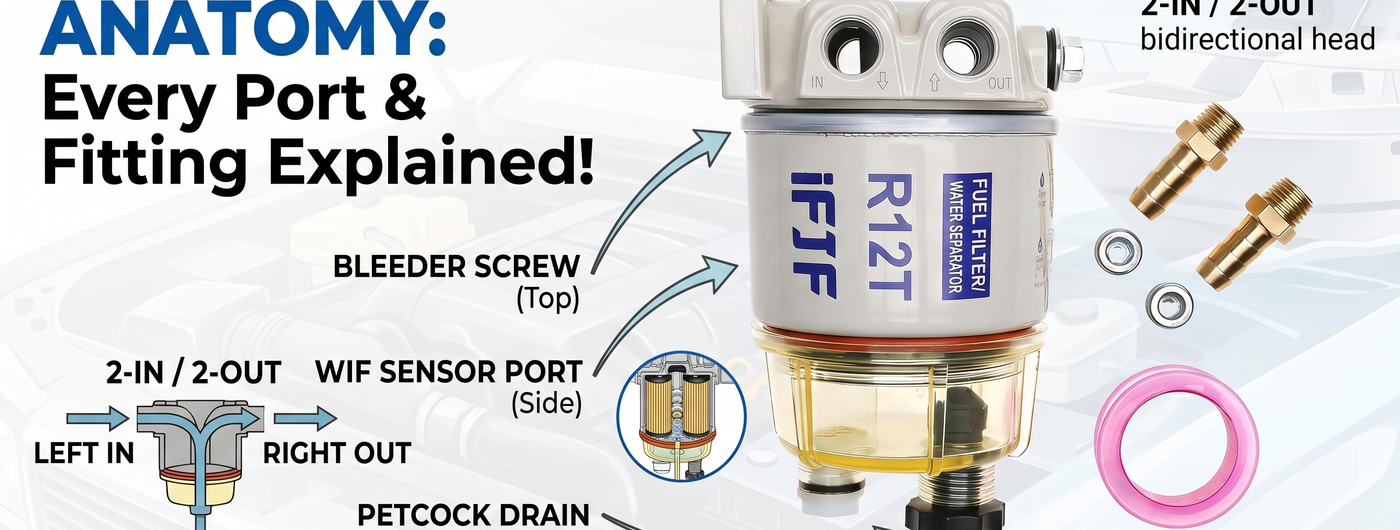
Answer-First: The R12T fuel filter water separator head features a 2-in/2-out bidirectional flow design, a built-in petcock drain, a dedicated water-in-fuel (WIF) sensor port, and a bleeder screw — all in one compact aluminum housing. Understanding each component is the difference between a leak-free install and a fuel system nightmare.
If you've just unboxed an R12T — whether it's an iFJF kit, a Racor S3240 equivalent, or a 120AT-series unit — you're staring at a maze of threaded ports, arrows, and fittings. This guide breaks down every component on the R12T housing so you know exactly what each port does, how the flow paths work, and how to configure your fittings correctly the first time.
We're drawing from a hands-on walkthrough of the R12T kit by Greg at GWA Auto Parts, combined with real-world diesel and marine installation experience. As of 2026, this filter head remains one of the most popular aftermarket fuel water separators for diesel trucks, marine gas engines, and off-road equipment — and for good reason.
Answer-First: The R12T housing has five key features: a petcock drain valve, a WIF sensor port with plug, a bleeder screw, and a 4-port flow head with directional arrows. Each serves a distinct purpose in filtering fuel and separating water.
The black twist-valve at the very bottom of the clear nylon bowl is your water drain. As fuel passes through the filter element, water — being heavier than diesel or gasoline — settles to the bottom of the bowl. Simply unscrew the petcock counterclockwise to drain accumulated water before it reaches your injectors. On marine applications where water contamination is common, check this weekly.
On the side of the housing, opposite the petcock, you'll find a threaded port with a factory-installed plug. If your engine has a WIF sensor (common on 2001-2016 Duramax, 2003-2018 Cummins, and most modern marine diesels), remove the plug and thread your sensor directly into this port. The sensor triggers a dashboard warning light when water accumulates — far more reliable than relying on visual bowl checks alone.
The small screw on top of the aluminum housing is your air bleed. After replacing the filter element, crack this screw open while priming the system. Air trapped in the housing causes hard starts and rough idle. Once fuel flows bubble-free from the bleeder, tighten it down. Skip this step and you'll be cranking far longer than necessary.
Answer-First: The top of the R12T housing has four threaded ports with directional arrows: two marked "IN" and two marked "OUT." This bidirectional design means you can route fuel from either side — left-to-right, right-to-left, or even mix and match for tight engine bay clearances.
Look closely at the casting and you'll see two arrows pointing inward (supply) and two arrows pointing outward (return/output). The engineering intent is simple: you use one IN port and one OUT port, then plug the remaining two. This gives you four possible flow paths without needing to rotate the housing.
| Component | Quantity | Purpose |
|---|---|---|
| Barbed fittings (hose barbs) | 2 | Connect fuel lines to your chosen IN and OUT ports |
| Threaded plugs | 2 | Seal the two unused ports |
| Teflon tape (PTFE) | 1 roll | Thread sealant for all fittings and plugs |
Typical Configuration: Choose your IN port based on where your fuel supply line enters the engine bay. Install one barbed fitting there. Choose the most convenient OUT port (usually the opposite side) and install the second barbed fitting. Thread the two plugs into the remaining ports. This is the setup 90% of installs use.
Important: The R12T works with standard 3/8" or 1/2" NPT fuel hose. The ZG1/4-19 thread variant (common in Asian and marine applications) requires a BSPP-to-NPT adapter — verify your thread type before ordering fittings.
Answer-First: Wrap Teflon tape counterclockwise on the fitting threads. When you screw the fitting in clockwise, the tape tightens rather than unwinding. Three to four wraps is the sweet spot — fewer and it leaks, more and you risk cracking the aluminum housing.
| Step | Action |
|---|---|
| 1 | Clean both male and female threads with a rag — no debris, no old tape residue |
| 2 | Hold the fitting in your left hand, threads facing right |
| 3 | Start the tape at the fitting base (closest to the hex head) |
| 4 | Wrap counterclockwise — 3 to 4 complete revolutions |
| 5 | Pull the tape tight and tear it clean against the thread edge |
| 6 | Thread the fitting into the housing by hand until snug, then tighten 1/2 to 3/4 turn with a wrench |
Pro Tip: Never wrap Teflon tape past the first thread. Excess tape can shred, enter the fuel stream, and clog your injectors. A $0.02 piece of tape can cause a $2,000 injector rebuild.
Answer-First: The R12T housing accepts standard spin-on fuel filter cartridges that cross-reference across multiple brands. The most common direct-fit filter elements are listed below:
| Brand | Part Number | Micron Rating | Notes |
|---|---|---|---|
| Racor | S3240 / 120AT | 10 micron | OEM spec, marine-grade |
| WIX | 33583 | 10 micron | Aftermarket direct replacement |
| Baldwin | BF1258 | 12 micron | Heavy-duty / fleet use |
| Fleetguard | FF5320 | 10 micron | Cummins-approved replacement |
| Donaldson | P551313 | 7 micron | Premium filtration, longer interval |
All filters listed are 10-micron nominal unless noted. For high-pressure common-rail diesels (2003+ Cummins 5.9L/6.7L, 2001+ Duramax 6.6L), a 10-micron or finer filter is non-negotiable — anything coarser risks CP3/CP4 pump damage.
| # | Tip | Why It Matters |
|---|---|---|
| 1 | Mount the housing with the bowl facing down — never sideways or upside-down | Water separation depends on gravity. A tilted housing sends water straight to your engine instead of the bowl. |
| 2 | Pre-fill the filter element with clean diesel before spinning it on | Dry-starting the filter housing pulls air into the injection system. Pre-filling cuts priming time by 80%. |
| 3 | Use diesel-rated fuel hose, not generic rubber hose | Standard rubber hose degrades with diesel and biodiesel blends. SAE J30R9 spec hose is diesel-rated and ethanol-resistant. |
| 4 | Mark your filter change date on the housing with a paint pen | No more guessing. Every 15,000 miles or annually for diesel — whichever comes first. Marine: every 100 hours or seasonally. |
| 5 | Check the bowl O-ring every filter change — replace if flattened or cracked | The nylon bowl O-ring is the #1 leak point on R12T housings. A $3 O-ring beats a $50 tow bill. |
The R12T, S3240, and 120AT all refer to the same filter head design — a 2-in/2-out fuel water separator with a clear nylon bowl. The differences are primarily in branding and included fittings:
The bottom line: if your engine calls for a Racor S3240 or 120AT, any R12T-compatible housing with NPT or ZG1/4-19 threads will bolt up. As one DuramaxForum user noted, "The aftermarket R12T housing is cast from the same mold — I've been running one for 40,000 miles with zero issues."

This is the exact R12T housing covered in this guide. The iFJF R12T combo kit includes the aluminum filter head, clear nylon water-separation bowl, genuine 10-micron spin-on filter element, and four fittings (2 barbs + 2 plugs) — twice what most OEM kits include. Thread options: NPT for standard diesel applications, ZG1/4-19 for marine and Asian engine compatibility.
If you're diagnosing a clogged filter, replacing a leaking bowl, or upgrading from an OEM Racor unit that costs twice as much, this kit has everything you need in one box.
Shop Now →The R12T is a universal fuel water separator compatible with virtually any diesel or gas engine that uses a remote-mount filter head. Common applications include 2001-2016 GM Duramax 6.6L (LB7 through LML), 2003-2018 Ram Cummins 5.9L/6.7L, Ford Powerstroke 6.0L/6.4L/6.7L, marine gas inboards (Mercruiser, Volvo Penta), agricultural equipment (John Deere, Kubota), and generator sets. The key factor is thread type — NPT for North American applications, ZG1/4-19 (BSPP) for Asian and European engines.
Check the product listing or the stamping on the housing. NPT (National Pipe Taper) threads are standard on North American diesel trucks and most US-market marine engines. ZG1/4-19 (a BSPP variant) is common on Asian-manufactured engines and European marine applications. If you're unsure, measure: NPT fittings screw in 3-4 turns by hand before needing a wrench; BSPP fittings thread in nearly all the way by hand. Using the wrong thread type will strip the aluminum housing.
For most applications, yes. Aftermarket R12T housings use the same 6061 aluminum casting and standard 10-micron filter media as OEM Racor units. The primary differences are price (aftermarket is typically 40-60% less) and included fittings (aftermarket kits often include extra fittings). For commercial marine applications requiring USCG certification, stick with Racor-branded units. For recreational, diesel truck, and agricultural use, a quality aftermarket R12T is functionally identical.
Drain the water bowl every 5,000 miles or monthly — whichever comes first. In marine environments with high humidity, check weekly. Replace the filter element every 15,000 miles or annually for diesel trucks, every 100 operating hours for marine engines, and every 500 hours for stationary/generator applications. If you run biodiesel blends (B5-B20), cut those intervals in half — biodiesel releases deposits from your tank walls that load up the filter faster.
Both use the same filter head design (2-in/2-out, clear bowl). The R12H typically ships with a different filter element rating (often 10-micron absolute vs 10-micron nominal on the R12T), and may include a metal bowl option for high-heat engine bay installations. The iFJF R12H+R12T Upgrade Combo bundles both heads with additional fittings for dual-filter setups — ideal for Cummins and Duramax owners who want primary + secondary filtration.