
4655 Humidistat: Why Every Whole-House Humidifier Needs One
, by iFJF Direct, 22 min reading time
, by iFJF Direct, 22 min reading time

Your whole-house humidifier is a dumb water valve — the humidistat is the part that decides when to open it. Here is what 18% and 65% relative humidity do to a house, how to set a 4655 dial by outdoor temperature, and how to tell a dead control from a dead humidifier.
Here is something that happens every November. The humidifier has been running since the first cold night. The windows are sweating. And the hardwood floor still has gaps in it you could slide a dime into.
So people buy a new humidifier. Wrong move. The humidifier was doing its job the whole time. What failed is the little dial on the wall that nobody ever looks at — the humidistat.
Worth understanding properly, because that one part decides whether your house sits at a steady 35% all winter or swings between bone dry and dripping glass. By the end of this you will know what it does, what to set it to, and how to test yours with a ten-dollar meter before you buy anything.
A whole-house humidifier needs a humidistat because the humidifier cannot measure humidity. That is the entire reason. It is a valve. Something has to tell the valve when to open.
Most people assume the humidifier somehow knows the house is dry. It does not. There is no sensor inside it, no setting, no feedback loop of any kind. It sits on the duct and waits for 24 VAC to show up at its solenoid. Voltage arrives, water runs. Voltage stops, water stops. That is all it can do.
The three common styles behave identically on this point, which surprises people:
Different hardware, same blind spot. Every one of them is sitting there waiting for a dry contact to close.
Skip the control and you are back to doing its job by hand: walk to the saddle valve in November, open it, walk back in April, close it. In between, an open valve has no idea whether it is 15°F outside or 55°F, so you get both failures in one winter — a parched living room in January, water running down the glass in March.
Heating cold outdoor air up to room temperature roughly halves its relative humidity, and often worse. Air at 30°F and 80% RH is not carrying much water to begin with. Warm that same air to 70°F inside and you land near 20%. Nothing was taken out of it. It just got heated, and warm air has a much bigger tank.
That is the whole trick behind “my house feels so dry in winter,” and it is why the complaint shows up the week the furnace starts running rather than back in October.
The U.S. EPA’s mold and moisture guidance puts healthy indoor air at roughly 30% to 50% relative humidity, with 60% as the point where mold and dust mites get comfortable. ASHRAE Standard 55 allows up to 60% for thermal comfort. In practice most homes land at 40–55% in mild weather and need to come down to 30–40% during a real cold snap.
The gap between those two lists is narrower than it sounds, and it moves with the weather. A hand valve cannot track that. A humidistat can, which is the whole point of buying one.
| Outdoor Temperature | Target Indoor RH | Why |
|---|---|---|
| Above 40°F | 40–45% | Mild weather; glass stays above the dew point |
| 20–40°F | 35–40% | A normal heating season |
| 10–20°F | 30–35% | Interior glass is cold enough to condense above this |
| 0–10°F | 25–30% | Deep cold; no window frost matters more than comfort |
| Below 0°F | 20–25% | Comfort takes second place to the building envelope |
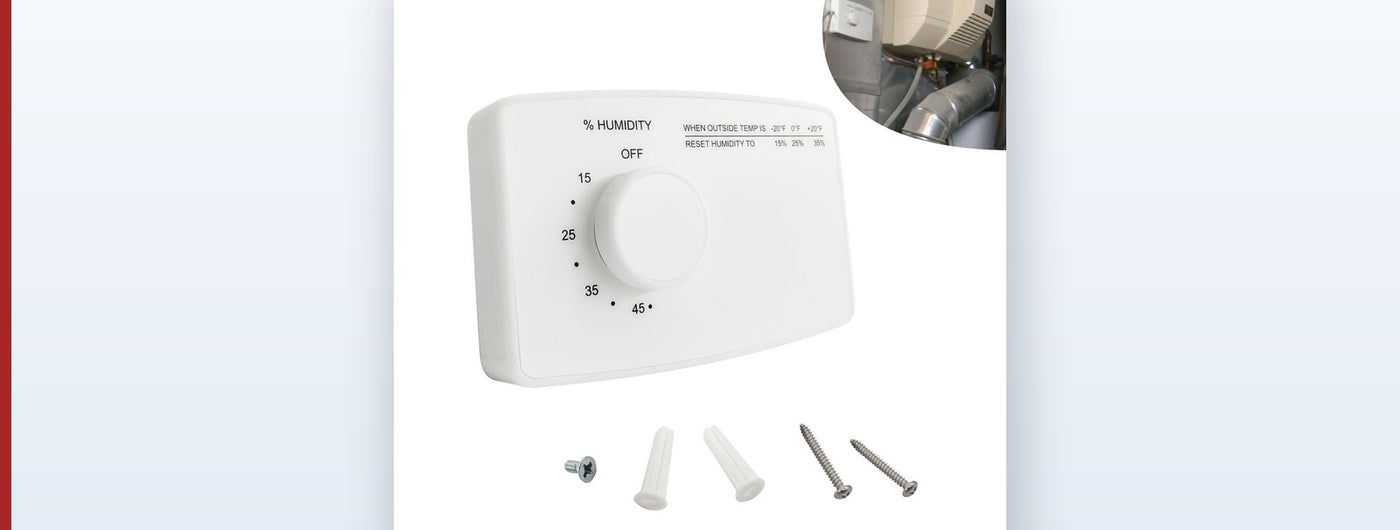
Notice the dial on a 4655 is printed with outdoor temperatures instead of just percentages. That is not decoration. The correct number depends on how cold it is outside, which is exactly what people miss when they set it to 40% in October and never touch it again.
A thermostat runs temperature. A humidistat runs moisture. Separate devices on separate circuits. You cannot hand one the other’s job unless that thermostat was built with a humidifier output and wired for it.
A humidistat is not a computer. Inside the 4655 housing there is a moisture-sensitive ribbon tied to a sponge pad. Humidity rises, the ribbon stretches, the switch opens. Air dries out, the ribbon shrinks, the switch closes. No firmware, no calibration menu, nothing to reboot.

You set a manual humidistat by matching the pointer to today’s outdoor temperature, not by picking a percentage that sounds comfortable. The 4655 dial does the conversion for you: −20°F lines up with 15% RH, 0°F with 25%, +20°F with 35%. A 45% setting covers mild weather. Past 15% the pointer reaches OFF.
Today’s, not tonight’s forecast. If a hard front is coming and you would rather not wake up to fogged glass, set it for the colder number before bed.
Line the knob up with the outdoor-temperature mark. Do not force it past the stops. It does not need forcing, and you will break the knob trying.

Condensation on the inside of a window means the set point is too high for this weather. Check in the morning when the glass is coldest. One look beats any amount of guessing, and it costs nothing.
Glass sweating? One mark colder. Static, dry throat, shocks off the carpet? One mark warmer. Then leave it alone for a day. Houses take in and let go of moisture slowly, so a big correction just overshoots and you spend the next week chasing it.
Click past 15% to OFF and you are done for the year. The humidifier stops adding moisture while the air conditioner is trying to pull it out. Bonus: you never have to touch the saddle valve again.
Quickest test: pull the two control wires off and touch them together with the blower running. If the humidifier fires and water runs over the panel, the humidifier is fine and the control is your failure. Nothing happens with the wires jumpered? Look downstream — solenoid, water supply, or the transformer.
Before you blame the control, knock out the three cheap ones: saddle valve still closed, water panel caked solid with scale, blower on a schedule that never runs while you are home. Those three cover a large share of “my humidistat is broken” complaints. If you want the full system walked in order, that is the six-step diagnosis for a humidifier that is not working.
Honest answer: less than you would think. The list is short, but read the note under the table — it is the one thing that trips people up on this job.
| Item | Why You Need It |
|---|---|
| Digital multimeter | Confirms you are on 24 VAC and not line voltage, and confirms the control actually opens and closes. |
| Phillips #2 screwdriver | Two mounting screws on the base. The cover snaps off by hand. |
| Digital hygrometer | A $15–30 wall or handheld unit gives you an independent number to compare against the set point. Do not trust “feels dry” — by the time it feels dry you are usually under 25%. |
| 4655 manual humidistat control | 2-wire, 24 VAC, 15–45% RH dial with OFF. The replacement control itself. |
| Wire nuts or lever connectors | For splicing the existing low-voltage leads if the old ends are too short to reach the new terminals. |
| Level (optional) | Only if you are drilling new holes instead of reusing the old screw pattern. |
These are the ones that turn into a second visit if you skip them.
| Tip | Why It Matters |
|---|---|
| Mount on the return duct, at least 6 inches upstream of the humidifier. | A humidistat senses the air right around it. Mount it after the humidifier and it reads artificially wet air, shuts off early, and leaves the rest of the house dry. |
| Never mount it on an exterior wall. | An exterior wall runs several degrees colder than room air. That pushes the ribbon toward the “humid” reading and makes the humidifier run longer than it should. |
| Drop the setting when the outdoor temperature drops. | The dew point inside your glass is the real limit. Holding a 40% setting through a 0°F week is how window frames rot. |
| Leave the thermostat fan on AUTO, not ON. | A continuously running blower can keep a humidifier cycling with no heat call, which is a common reason a house feels clammy in shoulder season. |
| Change the water panel before you change the control. | A scaled panel kills output long before the electronics ever fail. People replace a perfectly good humidistat every year because the panel was the actual restriction. |
| Photograph the wiring before you take it apart. | Two wires sounds simple until one of them disappears into the wall. One photo saves a service call. |
The 4655 is a manual two-wire control. It does not swap with the automatic digital controls that use an outdoor sensor. Match control type first, then wire count, then the model plate on your humidifier.
| Number | Brand | What It Is | Interchangeable? |
|---|---|---|---|
| 4655 | AprilAire | Manual 2-wire humidistat, dial with OFF, 24 VAC | Yes — direct replacement |
| 4655 | iFJF | The control in this guide | — |
| 60 | AprilAire | Automatic digital control with outdoor temperature sensor | No — needs sensor wiring |
| 62 | AprilAire | Automatic digital control for steam humidifiers | No — different output and sensor |
| Universal 24 VAC humidistat | Various | Two-wire mechanical or electronic switch | Usually yes — verify wire count |
AprilAire and the model numbers above are here so you can identify parts. They belong to their owners. The iFJF 4655 is an aftermarket manual humidistat, not a genuine AprilAire part.
A: That dial is the humidistat. If a wall or duct-mounted dial is already switching your humidifier, you have a manual control and only need to replace it when it fails or reads wrong. What you cannot do is run a whole-house humidifier with no control at all and expect steady humidity. An open valve under-humidifies in mild weather and over-humidifies in deep cold, usually in the same winter.
A: Only if that thermostat was built with a humidifier output and the humidifier is actually wired to it. A standard thermostat switches heat, cool and fan. It has no humidity sensor and no output for a 24 VAC solenoid. That is why most homes with a whole-house humidifier have a separate humidistat on the return duct or an interior wall.
A: Aim for 35-40% in normal heating weather and bring it down as the outdoor temperature falls: roughly 30-35% when it is 10-20 F outside, 25-30% near 0 F. The EPA points to 30-50% as the healthy band and 60% as the mold threshold, but your real limit is whether the windows are sweating, not what a chart says.
A: Usually because the thermostat fan is set to ON instead of AUTO, so the blower runs continuously and the humidistat keeps calling. Less often it is a wiring error that ties the humidifier to the fan circuit instead of the heating call. Check the fan setting first. It is the most common cause and it costs nothing to fix.
A: Different, not worse. A manual control has no display, no battery and no sensor wire to run, and it keeps its setting through a power cut. A digital control adjusts itself to outdoor temperature, which is more convenient if you do not want to think about it. If your existing control is a manual dial on two wires, the 4655 drops straight in. Going digital is an upgrade that needs additional wiring.
A: It is the manual 2-wire control used on AprilAire 400, 500, 600 and 700 series humidifiers, including the M, MK, MZ and MKZ versions, and it also switches the 800 series steam humidifier when that unit is controlled by a 24 VAC dry contact. Check the model plate on the humidifier and count the wires at the old control. Two wires and a manual dial means a direct replacement.

The control this whole article is about. Two wires, 24 VAC, a dial printed in outdoor temperatures, and an OFF position for summer. No battery, no programming, either lead on either terminal. It fits the 400, 500, 600 and 700 series humidifiers and mounts on a wall or on the return duct.
If your humidifier quit while the dial is still asking for humidity, start here.
Shop Now →Browse the rest of our HVAC controls and electronics, or look at the 57T01-843 blower time delay relay and the 031-01267-001A furnace control board if you are already working on the air handler.

