






Heavy-Duty Brake Parts for Diesel Trucks
Your diesel truck weighs 7,000-8,500 pounds empty. Add a trailer, bed load, or plow, and you're asking factory brake components to stop 15,000-26,000 pounds of rolling mass — repeatedly, from highway speeds, often downhill. Factory brake pads and rotors are engineered for a compromise between stopping power, noise, and dust. When you tow heavy, that compromise tilts toward danger. iFJF Direct carries brake components engineered for the real-world demands of diesel truck ownership.
Trailer Brake Controllers
The right brake controller is the difference between a confident stop and a white-knuckle moment. Modern proportional brake controllers use accelerometer-based sensing to apply trailer brakes in direct proportion to your truck's deceleration rate — no delay, no guesswork, no trailer pushing your truck through an intersection.
Proportional vs. Time-Delayed: Proportional controllers (like the Tekonsha Prodigy series) sense deceleration and apply trailer brakes accordingly. Time-delayed controllers apply a preset braking force after a user-set delay — they're simpler and cheaper but provide less precise trailer braking, particularly during emergency stops or on downhill grades. For any trailer over 5,000 pounds, a proportional controller is strongly recommended.
Integrated vs. Aftermarket: Ford, Ram, and GM all offer factory-integrated trailer brake controllers on modern diesel trucks. These systems integrate with the truck's stability control and ABS systems for coordinated braking. For older trucks without factory integration (pre-2011 Super Duty, pre-2013 Ram), aftermarket controllers provide the same functionality with under-dash mounting.
Stainless Steel Brake Lines
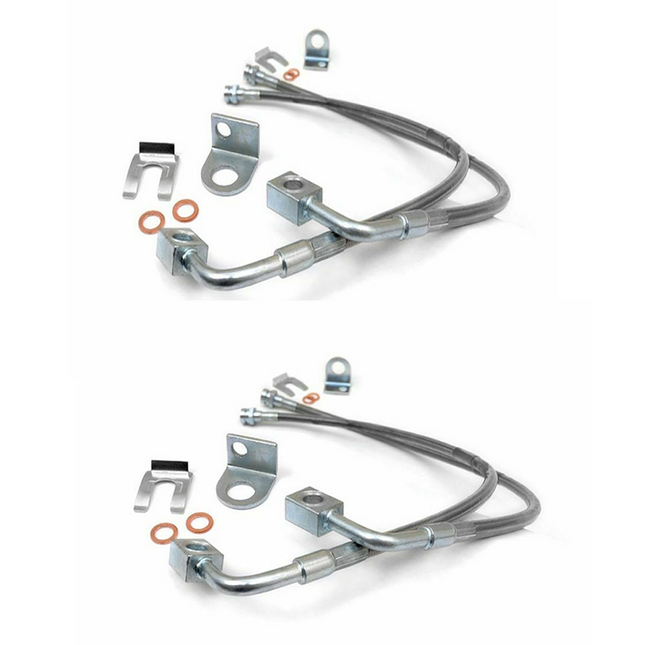
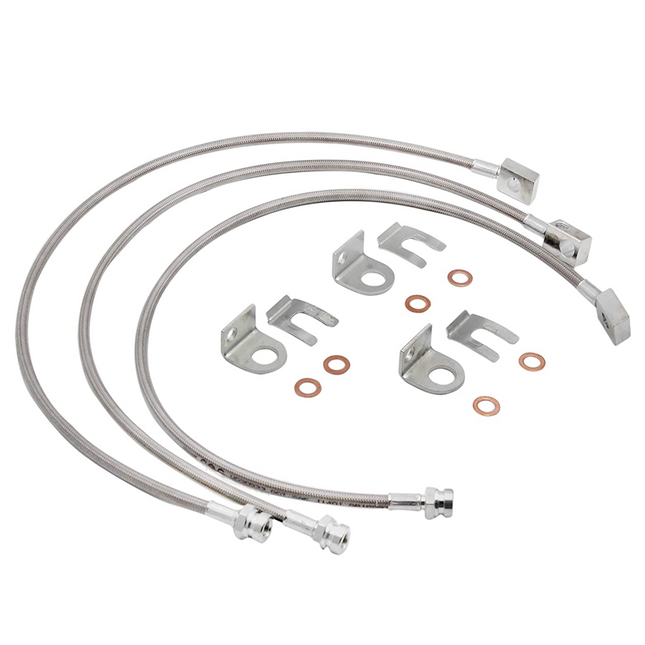
Factory rubber brake lines expand under pressure — especially when hot from repeated braking during mountain descents. This expansion translates to a soft, spongy brake pedal and reduced braking force at the caliper. Stainless steel braided brake lines eliminate this expansion, providing firmer pedal feel and more consistent braking performance throughout the entire temperature range.
DOT-Compliant Construction: Our stainless brake lines use PTFE (Teflon) inner tubing with a stainless steel braided outer sheath, covered by a clear PVC jacket for abrasion resistance. All fittings are zinc-plated steel or stainless steel with correct thread pitch and flare angle for each application. Every line is pressure-tested to 4,000 PSI — more than double the maximum pressure your brake system will ever generate.
Drum Brake Components
While most modern diesel trucks use four-wheel disc brakes, drum brakes remain common on trailers and older diesel applications (pre-2003 Ram 2500/3500 rear). Our drum brake hardware kits include springs, retainers, adjuster cables, and self-adjuster mechanisms — everything needed for a complete drum brake refresh.
FAQ: Diesel Truck Brake Parts
Q: How do I know if my brake controller is compatible?
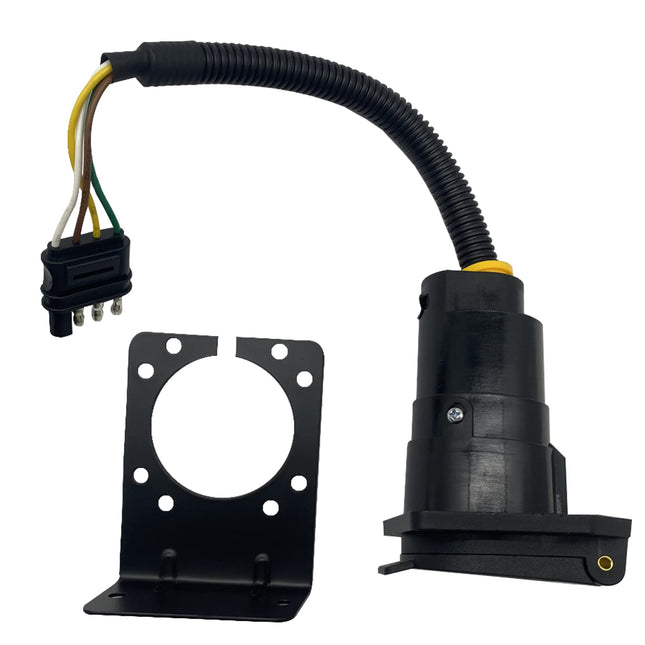
A: Most aftermarket brake controllers use a standard 4-pin or 7-pin harness connector. If your truck has the factory tow package, the connector is located above the brake pedal or behind the driver-side kick panel. We include vehicle-specific plug-and-play wiring adapters with every brake controller.
Q: Are stainless brake lines worth the upgrade?
A: If you tow heavy or drive in mountainous terrain — absolutely. The firmer pedal feel is immediately noticeable, and the elimination of line expansion under heat provides more consistent braking. For trucks that see primarily highway driving without heavy loads, the difference is less dramatic. Installation requires bleeding the brake system, so plan for a full brake fluid flush when upgrading lines.
Q: How do I adjust my trailer brake controller gain?
A: With the trailer connected, drive at 20-25 mph on a flat surface. Apply the manual override fully — the trailer brakes should lock up just before the truck comes to a complete stop. If they lock too early, reduce gain. If they don't lock at all, increase gain. Fine-tune by driving and applying the brakes normally — you should feel the trailer braking in proportion to the truck, not pushing or pulling.
Buying Guide: How to Choose the Right Brake Components for Your Diesel Truck
Pad Material Selection — Ceramic vs. Semi-Metallic vs. Heavy-Duty: Ceramic brake pads (OEM on many late-model trucks) produce less dust, operate quietly, and provide smooth cold bite — ideal for daily drivers that occasionally tow light trailers. Semi-metallic pads sacrifice some noise and dust performance for significantly better heat tolerance and friction at elevated temperatures — the right choice for trucks that tow 8,000+ pounds through mountain passes. Heavy-duty/towing-specific pads use a high-metal-content friction formula that maintains consistent stopping power from cold to 1,200°F — recommended for trucks that regularly tow near their GCWR. Never install ceramic pads on a dedicated tow rig — the friction coefficient drops off sharply above 600°F, right when you need it most. Check the pad's edge code (printed on the side of the friction material): the first letter is cold friction (C-G, higher is better), the second is hot friction — for towing, look for FF or GG rated pads.
Rotor Selection — Solid vs. Drilled vs. Slotted: Solid (blank) rotors provide the most thermal mass and longest pad life — the correct choice for towing, where heat absorption capacity matters more than cooling rate. Drilled rotors dissipate heat faster but the holes create stress risers that can crack under the extreme thermal cycling of heavy towing — not recommended for diesel trucks that tow. Slotted rotors provide a middle ground: the slots sweep away pad gasses and water for consistent bite without the structural compromise of drilled holes. For daily-driven trucks that tow, slotted rotors with semi-metallic pads offer the best balance of performance, longevity, and resistance to brake fade.
Brake Fluid — The Forgotten Component: Diesel trucks generate enormous brake heat when towing downhill. DOT 3 brake fluid (factory fill on most trucks) has a dry boiling point of 401°F and a wet boiling point of 284°F. DOT 4 fluid raises those numbers to 446°F dry and 311°F wet. DOT 5.1 (not DOT 5 — silicone-based fluids are not compatible with ABS systems) raises wet boiling point to 356°F. The wet boiling point is what matters for trucks in service, because brake fluid absorbs moisture from the air over time. If you tow in mountains, flush the brake fluid with fresh DOT 4 or DOT 5.1 every two years regardless of mileage. Boiled brake fluid equals zero brakes — there is no warning light for this, just a pedal that goes to the floor on a downhill off-ramp.
Common Brake Problems & Diagnosis on Heavy-Duty Trucks
Brake Pulsation (Warped Rotor Sensation): True rotor warping is rare — what feels like a warped rotor is almost always uneven pad material transfer (also called "disc thickness variation" or DTV). When brake pads overheat, friction material transfers unevenly to the rotor surface, creating high spots that cause pedal pulsation. The fix: if the rotor is within thickness specification, re-bed the pads by performing 8-10 moderate stops from 50 MPH to 10 MPH, followed by a 10-minute cool-down drive without stopping. If pulsing persists, the rotor needs to be turned or replaced. To prevent recurrence: avoid holding the brake pedal after a hard stop with hot brakes — this bakes pad material onto the rotor at the pad's contact point.
Trailer Brake Controller Diagnostic Flow: If your trailer brakes are weak or non-responsive: (1) With the trailer connected and engine running, activate the manual override on the controller — you should hear the trailer brakes engage (a distinct clunk from the drums or a hum from electric-over-hydraulic actuators). No sound = no power to the trailer brakes. (2) Check the 7-pin connector for corrosion — the blue wire (trailer brake output) is the most common failure point. Clean with electrical contact cleaner and dielectric grease. (3) Test the trailer's brake magnets by disconnecting the trailer plug and measuring resistance between the brake pin and ground — 3.2-4.0 ohms per axle is normal (two magnets in parallel). Open circuit = broken magnet wire inside the drum. (4) If voltage is present at the trailer connector but brakes don't engage, pull the drums and inspect the magnet surface — a grooved or glazed magnet face cannot grip the armature plate.
Soft Brake Pedal After Line Replacement: After installing stainless steel brake lines or replacing calipers, a soft pedal that won't firm up despite repeated bleeding indicates trapped air in the ABS pump — a pocket that standard bleeding cannot reach. The fix requires a scan tool with ABS bleed function (most professional-grade scanners support this, including Autel and Snap-on models). The ABS bleed procedure cycles the pump solenoids and requires 5-10 minutes of additional bleeding after the base system is bled. For 2011+ Super Duty trucks, the ABS bleed sequence is: right rear, left rear, right front, left front, then ABS pump bleed — following the Ford workshop manual sequence is critical.
Winter & Summer Brake Care Tips for Diesel Trucks
Winter Brake Care: Road salt is the enemy of every brake component. (1) Rinse the undercarriage — including brake calipers and rotors — after every snowstorm drive where salt was applied to roads. Focus the spray on the caliper slide pins, which seize when salt crystallizes in the rubber boots. (2) Apply silicone-based brake lubricant to caliper slide pins at every pad change — petroleum-based grease swells the rubber boots and must be avoided. (3) The parking brake on manual-transmission trucks should be exercised weekly in winter — cables can freeze in the "released" position, leaving you without a parking brake. Cycle the parking brake 5-6 times at the end of each drive. (4) If your truck has exhaust brake (Ram Cummins) or engine brake (Duramax), use it for winter driving on slippery roads — it provides vehicle speed control without the risk of wheel lockup that service brakes create on ice.
Summer Towing Brake Care: Mountain passes in summer ambient temperatures push brake systems to their absolute limits. (1) Before your towing season begins, measure rotor thickness with a micrometer — if any rotor is below the minimum thickness stamped on the rotor hat, replace it. A rotor at minimum thickness has insufficient thermal mass to absorb the heat of a mountain descent and will overheat rapidly. (2) Flush the brake fluid if it's been more than 2 years since the last change — brake fluid color is a quick indicator: amber = fresh, dark brown = contaminated with moisture, black = severely degraded. (3) Test the trailer brake breakaway switch battery — a dead breakaway battery means no trailer brakes if the trailer separates from the truck. (4) Carry an infrared thermometer ($20) and check rotor temperatures at the bottom of long grades — if one rotor is 100°F+ hotter than the others, that caliper is dragging and needs immediate attention.
Related Collections
Explore our full range of diesel performance and maintenance parts.