Ford 6.0 Liter Powerstroke EGR Valve Installation
, by iFJF Direct, 18 min reading time
, by iFJF Direct, 18 min reading time

🛒 Parts Used in This Guide 11025 Diesel Fuel Tank Aux Mount Kit Ford F250 F350 1999-201 $73.99 Shop Now → 12642623 Fuel Filter Head + 1R-0750 Refit for 2005-2016 Dura $87.99 Shop Now → 1R-0750 Fuel Fi...
The Ford 6.0L Powerstroke is a workhorse engine found in 2003.5–2010 Super Duty trucks and chassis-cab vehicles, and one of its most common failure points is the Exhaust Gas Recirculation (EGR) valve. Carbon buildup is endemic to this engine — the EGR circuit routes hot exhaust gases back into the intake to reduce combustion temperatures, but the byproduct is a sticky, hard carbon deposit that immobilizes the valve's internal components over time. When that happens, your truck sets codes, runs rough, loses power, or may not start at all. This guide walks you through a full EGR valve replacement on the 6.0L Powerstroke — from diagnosis to installation — using the same hands-on techniques a professional technician would use.
By the end of this article, you will know exactly how to diagnose a failing EGR valve on a Ford 6.0L Powerstroke, which tools you need, how to safely remove a carbon-locked valve without breaking the intake, and how to install the replacement with proper O-ring lubrication. You'll also learn what parts are compatible across the 2003.5–2010 model year range and what the technician-grade tips are that most DIY guides leave out. This procedure takes roughly 45–90 minutes depending on carbon accumulation.
Before you start, gather everything on your workbench. Working on the 6.0L Powerstroke EGR valve is straightforward mechanically, but every minute spent going back to the tool chest is a minute the truck sits open and exposed to debris. The tools below cover every step of this job.
| Item | Type / Notes | Why You Need It |
|---|---|---|
| 28mm socket | Deep-well, 6-point recommended | The EGR valve is held by two 28mm-headed bolts |
| Ratchet & breaker bar | Standard 3/8" or 1/2" drive | Breaker bar gives you leverage to break stubborn bolts free |
| Extension(s) | 3"–6" extension, 3/8" drive | Clears the intake horn to reach rear bolts |
| Channel-lock pliers | Standard adjustable pliers | First attempt to twist and break the valve free |
| Lady slipper / hooked pry bar | Also called an EGR valve puller | Hooks under valve housing lip to rock it off — essential when carbon locks it |
| Shop vacuum (shop vac) | Wet/dry vac preferred | Removes loose carbon chunks and debris from the intake port before installing new valve |
| Clean motor oil | 5W-30 or 10W-30 conventional oil | Lubricates the new O-rings — do not use silicone grease |
| Torque wrench | 3/8" drive, 10–75 ft-lb range | Ensures proper bolt torque to spec |
| OBD-II scanner | Ford-compatible, clears codes | Resets EGR-related trouble codes after installation |
| Replacement EGR valve | OEM or quality aftermarket (see cross-reference below) | The core part being replaced |
| Safety glasses & gloves | Standard PPE | Carbon debris is an irritant; hot components are a burn risk |
Before you touch a wrench, it helps to know what you are dealing with. The EGR valve on the 6.0L Powerstroke controls the flow of exhaust gases back into the intake manifold. It has moving components — a pintle and seat assembly — and these are immersed in exhaust gas byproducts during every drive cycle.
There are two primary failure modes on the 6.0L Powerstroke:
In both cases, the fix is the same: remove the carbon-locked valve, clean the mounting surface, and install a new unit. Some technicians also recommend an EGR delete kit for 6.0L Powerstroke owners who want to eliminate the EGR system entirely, but that is a separate modification with emissions compliance implications — check your local regulations.
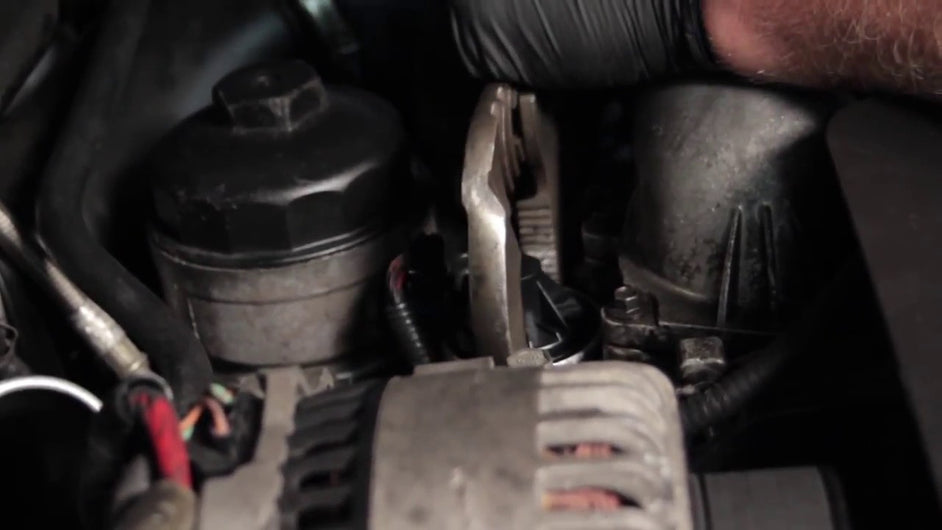
On the 6.0L Powerstroke, the EGR valve is mounted on the intake manifold, typically toward the passenger side of the engine bay. It is held in place by two bolts with 28mm heads — a relatively large fastener for an engine bay component, which actually makes this job easier than it might seem at first glance.
Before removing anything:
From here, you have direct access to the two 28mm mounting bolts. A long-handled ratchet with a deep-well 28mm socket and a 3"–6" extension is the most efficient setup. In many cases, a 6-point socket is preferred over a 12-point to avoid rounding the bolt heads.
This is where the job can get physical. The two 28mm bolts come out easily enough — but the valve itself is often fused to the intake manifold by years of baked-on carbon. Here's the technician's sequence that works:
Before reaching for the pry bar, try a pair of channel-lock pliers (adjustable pliers). Grip the EGR valve body and apply a twisting motion to break the carbon seal. After a quarter-turn or so, try rocking it back and forth while pulling upward. On lightly carboned valves, this is all it takes.
If the channel-lock method yields only a few millimeters of movement, reach for the "lady slipper" — a hooked pry bar designed specifically for EGR valve removal. Work the hook under the valve housing lip on both sides. Alternate sides with a rocking motion — this distributes the force evenly and prevents you from cracking the intake manifold plastic/aluminum. The goal is to break the carbon seal on one side at a time.
On severely carbon-locked valves, you may need to cycle through the channel-lock step, the pry bar step, and back again — patience is the key tool here. Forcing it risks damaging the intake manifold flange, which is an expensive repair.
When the valve finally pulls free, you will likely see:
This step is non-negotiable. Any carbon chunks left on the intake manifold flange will:
Use your shop vac to remove all loose debris first — this prevents you from pushing chunks further into the port. Then use a flat-blade scraper or a stiff nylon brush to remove the remaining carbon film from the manifold surface. Work carefully around the O-ring groove. Compressed air can blow out any remaining debris from the port bore.
Before installing, lubricate the O-rings with clean motor oil — a few drops spread evenly around each ring. Do not use silicone grease. Silicone-based lubricants can cause certain rubber compounds in the EGR O-rings to swell and degrade prematurely, leading to an immediate leak after installation. Conventional 5W-30 motor oil is what professional technicians use and it is the correct choice.
Align the new valve over the mounting flange, making sure the O-rings stay in their grooves as you lower it in. The valve should slide in smoothly — if you feel significant resistance, stop and check that the O-rings are not pinched and the mounting surface is clean. Do not force it. With a clean surface and properly lubricated O-rings, the valve will drop into place with light hand pressure.
Start both 28mm bolts by hand to avoid cross-threading, then snug them up with the ratchet. Final torque specification for the EGR valve bolts on the 6.0L Powerstroke is typically 18–22 ft-lb (refer to your specific service manual). Use a torque wrench for the final pass — under-torquing invites a vacuum leak; over-torquing risks cracking the intake manifold.
Reconnect the electrical harness to the new EGR valve, making sure the connector clicks and locks. Reconnect the negative battery terminal.
Start the engine and let it idle for 30–60 seconds. Watch the check engine light — on most 6.0L Powerstrokes, the PCM will run a self-check sequence and extinguish the light if the new valve is functioning correctly. Use your OBD-II scanner to verify no pending or active codes remain. If a code persists after installation, double-check the electrical connection and ensure the valve is fully seated.
| Tip | Why It Matters |
|---|---|
| Never force a stuck EGR valve — alternate tools and techniques | The 6.0L intake manifold is expensive and brittle when cold. A cracked manifold = $600+ repair. |
| Always use motor oil on O-rings, never silicone grease | Silicone grease chemically reacts with certain EGR O-ring compounds, causing them to swell and fail within weeks. |
| Shop vac the port BEFORE the new valve is near it | One dropped carbon chunk past the new valve enters the EGR cooler or intake — a cascading failure you won't see coming. |
| Disconnect battery before electrical work | The 6.0L PCM is sensitive to voltage spikes during harness work; battery disconnect prevents unintended module damage. |
| Keep the old EGR valve as a reference | Carbon pattern tells you something: heavy external carbon → stuck-open failure; minimal external carbon → stuck-shut internal failure. This tells you whether you have an EGR cooler issue compounding the problem. |
The Ford 6.0L Powerstroke EGR valve is used across the 2003.5–2010 Super Duty and excursion vehicle range. Compatibility is generally engine-specific, not model-year-specific, but always verify fitment for your exact application.
| Brand | Part Number / Product | Application | Notes |
|---|---|---|---|
| Ford / Motorcraft | 4C3Z-9F452-A (OE equivalent) | 2003.5–2010 Ford 6.0L Powerstroke Super Duty F-250 to F-550 | Genuine OE replacement; highest reliability |
| iFJF | 6.0 Powerstroke EGR Valve / Delete Kit | 2003.5–2010 Ford 6.0L Powerstroke | Aftermarket OE-style replacement or delete option — see product page for exact fitment |
| OMFIT / Aftermarket | Various 3rd-party EGR valve replacements | 2003.5–2010 Ford 6.0L Powerstroke | Check seller ratings; some use improved valve internals for better carbon resistance |
| DPF Delete + EGR Delete Kit | Complete emission elimination kit | Off-road / competition use 6.0L Powerstroke | Removes EGR and DPF entirely — not legal for on-road use in the US; for racing/off-road applications only |
Looking for 6.0L Powerstroke parts? Browse the full Ford Powerstroke parts collection on iFJF.net for filters, gaskets, sensors, and more.

The iFJF EGR valve for the Ford 6.0L Powerstroke is engineered as a direct drop-in replacement for the factory Motorcraft unit. It features the same bolt pattern and electrical connector, so installation requires no adapters or harness modifications. The improved valve internals resist carbon buildup better than the OE design, giving you longer service life in high-mileage applications. Compatible with 2003.5–2010 Ford F-250, F-350, F-450, F-550 Super Duty and Ford Excursion powered by the 6.0L Powerstroke diesel.
If you're doing this job, you'll want a quality replacement valve on hand — there's nothing worse than having the truck torn apart and waiting on a backordered part.
Shop Now →There is no fixed factory interval for EGR valve replacement on the 6.0L Powerstroke — it is a condition-based repair. Most technicians recommend inspecting the EGR valve at every intake manifold gasket replacement (typically 100,000–150,000 miles). If you see heavy carbon accumulation during inspection, replace the valve at that time rather than waiting for a failure. Diesel owners who run primarily short-trip cycles (under 20 miles), idle frequently, or operate in stop-and-go traffic should inspect more often — these conditions accelerate carbon buildup significantly.
Quality aftermarket EGR valves from reputable brands are generally equivalent to or better than the OE Motorcraft unit for the 6.0L Powerstroke. The OE valve was designed to meet cost and emissions targets, not maximum durability. Aftermarket units — particularly those with updated valve seat materials and improved actuator response — often outperform the factory part in longevity tests. The key is buying from a trusted seller with a real warranty. Avoid cheap, unbranded imports with no return policy: a failed aftermarket valve can set the same codes as a dead OE valve and cost you the same diagnostic time.
In mild cases — where the valve is sluggish but not seized — you can remove the EGR valve and clean the carbon off the pintle and seat with a parts cleaner spray and a soft brass brush. However, cleaning does not fix a valve that is stuck shut due to internal carbon intrusion, and it does not address degraded O-rings or a worn actuator motor. If your scanner shows a specific EGR performance code (P0401, P0402, P0404, etc.), replacement is almost always the correct call. Cleaning is a temporary measure at best on the 6.0L Powerstroke, which runs hot and carbon-heavy by design.
Yes. The 6.0L Powerstroke engine was used from 2003.5 through 2010 with essentially the same EGR system across all model years. The valve bolt pattern, electrical connector, and physical dimensions are consistent throughout the production run. As always, confirm the part number cross-references your specific application before ordering.
A stuck-open EGR valve on the 6.0L Powerstroke allows exhaust gases to enter the intake at all times, diluting the air-fuel mixture and causing rough idling, reduced power, increased exhaust smoke, and eventually catalyst/EGR cooler damage. A stuck-shut valve triggers continuous fault codes and can cause the PCM to derate the engine. Neither condition will resolve on its own — and delaying repair typically results in additional component damage and higher total repair costs.
No. Installing a new EGR valve will restore proper operation and clear fault codes without any tuner or PCM programming. However, if you want to delete the EGR system entirely (remove it from the truck), that requires a delete-specific tune from a reputable tuner like SCT, H&S Mini Maxx, or PPEI to prevent the PCM from throwing codes for missing hardware.
No. Always let the engine cool completely before removing the EGR valve. The intake manifold and surrounding components are aluminum and expand when hot — removing fasteners or prying on components while warm risks cracking the manifold, stripping bolt threads, and causing burns. Cool to ambient temperature — typically 2–4 hours after the last drive.
A competent DIY technician can complete this job in 45 minutes to 1.5 hours, depending on the severity of carbon lock. On vehicles with severe carbon accumulation (200K+ miles, heavy short-trip use), budget extra time for the removal step and port cleanup. First-time DIYers should plan for 2 hours including tool gathering and code clearing.
The Ford 6.0L Powerstroke EGR valve replacement is one of the most common service procedures on this engine — not because the part is poorly made, but because the 6.0L runs a duty cycle that is inherently hard on EGR components. Carbon buildup is a fact of life with this engine, and when it locks the valve shut or open, replacement is the correct fix. The good news: it is a straightforward job. Two 28mm bolts, a pair of channel locks, a lady slipper, and 45 minutes of your time are all that stand between you and a running truck. Buy a quality replacement valve, take your time on the removal, clean the port meticulously, lubricate the O-rings with motor oil, and you will be back on the road with a properly functioning EGR system.
If you have questions about specific fitment, part numbers, or need help diagnosing a check engine light on your 6.0L Powerstroke, browse the full range of 6.0L Powerstroke parts on iFJF.net or reach out to our parts specialists.
Since you're already working on your truck, these maintenance items take minutes to swap while everything's apart: