
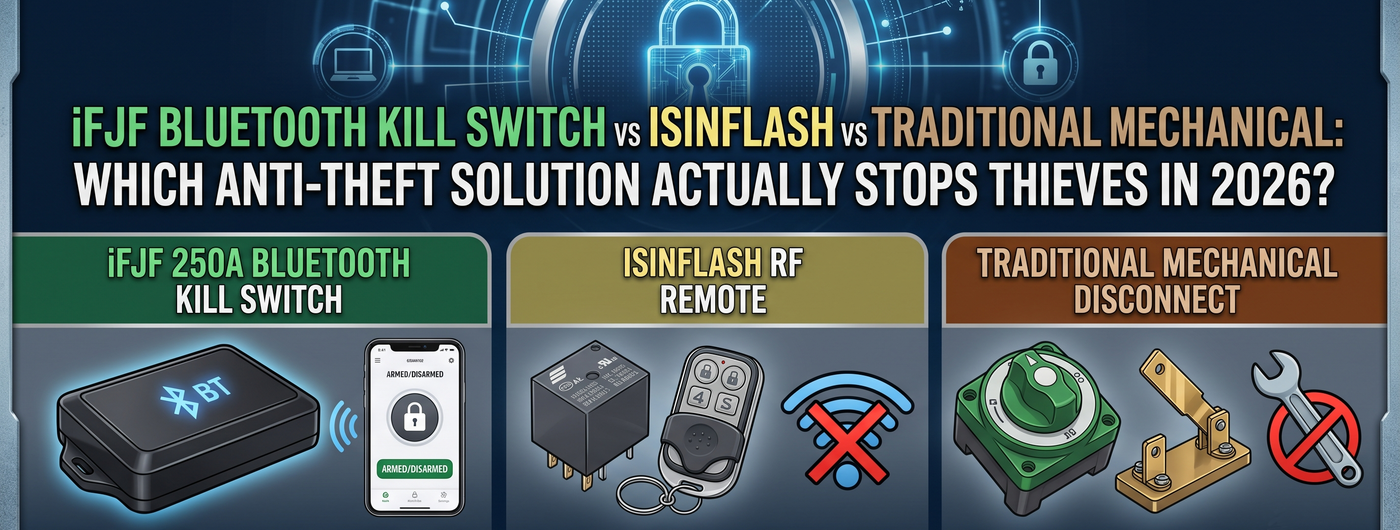
iFJF Bluetooth Kill Switch vs ISINFLASH vs Traditional Mechanical: Which Anti-Theft Solution Actually Stops Thieves in 2026?
, by iFJF Direct, 11 min reading time
, by iFJF Direct, 11 min reading time

Vehicle theft in the United States hit 1,020,729 incidents in 2025 according to the National Insurance Crime Bureau — that's one stolen vehicle every 31 seconds. Modern thieves don't hotwire cars anymore; they use relay attacks, OBD-II port programmers, and signal amplification to defeat factory immobilizers in under 90 seconds. A physical battery disconnect — one that a thief can't find and can't bypass without crawling under the vehicle — is the single most effective layer of defense you can add. But not all kill switches are created equal. Here's how the iFJF 250A Bluetooth Kill Switch stacks up against ISINFLASH and old-school mechanical disconnects, based on real installation data, spec comparisons, and the security realities of 2026.
Before comparing brands, you need to understand the three fundamentally different technologies that all fall under the "kill switch" label. Mixing them up is how people spend money on a solution that provides zero actual protection:
The $12–$35 hardware-store solution. A physical switch mounted on the battery terminal or negative cable that you manually turn or flip. Variants include the classic green-knob rotary disconnect, the blade-style knife switch, and the marine-grade Perko switch. These have been around since the Model T era and their security profile is exactly what you'd expect from 1910s technology: anyone who opens the hood can see it and bypass it in three seconds with a wrench.
Where mechanical switches shine is parasitic drain prevention — if your goal is keeping a stored RV, boat, or project car battery from dying over winter, a $15 rotary disconnect is perfectly adequate. They're also completely immune to electronic hacking because there are no electronics to hack. The 2024–2026 wave of Bluetooth relay attacks targeting aftermarket vehicle telematics and keyless entry systems doesn't touch a mechanical disconnect because there's literally no signal to intercept. But for theft deterrence? A mechanical switch is a speed bump, not a barrier.
ISINFLASH is the dominant brand in the 433MHz RF remote-controlled kill switch category, typically priced at $35–$55 on Amazon and eBay. These kits use a key-fob-style remote transmitter paired to a solenoid relay module wired inline on the negative battery cable or starter circuit. Press the button — relay opens, circuit dies, vehicle won't crank. Press again — relay closes, power restored.
The appeal is obvious: no hood-popping, no crawling under the dash, just a key fob click. The problem is equally obvious: 433MHz is a completely unencrypted, single-frequency band with zero rolling-code protection on any unit under $80. A $25 SDR (software-defined radio) dongle and a laptop running GNU Radio can capture and replay the ISINFLASH remote signal from 300 feet away. Code-grabbing attacks that used to require $500 in specialized equipment in 2020 now take $25 and a few hours of research. ISINFLASH has not updated their RF protocol since their initial release, and the fixed-code transmission makes these systems trivially bypassable by anyone with even hobbyist-level RF knowledge.
There's also a reliability concern: the generic solenoid relays used in ISINFLASH kits are typically rated at 100A continuous and 200A surge — adequate for a 4-cylinder commuter car but borderline for a V8 truck or diesel with dual batteries and a high-compression starter. Forum reports of ISINFLASH relay welding (contacts fusing closed under high current, leaving the switch permanently "on") are common enough to take seriously if you drive anything larger than a midsize sedan.
The iFJF 250A Bluetooth Kill Switch represents the newest generation of battery disconnect technology: smartphone app control over Bluetooth 5.0, a solid-state 250A continuous-rated relay, and no external key fob to lose, clone, or have its signal intercepted. At just $53.99, it delivers capabilities that competing systems at twice the price can't match.
Bluetooth 5.0 uses AES-128 encryption on the link layer by default and implements frequency-hopping spread spectrum (FHSS) across 40 channels — meaning there's no single fixed frequency to capture and no unencrypted transmission to replay. A relay attack that works against 433MHz fixed-code remotes in seconds becomes exponentially more difficult against a properly implemented BLE 5.0 connection. The iFJF unit also supports custom device naming (so it doesn't broadcast as "KILL_SWITCH" to every Bluetooth scanner within range) and auto-reconnect functionality — the relay automatically disconnects when you walk away with your phone and reconnects when you return.
| Category | iFJF 250A Bluetooth | ISINFLASH RF Remote | Traditional Mechanical |
|---|---|---|---|
| Price (Typical) | $53.99 | $35–$55 | $12–$35 |
| Continuous Current Rating | 250A | 100–200A (inconsistent) | 100–300A (varies) |
| Control Method | Smartphone app (BLE 5.0) | 433MHz key fob | Manual knob/lever |
| Signal Security | AES-128 encrypted, FHSS | Fixed code, no encryption | N/A (no signal) |
| Range | ~30–50 feet (BLE) | ~100–200 feet (RF) | Arm's length |
| Hidden Installation | Yes — relay hidden anywhere; no visible switch | Partially — relay hidden; key fob visible | No — switch mounted on battery terminal |
| Auto-Disconnect (Walk-Away) | Yes | No | No |
| Relay Welding Risk | Low (solid-state 250A rated) | Moderate (solenoid, ~100A rated) | None (no relay) |
| Parasitic Draw | <5mA standby | ~10–20mA standby | Zero |
Consider a 2022 Ford F-250 Super Duty parked in a hotel lot outside Houston, Texas — one of the top five metro areas for truck theft in the United States. The owner has a factory alarm, a steering wheel club, and an aftermarket GPS tracker hidden under the dash. At 2:47 AM, two thieves in a stolen sedan pull up. One breaks the rear window, climbs in, and plugs a $150 OBD-II programmer into the diagnostic port. In 47 seconds, they've programmed a blank key fob to the truck's immobilizer system — the factory alarm never triggered because they didn't open a door. The steering wheel club is cut off with a battery-powered angle grinder in under 30 seconds. The GPS tracker? A $40 5-band signal jammer plugged into the cigarette lighter renders it useless. Total time from broken glass to engine start: under three minutes.
Now replay the same scenario with a hidden Bluetooth kill switch installed. The thieves program their key, cut the club, hit the start button — and nothing. No crank, no click, no dashboard lights. The battery is physically isolated from the vehicle's electrical system by a relay hidden behind the glove box or under the rear seat, with no visible switch, no telltale key fob, and no wiring diagram to trace. They don't know if it's a kill switch, a dead battery, or an immobilizer fault. They have roughly 60 seconds before someone notices a broken window and lights come on in the hotel. In that window, they'll pop the hood, see a completely factory-looking battery terminal (because the relay is wired inline on the negative cable, not at the terminal), and walk away. The truck is still there in the morning.
Installing a Bluetooth kill switch isn't complicated, but it does require comfort with basic 12V wiring. Here's what the process looks like on most vehicles:
For truck and RV owners, the 250A continuous rating is the standout spec. A diesel truck with dual batteries can draw 400A+ for a split second during cold-cranking, and 250A is the continuous rating — surge handling is significantly higher. Most competing units in this price range use relays rated at 100–200A continuous, which is why relay welding complaints litter Amazon reviews for the generic alternatives.
A kill switch alone is one layer — effective, but best combined with other deterrence measures and proper maintenance. We recommend a layered approach:
Get a traditional mechanical disconnect if your only concern is preventing parasitic drain during storage, you drive a project car that never leaves the garage, or you're working with a sub-$20 budget. It's a battery maintainer, not a security device.
Avoid ISINFLASH and generic RF remotes unless you understand and accept the fixed-code vulnerability. They're functionally identical from a security standpoint whether you spend $35 or $55 — the RF protocol is the weak link and no amount of marketing changes that. The only scenario where an RF remote makes practical sense is for a marine application where you genuinely need 100+ feet of range and Bluetooth's ~50-foot limit is constraining.
Install the iFJF 250A Bluetooth Kill Switch if you want actual theft deterrence with modern encryption, no visible telltale components, walk-away auto-disconnect, and a current rating that won't leave you stranded on a cold morning. At $53.99, it costs roughly what you'd pay for a single tank of diesel in a Super Duty — and it protects an asset worth 500–1,000 times that amount.
Browse our full selection of vehicle electronics and accessories to complete your anti-theft setup, and check our Fuel & Oil Filter Collection for the maintenance parts that keep your protected vehicle running strong.
Author: iFJF Direct | Last updated: August 2026