
Marine Fuel Water Separator Install: R12H Aluminum Housing vs Racor S3240 — Complete Guide for Boat Owners
, by iFJF Direct, 6 min reading time
, by iFJF Direct, 6 min reading time

Water in boat fuel is not a maybe. It's a when. Condensation in the tank, a bad marina fuel fill-up, ethanol sitting for three weeks pulling moisture from the air — pick your poison. When that water hits your injectors, you're looking at rust, corrosion, and possibly a seized injector tip. On a modern outboard or sterndrive, that's a $500-800 repair before you even pay the marina labor rate.
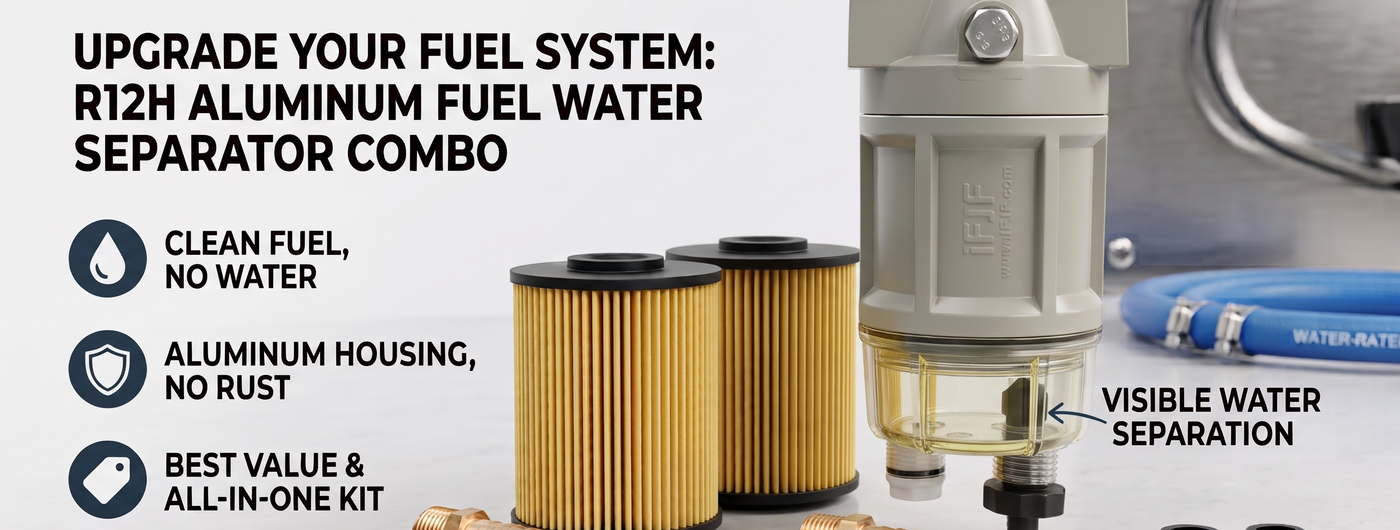
A good fuel water separator catches that water before it ever reaches the engine. The stock Racor S3240 or 120AT filter assembly does the job — until the housing corrodes. Which it will, because it's steel. The R12H Marine Fuel Water Separator Combo replaces the whole assembly with an aluminum housing. No rust. No paint flaking into your fuel. No housing seizing to the filter element when it's time to change it.
You get the complete kit in one box:
Thread specs: the filter head ports are 1/4" NPT. The filter element spins onto a standard 1"-14 thread. If you've ever changed a Racor element, this threads on exactly the same way. The aluminum body means it won't rust out in a saltwater bilge environment.
You want the separator between the tank and the engine, mounted vertically (bowl down) so water settles in the bowl. Pick a spot you can reach — you'll be draining the bowl and changing the filter at least once a season. Above the bilge water line. Away from direct exhaust heat. If you're replacing an existing separator, use the same mounting holes if you can — less drilling.
The kit includes a stainless bracket. Four screws into a bulkhead or transom stringer. Pre-drill with a 1/8" bit if you're going into fiberglass — prevents gelcoat cracking. Use stainless hardware, not the zinc-plated stuff from the hardware store. Zinc in a bilge lasts about 18 months before it turns to powder.
Wrap each NPT fitting with 2-3 turns of Teflon tape (clockwise). The filter head has two 1/4" NPT ports on each side — use whichever pair gives you the cleanest hose routing. Thread in the brass barb fittings for your fuel line. Plug the unused ports with the included NPT plugs — also wrapped with tape.
Use 3/8" USCG-approved marine fuel hose (Type A1-15). Not automotive fuel line — it's not rated for enclosed below-deck spaces. The intake side comes from the tank pickup. The output goes to the engine's fuel pump inlet. Cut your hoses long enough that they don't kink, short enough that they don't sag into bilge water. Double-clamp both ends — ABYC standard, and for good reason.
Fill the new filter with fresh fuel or diesel before spinning it on. Saves priming time. Lubricate the gasket with a thin film of clean fuel. Spin it on until the gasket contacts, then hand-tighten another 3/4 turn. No wrench. You'll thank yourself at the next filter change.
If you have a priming bulb, pump it until firm. Crank the engine and watch the clear bowl — fuel should fill without bubbles. Shut it down and check every fitting with a clean paper towel. Any wet spot is a leak. Fix it now, not when you're 12 miles offshore.
Drain the bowl every 2-3 trips. Put a clear cup under the petcock, crack it open, let it drain until you see clean fuel. If there's more than a tablespoon of water in there, you got bad fuel. Drain the whole separator and refill with fresh.
Change the element every 100 hours or annually, whichever comes first. A clogged 10-micron element creates vacuum on the fuel pump inlet. That vacuum makes the pump work harder, run hotter, and die younger. A $15 filter element is cheaper than a $300 fuel pump.
Keep a spare element on the boat. Not kidding. One bad tank of fuel on a fishing trip and you're dead in the water. A spare element and a pair of channel-locks in the tool kit takes 10 minutes to swap.
Aluminum housing = no galvanic corrosion with aluminum fuel tanks. If your boat has aluminum tanks, pairing them with an aluminum filter housing eliminates the dissimilar metals problem. Steel housings + aluminum tanks + saltwater bilge = a battery you didn't ask for.
Three spin-on fuel water separators claim the same 10-micron rating. Here's the reality from people who run them:
Racor S3240: The OEM standard. Good filter media. Steel housing that will rust if your bilge stays damp. $50-70 for the assembly. Replacement elements $12-18.
WIX 33583: Aftermarket drop-in for the S3240. Decent element, same steel housing problem. Usually $35-45.
R12H: Aluminum housing, same 10-micron media spec, 1/4" NPT ports with brass fittings included. Comes as a complete combo — you don't need to buy fittings separately. At $49.99 for the full kit (housing + element + fittings + plugs + bracket), you're beating Racor pricing with a housing that won't rust.
If you're doing other fuel system work, check our R12T fuel water separator post for the spin-on-only version. For diesel applications, the R25T diesel water separator guide covers larger marine diesel setups.
Q: Can I use this with diesel engines?
A: Yes. The 10-micron element is rated for both gasoline and diesel. The aluminum housing is compatible with diesel. Just make sure your fuel lines are diesel-rated (Type A1-15 covers it).
Q: What size fuel line does this take?
A: The included brass barb fittings accept 3/8" ID fuel hose. If you need 5/16" or 1/2", swap the fittings — the ports are standard 1/4" NPT, so any NPT-to-barb fitting works.
Q: How do I know when to drain the bowl?
A: Look at it. The clear bowl shows you exactly how much water is in there. If you can see a visible layer of water at the bottom, drain it. Water is heavier than fuel — it'll be at the bottom, with a clear separation line.
Q: Does the aluminum housing need a bonding wire?
A: For most recreational boats under 30 feet, no. If you have a full bonding system with zinc anodes, it doesn't hurt to connect it, but the filter element gasket electrically isolates the housing from the block anyway.
Q: Can I mount this horizontally?
A: Don't. The water separation bowl relies on gravity to collect water at the bottom. Mount it vertically, bowl down, for the separator to actually separate.
Browse more Marine Fuel Filters and Filtration Products at iFJF Direct.