
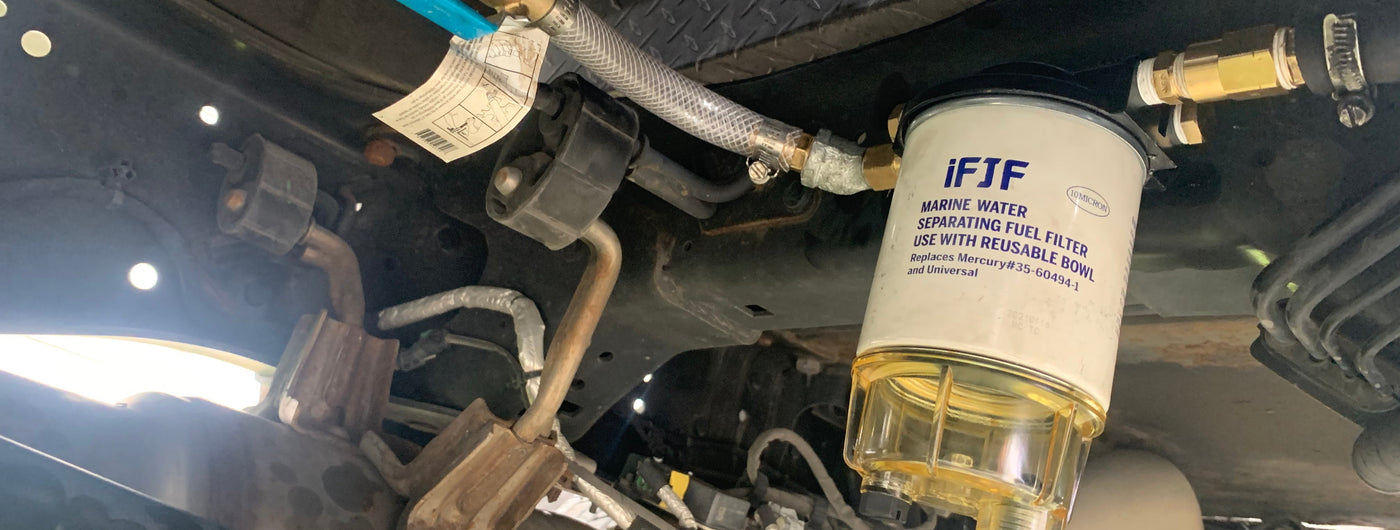
Do You Need a Marine Fuel Water Separator? Complete Outboard Guide
, by iFJF Direct, 15 min reading time
, by iFJF Direct, 15 min reading time

How fuel water separators work, why your outboard needs one, and how to choose the right micron rating. Top picks for Yamaha, Mercury, Suzuki & Honda. Prevent engine damage from water-contaminated fuel.
Every seasoned boater has a story — or knows someone who does. The engine sputters 3 miles offshore. The sky is darkening. You turn the key and hear nothing but a weak cough. More often than not, the culprit isn't mechanical failure. It's water in your fuel.
Modern marine fuel — especially E10 ethanol-blended gasoline — is a magnet for moisture. Ethanol is hygroscopic, meaning it actively absorbs water from the air. In a marine environment with high humidity, condensation inside your fuel tank is constant. Over weeks and months, that moisture accumulates.
Here's the real danger: phase separation. When ethanol-saturated gasoline absorbs enough water, the ethanol-water mixture separates from the gasoline and sinks to the bottom of the tank. What's at the bottom? Your fuel pickup line. What does your engine get? A slug of water-ethanol sludge that corrodes injectors, fouls carburetors, and leaves you dead on the water.
Consider these facts:
The bottom line: you can't prevent water from entering your fuel system. But you can stop it before it reaches your engine. That's where a marine fuel water separator filter enters the picture.
A fuel water separator is deceptively simple but critically effective. It sits between your fuel tank and your engine, performing two jobs simultaneously: filtering solid contaminants and separating water from fuel.
Fuel enters the filter housing and passes through a specialized media — typically cellulose fiber treated with water-repellent resins. Here's what happens inside:
Filter micron ratings are the single most misunderstood specification in marine filtration. A 10-micron filter captures particles as small as 0.0004 inches — roughly 1/7th the diameter of a human hair. A 30-micron filter allows particles three times larger to pass through.
Modern direct-injection and EFI outboard engines demand 10-micron filtration. Their high-pressure fuel pumps and precision injectors have clearances measured in microns. Larger particles cause:
If you're running a Mercury Verado, Yamaha SHO, or any modern four-stroke outboard, 10-micron filtration isn't optional advice — it's what your engine manufacturer specifies.
Spin-on filters are the standard for marine fuel water separators. Like an oil filter, they thread onto a mounting head and seal with a gasket. Replacement takes minutes with no tools beyond your hand. Cartridge-style filters require disassembling a housing, handling a messy element, and carefully reseating O-rings — all while dealing with fuel spills.
For the average boater doing their own maintenance, spin-on wins every time on convenience and reliability.
Some separators, including compatible variants of the S3213 design, feature a clear drain bowl at the bottom. This simple feature is a game-changer:
If you've been shopping for marine fuel filters, you've probably encountered the S3213 and S3214 designations and wondered what separates them. Here's the straight answer:
| Feature | S3213 | S3214 | Racor B32013 |
|---|---|---|---|
| Micron Rating | 10 micron | 10 micron | 10 micron |
| Port Size | 3/8" NPT | 3/8" NPT | 3/8" NPT |
| Design | Spin-On | Spin-On | Spin-On (Canister) |
| Clear Bowl | Optional variant | Typically included | Not included |
| Price Range | $24–35 | $30–45 | $45–70 |
| Cross-Reference | Mercury 35-60494-1, Sierra 18-7928-1, Yamaha MAR-FUELF-IL-TR | Same fitment; longer canister for higher flow applications | Genuine Racor; identical thread and gasket spec |
The key difference: The S3214 is essentially a longer S3213 — it has a taller canister for higher dirt-holding capacity in higher-flow applications. For most single-engine outboard setups under 300 HP, the S3213 provides excellent filtration with standard change intervals. The B32013 is Racor's OEM-branded equivalent — functionally identical but priced at a significant premium for the brand name.
Our take: For 95% of recreational boaters, the S3213 delivers everything you need at the best value. The filtration media, micron rating, and build quality are identical to the Racor B32013 — the difference is primarily the label and the price tag.
Replacing a spin-on fuel water separator is one of the easiest maintenance tasks on a boat. No mechanic needed. Here's the step-by-step:
Locate your fuel primer bulb and squeeze it until firm. Then loosen the fuel tank cap to release any vacuum in the system. If your boat has a fuel shut-off valve at the tank, close it. Place an absorbent pad or small container under the filter to catch drips.
Grip the old filter canister firmly and turn counterclockwise. Most spin-on filters are hand-tightened, so you shouldn't need a wrench. If it's stuck, a strap wrench or filter wrench will break it loose. Watch for fuel in the old filter — keep it upright as you unscrew.
Apply a thin film of clean engine oil or fuel to the rubber gasket on the new filter. This lubricates the seal and ensures it seats properly without binding or tearing. Do not pre-fill the filter with fuel — the mounting head will fill it as the system primes. Pre-filling risks introducing contaminants.
Thread the new filter onto the mounting head by hand. Spin it until the gasket contacts the mounting surface, then tighten an additional 3/4 to 1 full turn — hand-tight, not wrench-tight. Over-tightening can deform the gasket and cause leaks. Open your fuel shut-off valve if you closed one. Squeeze the primer bulb repeatedly until firm — you'll feel resistance when the system is purged of air.
Start the engine and let it idle for 2–3 minutes. Check the filter base for any signs of weeping or leaks. If dry, you're done. Total time: under 5 minutes.
Pro tip: Write the date and engine hours on the new filter with a permanent marker. You'll never wonder when you last changed it.
The S3213 filter fits a wide range of marine outboard applications. Here's a comprehensive cross-reference so you know exactly which part numbers it replaces:
| OEM / Brand | Part Number(s) |
|---|---|
| Mercury Marine | 35-60494-1, 35-809097 |
| Yamaha Marine | MAR-FUELF-IL-TR |
| Sierra Marine | 18-7928-1 |
| Mallory | 9-37801 |
| Racor | S3213, S3214, B32013 |
| iFJF | 802893Q01 |
| GLM Marine | 24940 |
| Johnson/Evinrude (OMC) | 502906, 174377 |
If your engine uses any of these part numbers, the S3213 is a direct drop-in replacement. No adapters. No modifications. Same thread pitch, same gasket surface, same flow characteristics.
Fuel filter replacement intervals aren't a suggestion — they're insurance against becoming that boater drifting offshore with a dead engine. Here are the guidelines:
For recreational boaters averaging 50–100 hours per season, one replacement at the start of each season is the minimum. If you run more than 100 hours annually, replace at the 100-hour mark. Which comes first — hours or calendar time — is your trigger.
Spring commissioning: replace the fuel water separator as part of your annual service, alongside the engine oil, gear lube, and lower unit water pump impeller. It's the cheapest engine insurance you can buy — $24 to protect a $15,000+ outboard.
Yes. The S3213 uses the standard 3/8"-18 NPT thread pattern and 11/16"-16 center post found on Mercury fuel water separator mounting heads, including Optimax engines from 135 HP to 300 HP. It is a direct replacement for Mercury part 35-60494-1, which is the factory filter for Optimax fuel systems. Always verify your existing filter's thread specification before ordering, but the vast majority of Mercury outboards use this standard fitment.
Both are 10-micron, spin-on fuel water separators with identical 3/8" NPT ports and thread specifications. The S3214 has a taller canister — approximately 1.5 inches longer — providing greater dirt-holding capacity for higher-flow applications. For most single outboard setups under 300 HP, the S3213 provides more than adequate capacity. The S3214 is commonly specified for larger displacement engines, multi-engine installations, or vessels with high fuel consumption rates where extended service intervals are desired. Either one will thread onto the same mounting head.
No adapter is required for standard Mercury, Yamaha, or aftermarket Racor-style mounting heads with 3/8" NPT ports and an 11/16"-16 center stud. The S3213 is a standard-form-factor spin-on filter — it threads directly onto your existing fuel filter head. If your boat uses a different mounting system (some Volvo Penta or older OMC setups), verify port size and thread pitch before ordering. For 99% of outboard applications with a spin-on fuel water separator, this is a direct fit.
Yes. The S3213 filter media is specifically engineered for compatibility with ethanol-blended fuels up to E10, which covers all standard recreational marine gasoline sold in the United States. The cellulose fiber media is treated with water-repellent resins that maintain their integrity and separation performance even when continuously exposed to ethanol. The gasket material is ethanol-resistant nitrile rubber. That said, ethanol fuel still attracts moisture — the filter catches it, but best practice remains using fresh fuel, keeping tanks full during storage, and adding a marine fuel stabilizer for seasonal layup.
Replace every 50–100 engine hours or once per season — whichever comes first. If you operate in humid conditions, use ethanol-blended fuel, or run in rough water (which stirs up tank sediment), lean toward the 50-hour side of that range. Boaters who store their vessel for winter should always replace the filter during spring commissioning. If your filter has a clear bowl and you see visible water accumulation before the 50-hour mark, drain the bowl — but still replace the filter element at the regular interval, as the media's water-repellent coating degrades over time.
Replaces Mercury 35-60494-1, Yamaha, and Racor filters. Standard 3/8" NPT ports. $23.99
Shop Now →Related Product: 807764A1 Marine Carburetor for Mercruiser 4.3L — available at iFJF Direct with free US shipping.
Complete aluminum spin-on kit — replaces S3240/120AT. Includes fittings & plugs. 10 Micron.
View R12H Combo →10 Micron spin-on replacement for R12H housing. Direct fit for S3240/120AT applications.
View R12T Element →30 Micron spin-on filter — diesel, gas & biodiesel compatible. Universal fit.
View PL420 →Browse our complete marine collection — fuel water separators, carburetors, outboard parts.
Shop Marine Collection →Need help choosing the right filter? Contact our support team — we'll help you find the exact fit for your outboard or marine engine.
Disclaimer: This guide is for informational purposes. Always consult your engine manufacturer's service manual for specific maintenance procedures and specifications. Part numbers are provided for cross-reference only — verify compatibility with your specific engine model before purchase.
Shop the marine fuel water separator from this guide
iFJF R12T Fuel Water Separator Combo Kit — 10-micron spin-on filter, 15 GPH, NPT ZG1/4-19 ports. Direct replacement for Racor S3240 & 120AT. Includes aluminum filter head, clear water bowl, 4 brass fittings and 2 port plugs.
Ships from the US · browse all marine fuel water separators
 Fuel Filter Assembly for 1992-2002 Chevy GMC 6.5L Diesel — Suburban Tahoe Silverado Sierra Yukon Hummer H1 — Replaces 10226035
$177.99
Fuel Filter Assembly for 1992-2002 Chevy GMC 6.5L Diesel — Suburban Tahoe Silverado Sierra Yukon Hummer H1 — Replaces 10226035
$177.99
 FS1098 Fuel Water Separator w/ PCV for Cummins B6.7 ISL8.9 — 10 Micron
$79.99
FS1098 Fuel Water Separator w/ PCV for Cummins B6.7 ISL8.9 — 10 Micron
$79.99
 68394482AA Water Separator for 2014-2018 Ram 1500 3.0L EcoDiesel
$489.73
68394482AA Water Separator for 2014-2018 Ram 1500 3.0L EcoDiesel
$489.73
 FS20081 Fuel Water Separator for EPA 2017 Cummins ISX15 X15
$47.99
FS20081 Fuel Water Separator for EPA 2017 Cummins ISX15 X15
$47.99