Marine Fuel Filters Marine Fuel Filters

Marine Fuel Filters

Marine Fuel Filters: Engine Protection for Saltwater, Freshwater, and Offshore Conditions Marine fuel filters face challenges that no tr...

5 products


  • 🔥 Best Seller✅ 6+ sold R12H Marine Fuel Water Separator S3240 120AT Aluminum Spin-On Combo Kit — Front View

    iFJF Marine Fuel Water Separator R12H - Aluminum Spin-On Combo (S3240 120AT)

    Marine-Grade Fuel Water Separator — Protect Your Engine, Save on Maintenance R12H Marine Fuel Water Separator — 10 Micron, 15 GPH, Aluminum Alloy, Replaces Racor S3240 / 120AT, NPT ZG1/4-19. Upgraded detachable filter element design: replace only the cartridge, keep the housing — saves up to 60% vs. disposable units. Complete kit includes aluminum housing, 3 filter elements, 4 O-rings, 2 inlet/outlet fittings, and 2 plugs. Key Features Detachable Spin-On Design — Replace only the filter element, not the entire unit. Quick tool-free cartridge swaps. Aluminum Alloy Body + Powder Coating — Superior corrosion resistance against seawater and harsh marine environments. Built to outlast iron/steel alternatives. 15 GPH High Flow Rate — Engineered for high-performance marine and diesel applications. Maintains fuel pressure under load. 10-Micron Advanced Filtration — High-capacity filter media removes water and particles as small as 10 microns for clean, water-free fuel delivery. Transparent Nylon Collection Bowl with Drain Valve — Visually inspect water accumulation and drain with a simple twist of the black valve. What's Included (Complete Combo) 1 x R12H Fuel Water Separator Assembly (aluminum housing + base) 3 x Filter Elements (1 installed + 2 bonus spares) 4 x O-Rings (2 installed + 2 bonus spares) 2 x NPT/ZG1/4-19 Connection Fittings 2 x Plugs for unused ports Installation Instructions Specifications Model R12H (R12T Upgrade) Material Aluminum Alloy + Powder Coating Flow Rate 15 GPH (57 LPH) Filtration 10 Micron Port Size NPT / ZG1/4-19 Filter Type Spin-On, Replaceable Cartridge Replaces Part # S3240, 120AT, 18-7987, RK10222, R12T Applications Marine boats, diesel trucks, generators, oil storage equipment Easy Installation — No Professional Tools Required (Boats) Designed for DIY boat owners. Comes with detailed step-by-step instructions: Apply fuel to both O-rings for lubrication before assembly Mount the unit securely — use screws on a wood board (min 1cm) with marine adhesive if you prefer not to drill into your boat Fill the filter housing completely with fuel before starting the engine to prevent air-lock Periodically check the collection bowl and drain accumulated water via the drain valve For automotive/diesel truck installation, professional installation is recommended. Frequently Asked Questions Q: What is the difference between R12H and R12T?A: The R12T has a sealed, non-removable filter element — you must replace the entire housing. The R12H has a detachable cartridge: keep the housing, replace only the internal filter, saving you money every service. Q: Will this fit my boat?A: As long as you have sufficient mounting space, it works for boats, cars, diesel trucks, and fuel storage equipment. Ports: NPT/ZG1/4-19. Q: Why won't my engine start after installation?A: You must fill the filter housing completely with fuel before starting. An empty filter causes air-lock and starting failure. Q: How often should I replace the filter element?A: Every 100 hours of operation or annually, whichever comes first. Check the transparent bowl regularly for water accumulation. Q: Is this compatible with Racor / Sierra / Yamaha systems?A: This replaces S3240 and 120AT filter elements commonly used across marine brands. Verify your port size (NPT/ZG1/4-19) and mounting space before ordering. WHOLESALE INQUIRIES Bulk pricing available for marine dealers, fleet operators, and distributors. Contact us for wholesale discounts. R12T Fuel Filter Water Separator Complete Combo Kit → 📦 Related Products & Guides 🛒 Complete Your System: R12H Replacement Filter Element (from $13.99) — Drop-in replacement cartridge for this assembly R12T Combo Kit ($29.99) — Compare: our economy sealed-unit option R12T Replacement Filter Element ($17.99) — Compatible spin-on cartridge R12T Clear Nylon Collection Bowl ($13.99) — Replacement drain bowl (also fits R12H) 📖 Related Guides: R12T vs R12H: Real Customer Review (20K+ Views) R12T vs Racor 120AT vs WIX 33583 Showdown R12T Marine Installation Guide: NPT & ZG Fittings 📦 Related Products & Guides 🛒 Complete Your System: R12H Replacement Filter Element (from $13.99) — Drop-in replacement cartridge for this assembly R12T Combo Kit ($29.99) — Compare: our economy sealed-unit option R12T Replacement Filter Element ($17.99) — Compatible spin-on cartridge R12T Clear Nylon Collection Bowl ($13.99) — Replacement drain bowl (also fits R12H) 📖 Related Guides: R12T vs R12H: Real Customer Review (20K+ Views) R12T vs Racor 120AT vs WIX 33583 Showdown R12T Marine Installation Guide: NPT & ZG Fittings Related Guide Read: RV VacuFlush Toilet Bowl Seal Replacement: Fix That Leak and Stop the Constant Pump Cycling Related Guide Read: 245R Diesel Fuel Water Separator Replacement: R25T WK940/38X Swap in Under an Hour

    $49.99

  • R12T Fuel Water Separator Element — 10 Micron Spin-On Filter for Boat Outboard Motors — Front View

    R12T Fuel Water Separator Element — 10 Micron Spin-On Filter for Boat Outboard Motors | iFJF

    Product Overview The iFJF R12T Fuel Water Separator Element is a high-efficiency 10-micron fuel water separator designed to protect your marine outboard engine from harmful water and debris contamination. Whether you're running a Mercury, Yamaha, Suzuki, or Honda outboard, this spin-on filter element provides reliable fuel filtration that meets or exceeds OEM specifications. Key Features 10-Micron Filtration: Captures 98% of water and particulate contaminants down to 10 microns, preventing injector damage and engine knock Spin-On Design: Quick, tool-free filter changes — no messy disassembly required Marine-Grade Construction: Corrosion-resistant coating stands up to saltwater environments and harsh marine conditions Universal Compatibility: Fits standard marine fuel water separator heads with 3/8" or 1/4" NPT ports OEM Equivalent: Direct replacement for Racor S3240, 120AT, Mercury 35-60494-1, and other leading marine filters Compatibility Make Engine Type Models Mercury 2-Stroke & 4-Stroke Outboard 4HP - 300HP (All Years) Yamaha 2-Stroke & 4-Stroke Outboard 4HP - 350HP (All Years) Suzuki 4-Stroke Outboard 4HP - 300HP (All Years) Honda 4-Stroke Outboard 2HP - 250HP (All Years) Johnson/Evinrude 2-Stroke Outboard 4HP - 300HP (All Years) Specifications Specification Value Filtration Rating 10 Micron Thread Type 1/4 NPT (ZG1/4-19) Flow Rate Up to 90 GPH Material Corrosion-resistant steel with marine coating Replaces OEM Racor S3240, 120AT, R12T, 18-7947 Why Choose iFJF Marine Filters Water in your fuel is the #1 cause of outboard engine failure on the water. Our r12t fuel water separator element uses advanced hydrophobic media that separates and captures water droplets while allowing clean fuel to pass through — protecting your injectors, fuel pump, and combustion chamber. Each filter is individually tested and backed by our satisfaction guarantee. Frequently Asked Questions Q: How often should I replace my marine fuel water separator?A: We recommend replacing your fuel water separator every 100 hours of operation or once per season, whichever comes first. If you notice reduced engine performance, difficulty starting, or water in your fuel filter bowl, replace immediately. Q: Will this fit my Mercury outboard?A: Yes. This filter fits standard marine fuel water separator heads with 1/4" NPT (ZG1/4-19) threads, compatible with all Mercury outboard engines from 4HP to 300HP when used with the appropriate filter head. Q: What's the difference between 10-micron and 30-micron filters?A: 10-micron filters capture finer particles and provide better protection for modern fuel-injected engines. If you have a carbureted older outboard, 30-micron may be sufficient, but for EFI/DFI engines, 10-micron is strongly recommended. Q: Can I use this filter with ethanol-blended fuel (E10)?A: Yes. Our filter media is compatible with ethanol-blended fuels up to E10. However, ethanol can accelerate water absorption, so more frequent filter changes may be needed if you use ethanol fuel regularly. Q: How do I know when the filter needs replacement?A: Signs include engine hesitation at high RPM, difficulty reaching full throttle, rough idle, or a visible water layer in the clear bowl (if equipped). Always carry a spare filter on board. Q: Is this filter USCG compliant?A: Yes. Our fuel water separators meet USCG and ABYC standards for marine fuel system components. Related Products Complete your marine fuel system maintenance: S3213 Fuel Water Separator — 3/8" NPT Marine Fuel Line Hose Kit 5/16" 10Ft 802893Q01 Fuel Water Separator Kit 📦 Related Products & Guides 🛒 This Element Fits: R12T Combo Kit ($29.99) — The complete fuel water separator this element fits R12T Economy Combo ($22.99) — Budget complete kit R12T Filter Base / Head ($17.99) — Need just the aluminum head? R12T Clear Nylon Bowl ($13.99) — Replacement collection bowl R12H Marine Aluminum Combo ($49.99) — Upgrade to replaceable-cartridge system R12H Replacement Filter Element (from $13.99) — For R12H assembly 📖 Related Guides: R12T vs R12H: Real Customer Review (20K+ Views) R12T Installation Guide — Step-by-Step Best Water Separator Fuel Filter Buying Guide 2026 iFJF R12T vs Genuine Racor 120A: Tractor Owner Tear-down 📦 Related Products & Guides 🛒 This Element Fits: R12T Combo Kit ($29.99) — The complete fuel water separator this element fits R12T Economy Combo ($22.99) — Budget complete kit R12T Filter Base / Head ($17.99) — Need just the aluminum head? R12T Clear Nylon Bowl ($13.99) — Replacement collection bowl R12H Marine Aluminum Combo ($49.99) — Upgrade to replaceable-cartridge system R12H Replacement Filter Element (from $13.99) — For R12H assembly 📖 Related Guides: R12T vs R12H: Real Customer Review (20K+ Views) R12T Installation Guide — Step-by-Step Best Water Separator Fuel Filter Buying Guide 2026 iFJF R12T vs Genuine Racor 120A: Tractor Owner Tear-down

    $19.99

  • S3213 Marine Fuel Water Separator — 10 Micron Spin-On Filter for Boat Outboard Motors — Front View

    S3213 Marine Fuel Water Separator — 10 Micron Spin-On Filter for Boat Outboard Motors | iFJF

    Product Overview The iFJF S3213 Marine Fuel Water Separator is a high-efficiency 10-micron fuel water separator designed to protect your marine outboard engine from harmful water and debris contamination. Whether you're running a Mercury, Yamaha, Suzuki, or Honda outboard, this spin-on filter element provides reliable fuel filtration that meets or exceeds OEM specifications. Key Features 10-Micron Filtration: Captures 98% of water and particulate contaminants down to 10 microns, preventing injector damage and engine knock Spin-On Design: Quick, tool-free filter changes — no messy disassembly required Marine-Grade Construction: Corrosion-resistant coating stands up to saltwater environments and harsh marine conditions Universal Compatibility: Fits standard marine fuel water separator heads with 3/8" or 1/4" NPT ports OEM Equivalent: Direct replacement for Racor S3240, 120AT, Mercury 35-60494-1, and other leading marine filters Compatibility Make Engine Type Models Mercury 2-Stroke & 4-Stroke Outboard 4HP - 300HP (All Years) Yamaha 2-Stroke & 4-Stroke Outboard 4HP - 350HP (All Years) Suzuki 4-Stroke Outboard 4HP - 300HP (All Years) Honda 4-Stroke Outboard 2HP - 250HP (All Years) Johnson/Evinrude 2-Stroke Outboard 4HP - 300HP (All Years) Specifications Specification Value Filtration Rating 10 Micron Thread Type 3/8 NPT Flow Rate Up to 90 GPH Material Corrosion-resistant steel with marine coating Replaces OEM Mercury 35-60494-1, 35-809097, 802893Q01, Yamaha MAR-FILT-001, Racor S3213/S3214 Why Choose iFJF Marine Filters Water in your fuel is the #1 cause of outboard engine failure on the water. Our s3213 marine fuel water separator uses advanced hydrophobic media that separates and captures water droplets while allowing clean fuel to pass through — protecting your injectors, fuel pump, and combustion chamber. Each filter is individually tested and backed by our satisfaction guarantee. Frequently Asked Questions Q: How often should I replace my marine fuel water separator?A: We recommend replacing your fuel water separator every 100 hours of operation or once per season, whichever comes first. If you notice reduced engine performance, difficulty starting, or water in your fuel filter bowl, replace immediately. Q: Will this fit my Mercury outboard?A: Yes. This filter fits standard marine fuel water separator heads with 3/8" NPT threads, compatible with all Mercury outboard engines from 4HP to 300HP when used with the appropriate filter head. Q: What's the difference between 10-micron and 30-micron filters?A: 10-micron filters capture finer particles and provide better protection for modern fuel-injected engines. If you have a carbureted older outboard, 30-micron may be sufficient, but for EFI/DFI engines, 10-micron is strongly recommended. Q: Can I use this filter with ethanol-blended fuel (E10)?A: Yes. Our filter media is compatible with ethanol-blended fuels up to E10. However, ethanol can accelerate water absorption, so more frequent filter changes may be needed if you use ethanol fuel regularly. Q: How do I know when the filter needs replacement?A: Signs include engine hesitation at high RPM, difficulty reaching full throttle, rough idle, or a visible water layer in the clear bowl (if equipped). Always carry a spare filter on board. Q: Is this filter USCG compliant?A: Yes. Our fuel water separators meet USCG and ABYC standards for marine fuel system components. Related Products Complete your marine fuel system maintenance: S3213 Fuel Water Separator — 3/8" NPT Marine Fuel Line Hose Kit 5/16" 10Ft 802893Q01 Fuel Water Separator Kit

    $49.99

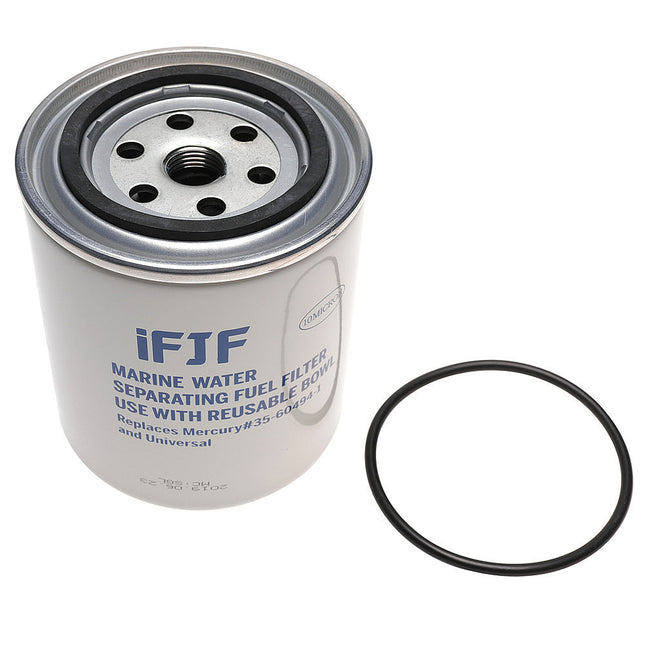
  • R12H Replacement Filter Element 10 Micron — Marine Fuel Water Separator Cartridge | iFJF

    iFJF R12H Replacement Filter Element 10 Micron — Marine Fuel Water Separator Cartridge | iFJF

    R12H Replacement Filter Element — Keep Your Marine Fuel System at Peak Performance This is the genuine iFJF R12H 10-micron replacement filter cartridge, designed exclusively for the R12H fuel water separator assembly. Unlike the older R12T (which forces you to replace the entire housing), the R12H system lets you swap only the filter element — saving you money every service while maintaining the same high-performance filtration. Key Features 10-Micron High-Capacity Filtration — Advanced filter media captures water and particles as small as 10 microns, ensuring clean, water-free fuel reaches your engine. Drop-In Replacement for R12H Assembly — Designed to fit the iFJF R12H aluminum housing perfectly. No modifications, no adapters needed. Cost-Effective Maintenance — Replace only the filter element, not the entire unit. A $13.99 cartridge vs. replacing a whole separator system. Marine & Diesel Ready — Built for the demands of saltwater marine environments, diesel trucks, generators, and fuel storage equipment. High Flow Design — Maintains 15 GPH flow rate when installed in the R12H assembly, ensuring consistent fuel delivery under load. Compatibility — Fits ONLY the iFJF R12H Assembly ⚠️ Important: This filter element is designed exclusively for the iFJF R12H fuel water separator housing. It replaces internal cartridges in assemblies that fit S3240, 120AT, 18-7987, and RK10222 form factors. ✅ Compatible with: iFJF R12H Fuel Water Separator Assembly ❌ NOT compatible with: Older R12T sealed units (the R12T cannot accept replacement cartridges) Specifications Product R12H Replacement Filter Element (1 Pack) Filtration Rating 10 Micron Compatible Assembly iFJF R12H Fuel Water Separator (Aluminum Housing) Replaces Part # S3240 · 120AT · 18-7987 · RK10222 (filter element only) Flow Rate 15 GPH (when installed in R12H assembly) Material High-efficiency cellulose/synthetic blend filter media Recommended Replacement Interval Every 100 hours of operation or annually When to Replace Your Filter Element 🔴 Engine hesitation or power loss under load 🔴 Visible water in the transparent collection bowl 🔴 More than 100 operating hours since last change 🔴 Annual preventive maintenance schedule 🔴 After any fuel contamination event Frequently Asked Questions Q: Will this fit the older R12T unit?A: No. The R12T is a sealed unit with a non-removable filter — you must upgrade to the R12H assembly to use replacement cartridges. This is why the R12H saves you money long-term. Q: How do I install the replacement element?A: 1) Shut off fuel supply. 2) Unscrew the R12H housing. 3) Remove old element (may require firm push). 4) Insert new element. 5) Lubricate O-rings with clean fuel. 6) Reassemble and fill with fuel before starting. Q: How many elements come in this package?A: This is a single (1-pack). We also offer a cost-saving 2-pack. Q: Do I have the R12H assembly?A: If your fuel water separator has a detachable aluminum housing with a replaceable internal cartridge, you have the R12H. Need the assembly? Shop here. Complete Your Fuel System 🛒 R12H Complete Assembly — The full aluminum housing + 3 elements combo 🛒 2-Pack Filter Elements — Save more with a twin pack 📖 See our 20K-view customer review: R12T vs R12H comparison & install guide → R12T Fuel Filter Water Separator Complete Combo Kit → 📦 Related Products & Guides 🛒 This Cartridge Fits: R12H Marine Aluminum Combo ($49.99) — The complete R12H fuel water separator assembly R12T Combo Kit ($29.99) — Compare: our economy sealed-unit option R12T Replacement Filter Element ($17.99) — Compatible spin-on cartridge for R12T R12T Clear Nylon Collection Bowl ($13.99) — Replacement drain bowl (fits R12H too) 📖 Related Guides: R12T vs R12H: Real Customer Review (20K+ Views) R12T vs Racor 120AT vs WIX 33583 Showdown R12T Marine Installation Guide: NPT & ZG Fittings 📦 Related Products & Guides 🛒 This Cartridge Fits: R12H Marine Aluminum Combo ($49.99) — The complete R12H fuel water separator assembly R12T Combo Kit ($29.99) — Compare: our economy sealed-unit option R12T Replacement Filter Element ($17.99) — Compatible spin-on cartridge for R12T R12T Clear Nylon Collection Bowl ($13.99) — Replacement drain bowl (fits R12H too) 📖 Related Guides: R12T vs R12H: Real Customer Review (20K+ Views) R12T vs Racor 120AT vs WIX 33583 Showdown R12T Marine Installation Guide: NPT & ZG Fittings

    $15.99 - $21.00

  • PL420 Fuel Water Separator Filter 30 Micron Spin-On Diesel Filter Front View

    iFJF PL420 Fuel Water Separator Filter — 30 Micron Spin-On Diesel Gas Biodiesel | iFJF

    PL420 Fuel Water Separator Filter — 30 Micron Spin-On Protection The PL420 Fuel Water Separator Filter is a high-efficiency spin-on filter designed to remove water, rust, sand, dirt, and metal particles from diesel, gasoline, and biodiesel fuel systems. Built for standard 420-series filter housings, this water separator protects your engine's fuel pump, injectors, and combustion chamber from contamination damage. Key Features 30 Micron Absolute Filtration — Captures harmful particles 30 microns and larger, including carbon, sand, rust, and metal debris Water Separation — Hydrophobic filter media separates emulsified water from fuel, preventing injector rust and microbial growth Multi-Fuel Compatible — Safe for diesel, gasoline, biodiesel (B5-B100), and blended fuels Spin-On Design — Tool-free replacement — spin off the old filter, spin on the new PL420 in minutes Universal 420-Series Fit — Fits standard engine fuel filter assembly 420 housings across multiple applications Applications Application Equipment Types Stationary Generators Standby & prime power diesel generators Agricultural Tractors, harvesters, sprayers, irrigation pumps Marine Inboard, stern drive, auxiliary diesel engines Automotive Light truck and automotive diesel fuel systems Industrial Construction equipment, mining machinery, stationary engines Biodiesel Processing and storage equipment, transfer pumps Technical Specifications Specification Value Filter Type Spin-On Fuel Water Separator Micron Rating 30 Micron (Absolute) Thread Standard 420-Series Fuel Compatibility Diesel, Gasoline, Biodiesel B5-B100 Water Removal 95%+ Efficiency Replacement Interval Every 15,000 miles / 500 hours / 12 months Part Number PL420 Why Replace Your Fuel Water Separator Regularly? Diesel and gasoline naturally accumulate water through condensation in storage tanks and vehicle fuel tanks. Water in fuel causes: Injector Failure — Water displaces the lubricating film, causing injector tip erosion and seizure Fuel Pump Damage — High-pressure pumps rely on fuel for lubrication; water accelerates internal wear Microbial Growth (Diesel Bug) — Bacteria and fungi thrive at the fuel-water interface, producing corrosive acids Filter Plugging — Rust particles from steel tanks clog filters and injectors downstream Installation Guide Shut off the engine and allow the fuel system to cool Place a drain pan under the filter housing — some fuel will spill Unscrew the old filter by hand or with a filter wrench Clean the filter head mounting surface with a clean rag Apply a thin film of clean diesel to the new filter's gasket Spin on the new PL420 filter until the gasket contacts the base, then tighten an additional 3/4 turn Prime the fuel system per your engine's manual before starting Start the engine and check for leaks FAQ Q: How often should I replace my PL420 fuel water separator?A: Replace every 15,000 miles, 500 engine hours, or every 12 months — whichever comes first. Replace more frequently in dusty conditions or when running biodiesel blends above B20. Q: Does this filter work with biodiesel?A: Yes — the filter media handles biodiesel blends up to B100. However, biodiesel's solvent properties mean we recommend more frequent replacement. Q: Will this fit my engine?A: If your engine uses a standard 420-series spin-on filter housing, this PL420 fits. Check your current filter part number — if it shows PL420 or equivalent cross-reference, this is your replacement. Q: 30 micron vs 10 micron — which do I need?A: 30 micron is ideal as a primary water-separating filter — it removes bulk water and larger debris without restricting fuel flow. For final filtration before injection, a secondary 2-10 micron filter downstream provides fine-particle protection. Q: How do I know when the filter needs replacing?A: Signs include hard starting, rough idle, loss of power under load, or visible water in the separator bowl. A vacuum gauge on the filter head is the most reliable indicator — replace at 10 inHg or per manufacturer spec.

    $129.99

Marine Fuel Filters: Engine Protection for Saltwater, Freshwater, and Offshore Conditions

Marine fuel filters face challenges that no truck or tractor filter ever encounters. Salt spray corrosion, constant vibration from wave action, extreme humidity inside enclosed engine compartments, and fuel that may sit for months between boating seasons all conspire to compromise filtration performance. A marine diesel or gasoline engine operates in one of the harshest environments imaginable for precision fuel system components—and when a fuel filter fails 20 miles offshore, you can't simply pull over and call a tow truck. Marine fuel filters must deliver uncompromising reliability under conditions that would destroy an automotive filter within a single season. That means aluminum alloy or stainless steel construction to resist saltwater corrosion, spin-on designs that can be changed in minutes with basic hand tools, and high-efficiency filter media that traps everything from coarse tank sediment to microscopic water droplets before they reach your injectors or carburetor.

At iFJF Direct, we engineer our marine fuel filters specifically for the demands of saltwater and freshwater boating. Our filters feature 10-micron high-efficiency filtration media encased in corrosion-resistant aluminum alloy housings with marine-grade powder coating. The spin-on design means filter changes are fast, clean, and tool-free aboard a rocking boat. Each unit incorporates a water-separating barrier layer that strips moisture from fuel before it can cause corrosion or microbial growth inside your engine's fuel system. Whether you're maintaining an inboard diesel cruiser, an outboard-powered fishing boat, a high-performance offshore racing vessel, or a sailboat auxiliary engine, the right marine fuel filter is the difference between confident offshore passages and expensive emergency repairs. Our filters are compatible with Yamaha, Mercury, Volvo Penta, Yanmar, Cummins Marine, Caterpillar Marine, and all major marine engine platforms.

Why Marine Fuel Filters Are Critical for Your Boat or Yacht

Marine fuel systems face a perfect storm of contamination risks that land-based engines simply don't encounter. Understanding these unique threats explains why a dedicated marine-grade fuel filter is not optional—it's essential safety equipment:

  • Persistent Water Contamination: Boats operate in a 100% humidity environment. Day-night temperature cycling inside an enclosed engine compartment creates relentless condensation that drips into fuel tanks. A half-full 100-gallon tank can produce several ounces of water condensation per week in tropical conditions. Additionally, deck fill caps that aren't perfectly sealed allow rainwater and spray to enter the tank directly. A marine fuel filter with aggressive water separation capability is the only barrier preventing this water from reaching your injectors.
  • Fuel Aging and Degradation: Unlike a daily-driven truck that cycles through a tank of fuel every week, a recreational boat's fuel may sit in the tank for 3-6 months between trips. During that time, lighter fuel fractions evaporate, leaving behind varnish and gum deposits. Oxidation creates acidic compounds that corrode aluminum tanks and fuel system components. Microbial growth flourishes at the fuel-water interface inside the tank. A high-capacity marine fuel filter must handle the increased particulate load from degraded fuel without plugging prematurely.
  • Saltwater Corrosion: Salt spray penetrates every corner of a marine engine compartment. Standard steel filter canisters rust through within months. Threaded mounting surfaces seize solid. Drain valves corrode shut. Marine fuel filters combat this with aluminum alloy bodies, stainless steel internal components, and protective coatings rated for continuous salt spray exposure. This isn't a cosmetic upgrade—it's a fundamental material requirement that directly affects filter integrity and serviceability.
  • Vibration and Shock Loading: A boat pounding through 4-foot chop subjects every component to continuous vibration and occasional shock loads that far exceed the smooth operation of a highway vehicle. Filter mounting brackets, canister seams, and internal element supports must be engineered to withstand these dynamic loads without cracking, loosening, or developing fatigue failures.
  • Emergency Dependability: Fuel contamination is the single most common cause of marine engine failure, and engine failure at sea is a genuine safety emergency. A properly maintained marine fuel filter system—with a clear sight bowl for instant water inspection and a quick-change spin-on design—gives you the confidence to venture offshore knowing you can diagnose and resolve a fuel contamination issue without outside assistance.

Common Problems & Warning Signs of Marine Fuel Filter Issues

Spotting fuel filter problems before they strand you requires awareness of the subtle symptoms that precede a complete failure:

  • Engine Stumbles or Dies When Pounding Through Chop: Wave action stirs up sediment that has settled at the bottom of your fuel tank. This is when your filter faces its highest contaminant load. If your engine runs smoothly in calm water but stumbles, surges, or stalls when conditions get rough, you almost certainly have sediment-loaded fuel overwhelming a clogged or undersized filter.
  • Loss of Top-End RPM: A partially restricted fuel filter may allow enough flow for idle and low-speed cruising, but starves the engine at wide-open throttle. If your boat won't reach its normal maximum RPM—especially if it was reaching that RPM last trip—check your fuel filter first. A restriction of just 2-3 PSI at the filter can reduce fuel flow enough to cost you 500-1000 RPM at the top end.
  • Water in Sight Bowl: If your filter has a clear sediment bowl, inspect it before every trip. Any visible water accumulation (it appears as clear bubbles or a distinct layer below the fuel) must be drained immediately. A bowl that's half-full of water means your filter is overwhelmed and water is likely already passing through to the engine.
  • Rust or Corrosion on the Filter Canister: External rust on a steel canister or white powdery oxidation on aluminum is a warning that the filter body may be compromised. A pinhole in a filter canister allows unfiltered fuel and air to bypass the element entirely. Replace any filter showing visible corrosion immediately—don't wait for the scheduled interval.
  • Fuel Smell in the Engine Compartment: A leaking filter seal or corroded canister allows fuel vapors to escape. In an enclosed engine compartment, this creates an explosion hazard in addition to the filtration bypass. Any fuel odor demands immediate investigation.
  • Hard Starting After Storage: If your engine starts reluctantly after sitting for weeks or months, the fuel in the filter and lines may have degraded. Volatile compounds evaporate, leaving behind heavy varnish that doesn't atomize or ignite properly. Fresh fuel and a new filter element often solve this problem instantly.

How to Choose the Right Marine Fuel Filter

Marine fuel filter selection involves matching the filter to your engine type, fuel flow requirements, and operating conditions:

  • Engine Type Compatibility: Diesel marine engines (Yanmar, Volvo Penta, Cummins, Caterpillar) require filters rated for diesel fuel with water separation capability. Gasoline marine engines (Mercury, Yamaha, Suzuki, Honda) need filters compatible with ethanol-blended fuels and may not require water separation if using a water-separating filter upstream. Always verify chemical compatibility with the fuel type you run.
  • Flow Rate (GPH): Match the filter's rated flow to your engine's maximum fuel consumption plus a 30% safety margin. A 300 HP diesel burning 15 GPH at WOT needs a filter rated for at least 20 GPH. For twin-engine installations, each engine should have its own dedicated filter, or the shared filter must be rated for the combined flow of both engines with margin.
  • Micron Rating: For marine diesel engines, a 10-micron primary filter (water separator) followed by a 2-5 micron secondary filter on the engine provides optimal protection in a two-stage setup. For single-filter installations, a 10-micron water-separating filter is the practical minimum. Marine gasoline engines can typically use 10-30 micron filtration without issue.
  • Construction Material: Aluminum alloy with marine-grade corrosion protection is the minimum standard for saltwater use. Stainless steel components for the mounting bracket, drain plug, and internal support structure resist the relentless corrosion of the marine environment. Avoid filters with exposed steel components unless you enjoy drilling out rusted bolts.
  • Sight Bowl vs. Metal Bowl: A clear sight bowl lets you inspect for water and sediment at a glance without tools—this is invaluable for peace of mind before departing the dock. Metal bowls are more durable for commercial and heavy offshore use, but require periodic draining to check for water. If your boat is surveyed or inspected (USCG, insurance), verify that your sight bowl material meets flame-resistance requirements for gasoline engine compartments.
  • Mounting Configuration: Ensure the filter's bracket and port locations work with your available mounting space. Spin-on filters need clearance above the filter for removal. Remote-mount filter heads allow flexible placement with hose connections to the filter head, while direct-mount units attach directly to the engine or a bulkhead. Dual-filter setups with a selector valve allow filter changes without shutting down the engine—a feature worth its weight in gold for commercial and serious offshore vessels.

Maintenance Tips & Replacement Schedule

Maintenance Task Recreational Boat Commercial / Charter Boat Notes
Inspect sight bowl / drain check Before every trip Daily Drain any water immediately—never "get to it later"
Replace primary filter element Every 100 hours or annually Every 200-300 hours or quarterly Change before winter layup, not after—old fuel degrades over storage
Replace secondary (engine) filter Every 200 hours or annually Every 400-600 hours Follow engine manufacturer's schedule
Replace O-rings and gaskets Every filter change Every filter change Never reuse old seals—they harden and shrink
Inspect fuel lines and connections Annually Quarterly USCG requires A1-rated fuel hose; check date codes
Pressure/vacuum gauge check Before every trip (if equipped) Daily (if equipped) Rising vacuum = clogging filter; change when in the yellow zone

Essential marine fuel filter best practices:

  • Install a vacuum gauge on the outlet side of your primary filter. This $30 instrument tells you exactly when filter restriction is building before performance suffers. Change the filter when vacuum reaches 5-7 inHg for gasoline or 7-10 inHg for diesel.
  • Carry at least two spare filter elements aboard at all times, plus the wrench needed to change them. Know how to prime your engine after a filter change—air in the fuel lines is the #1 cause of "I changed the filter and now it won't start."
  • Use a biocide additive in your fuel tank before extended storage to prevent microbial growth. Treat the tank, run the engine long enough for treated fuel to fill the filter and lines, then change the filter at the start of next season to remove dead organisms.
  • If your boat has saddle tanks, alternate their use regularly to prevent fuel from aging in one tank for extended periods. Stale fuel is the single biggest contributor to premature filter plugging.
  • When replacing a spin-on filter, lubricate the new O-ring with clean diesel fuel or motor oil, then hand-tighten plus 1/2 to 3/4 turn. Overtightening with a wrench crushes the gasket and guarantees a leak.

Browse More Diesel Parts

  • Diesel Fuel Filters — High-efficiency particulate filters for diesel trucks, generators, agricultural equipment, and stationary engines. 10-micron filtration with spin-on convenience.
  • Fuel Water Separators — Dedicated water separation units with clear sediment bowls, drain valves, and modular replaceable elements. The perfect primary filter upstream of your engine-mounted final filter.
  • Oil Filters — Marine engines work hard and run hot. Protect your engine oil with high-capacity filters that handle extended oil change intervals and the heavy soot loading of marine diesel operation.
  • Air Filters — Salt-laden marine air is abrasive. Heavy-duty air intake filtration prevents salt crystals and sand from sandblasting your turbocharger compressor wheel and cylinder walls.
  • Fuel Additives — Marine-specific fuel stabilizers, biocides, and water dispersants formulated to protect fuel during extended storage and combat the unique contamination challenges of the marine environment.

Frequently Asked Questions

How often should I change my boat's fuel filter?

For recreational boats, replace your primary fuel filter/water separator at least once per season—ideally at the start of the season with fresh fuel in the tank. If you boat more than 100 hours per year, change it every 100 operating hours. The best practice is to change the filter before winter layup as well, so your fuel system sits with clean fuel rather than contaminated fuel that degrades over months of storage. Commercial and charter vessels operating daily should follow a 200-300 hour schedule or quarterly replacement. The golden rule of marine fuel filtration: change your filter more often than you think you need to. A $25 filter changed preventatively is infinitely cheaper and less stressful than a clogged filter at the inlet on an outgoing tide.

Why does my boat's fuel filter keep clogging so quickly?

Rapidly clogging fuel filters—plugging in less than 20-30 hours of operation—indicate a fuel tank contamination problem, not a filter problem. The most common causes are: (1) Years of accumulated sediment and sludge in the tank being gradually loosened by fuel sloshing, (2) microbial growth (diesel bug) producing biomass that overwhelms the filter, (3) a deteriorating fuel tank lining or internal coating shedding particles, (4) ethanol-blended gasoline acting as a solvent and stripping varnish deposits from tank walls and fuel lines. The solution is to have your fuel tank professionally cleaned ("fuel polishing") and to treat the fresh fuel with a biocide. Once the tank contamination source is eliminated, your filters will achieve their normal service life. Continuously replacing filters without addressing the tank contamination is treating the symptom, not the disease.

Can I use an automotive fuel filter on my boat?

No—and this is one area where cutting corners can have life-threatening consequences. Automotive fuel filters are not designed for the marine environment. Their steel canisters rust rapidly in salt air. Their internal components may not resist corrosion from water-contaminated marine fuel. Their seals and O-rings may not be compatible with ethanol-blended gasoline at marine humidity levels. Most critically, automotive filters lack the water separation capability that marine engines depend on. USCG regulations and marine insurance surveys may also require marine-rated filtration components that meet specific flame-resistance and pressure-test standards. Use only marine-rated fuel filters with aluminum or stainless steel construction, USCG-compliant components where applicable, and proven water separation capability. Your safety—and the safety of everyone aboard—depends on it.

What's the correct fuel filter setup for a twin-engine boat?

The best-practice setup for a twin-engine vessel is a dedicated primary filter/water separator for each engine, plus the engine-mounted secondary filter on each engine. This provides complete redundancy—a problem with one engine's fuel system doesn't affect the other engine, which is critical for getting home safely. For extra reliability, install a dual-filter manifold for each engine with a selector valve. This allows you to switch to a fresh filter while underway without shutting down. The fuel supply should also have dual pickups from the tank (or separate supply lines from independent tanks) with isolation valves, so a clogged pickup on one side doesn't starve both engines. In an emergency, carry the hoses and fittings to cross-connect the fuel supply so you can feed both engines from one tank or one pickup if necessary.

© 2026 iFJF Direct | Sitemap

    • American Express
    • Diners Club
    • Discover
    • Maestro
    • Mastercard
    • PayPal
    • Visa

    Login

    Forgot your password?

    Don't have an account yet?
    Create account