7.3L Powerstroke Fuel Filter Replacement (1999-2003 Ford F-250/F-350)
, by iFJF Direct, 10 min reading time
, by iFJF Direct, 10 min reading time

The short answer: On a 1999–2003 Ford 7.3L Powerstroke (F-250, F-350, F-450, F-550 Super Duty, Excursion, and E-350/E-450/E-550 vans), the fuel filter sits in a fuel bowl on top of the engine, under a...
The short answer: On a 1999–2003 Ford 7.3L Powerstroke (F-250, F-350, F-450, F-550 Super Duty, Excursion, and E-350/E-450/E-550 vans), the fuel filter sits in a fuel bowl on top of the engine, under a plastic cover held by two 13mm nuts. Remove the cover, unthread the filter cap, swap the FD-4596 cartridge and its two O-rings, snug the cap only about 1/8 turn past contact, then cycle the key a few times to prime. The job takes 15–30 minutes with hand tools — no crawling under the truck.
The 7.3L Powerstroke is one of the last great DIY diesel engines, and its top-of-engine fuel filter is a big reason why. There is no chassis-mounted filter to fight, no skid plate to drop, and no special bleeder tool. If you can turn a socket, you can do this job in your driveway.
This guide walks through the exact procedure a technician uses on a 7.3L Super Duty, including the two mistakes that cause most of the problems: over-tightening the cap and rushing the prime. Whether you drive a 1999 F-350 work truck or a 2003 Excursion, the steps are the same.
You need basic hand tools and one correct filter. The 1999–2003 7.3L uses the Motorcraft FD-4596 cartridge (Ford OEM part number F81Z-9N184-AA). The older 1994–1997 OBS Powerstroke uses a different filter (FD-4595), so verify your year before you buy.
| Item | Notes |
|---|---|
| 13mm socket + ratchet | Removes the two nuts holding the engine cover |
| Adjustable wrench or filter-cap socket | Snugs the filter cap; some caps have tabs, some have a socket drive |
| New FD-4596 fuel filter | Includes the small bottom O-ring and the larger top O-ring |
| Clean diesel fuel | To pre-fill the bowl and cut down on priming |
| Brake parts cleaner + shop rags | Dries the area so you can spot any leak instantly |
| Drain pan | Catches the fuel that spills when the cap comes off |

This is the exact cartridge for 1999–2003 F-250/F-350/F-450/F-550 Super Duty, Excursion, and E-Series 7.3L diesels. It ships with the correct bottom and top O-rings, traps 99%+ of contaminants, and costs a fraction of the dealer price.
If you are already under the hood, keep a spare on the shelf — dirty fuel and winter gelling are the two fastest ways to clog a 7.3L filter.
Shop Now →It is on top of the engine, front and center, inside a cast aluminum fuel bowl. Nothing is underneath the truck. A plastic engine cover hides it; once that cover is off, the filter cap is staring at you. This top-mounted design is why a 7.3L fuel filter change is one of the few diesel maintenance jobs you can finish on a lunch break.
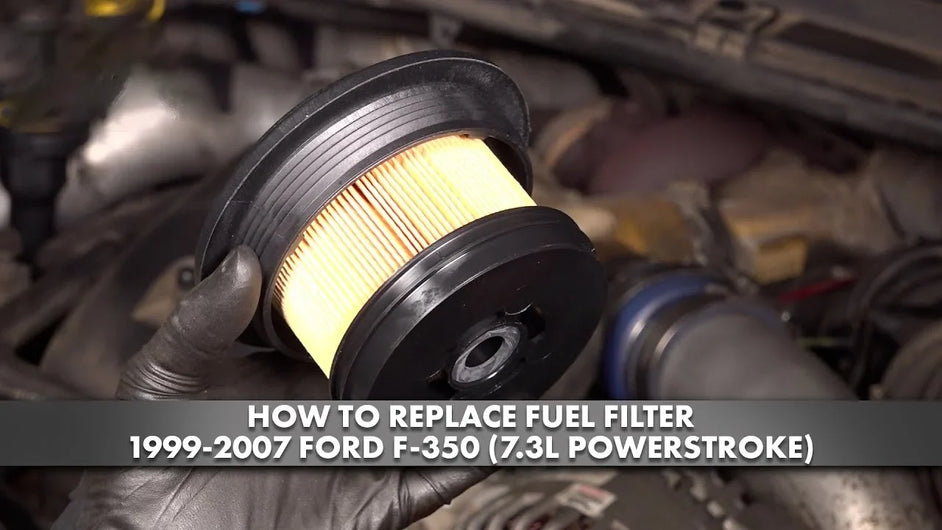
Inside the bowl the filter is a drop-in cartridge — not a spin-on canister. You lift the old element out, drop the new one in, and thread the cap back down. The cap seals with an O-ring, so torque is not what stops leaks; the O-ring is.
Use a 13mm socket to remove the two mounting nuts that hold the plastic cover on. Lift the cover off and set it aside. You now have a clear view of the fuel filter cap inside the bowl.
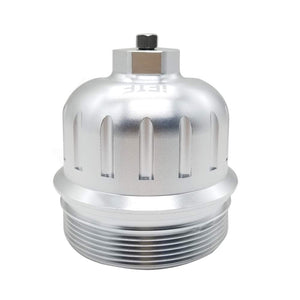
Not every 7.3L cap looks the same — some have a socket drive on top, some have a handle, and some (like the truck in this guide) have tabs you can spin by hand. Use whatever tool fits yours. Unthread the cap all the way, then lift it up and out.
Grab the filter element and lift it straight out. Let it drain as much as you can over a pan — the bowl holds fuel and a little will spill, which is normal. Pull off the old O-ring; it gets replaced every time.
Hold the new filter upside down. A round O-ring goes onto the groove on the bottom of the element — make sure it is seated all the way around. Fit the larger O-ring up top. Some kits come with the cap already attached to the filter; if so, drop the whole assembly in.
Lower the filter in slowly so it soaks up fuel on the way down — that keeps fuel from spilling everywhere and reduces the air you have to bleed later. Let it settle on its own. Once it reaches the threads, spin the cap on by hand and make sure it is not cross-threading and that the O-ring stays in place.
If the cap will not bottom out by hand, something is in the way — usually the O-ring or a filter that did not seat. Once it bottoms out, snug it with a wrench: about 1/8 turn past contact is plenty. The O-ring does the sealing, and over-tightening is how you crack the cap.
Wipe up spilled fuel and dry the area with brake parts cleaner so any future leak is obvious. Reinstall the cover and snug the two 13mm nuts. To prime, simply cycle the key to the RUN position and wait about 30 seconds. The in-tank lift pump pushes fuel up to the filter and high-pressure pump, and any air escapes to the tank through the return line. Do this several times — you can hear air rushing through the filter at first, then an audible click inside the cab when the pump relay shuts off.
Once the prime cycles are done, start the engine. Let it idle and inspect the bowl and cap for weeping. If it is dry, take it for a road test and re-check after the first drive.
| Tip | Why it matters |
|---|---|
| Fill the bowl / drop the filter in slowly | Less air in the system means less cranking and faster starts |
| Snug the cap only ~1/8 turn past contact | The O-ring seals the bowl; over-torquing cracks the plastic cap |
| Replace both O-rings every single time | A reused or pinched O-ring is the #1 cause of air intrusion and hard starts |
| Dry the area with brake parts cleaner | A clean, dry surface makes a new diesel leak visible in seconds |
| Listen for the pump relay click during prime | Confirms the lift pump ran a full cycle before you crank |
Match your model year before ordering. The 1999–2003 Super Duty 7.3L takes a different element than the 1994–1997 OBS truck.
| Brand | Part Number | Notes |
|---|---|---|
| Motorcraft (OEM) | FD-4596 | Factory filter for 1999–2003 7.3L Powerstroke |
| Ford | F81Z-9N184-AA | OEM service part number for the same element |
| iFJF | FD-4596 | Direct-fit aftermarket replacement, includes O-rings |
| Motorcraft | FD-4595 | 1994–1997 OBS 7.3L only — does NOT fit 1999–2003 |
If your cap is cracked, stripped, or the tabs are rounded off, replace it. Filter caps cross to Ford F81Z-9G270BA and aftermarket numbers 1831193C91, RK31449, and 904-203.
While the cover is off, it is smart to check the rest of the intake and filtration. A clogged 7.3L Powerstroke engine air filter (CA9676) will rob power and hurt fuel economy the same way a dirty fuel filter does.
Every 15,000 miles, or once a year, whichever comes first. Tighten that to 10,000 miles if you fuel from farm tanks, run biodiesel blends, or drive in dusty conditions. Symptoms that you waited too long include low power under load, longer cranking, rough idle, and random stalling.
Yes, if it is the 7.3L Powerstroke. The FD-4596 fits 1999–2003 F-250, F-350, F-450, and F-550 Super Duty trucks, 2000–2003 Excursion, and E-350/E-450/E-550 vans. Ford switched to the 6.0L mid-2003, so confirm which engine your truck has.
It helps, but it is not mandatory. Pre-filling the bowl or letting the filter soak on the way in reduces cranking time. If you skip it, cycle the key several times so the lift pump fills the bowl before you crank.
Turn the key to the RUN (not START) position and wait about 30 seconds, then repeat several times. The in-tank lift pump pushes fuel forward and air returns to the tank. You will hear an audible click when the pump relay cycles off.
A quality aftermarket cartridge with the correct O-rings performs the same job at a lower price. The key is fitment and O-ring quality — a pinched O-ring causes air intrusion regardless of brand.
Snug only — about 1/8 turn past the point where it bottoms out. The O-ring does the sealing, and over-tightening cracks the cap.
It can cause low power, hard starting, and stalling under load. On a 7.3L, though, random stalling with no restart until the engine cools is usually a cam position sensor, not the filter.
The 7.3L fuel bowl is always full of diesel by design. Expect a small spill when the cap comes off — that is normal, not a failure.
Browse the full fuel filter collection for diesel, gas, and marine filtration, or grab the complete FD-4596 fuel filter and cap kit if your cap is due for replacement.