
Top 5 Diesel Fuel Filter Housing Problems (And How to Fix Them)
, by iFJF Direct, 26 min reading time
, by iFJF Direct, 26 min reading time

Why Your Fuel Filter Housing Deserves Your Attention Right Now If you own a diesel truck — whether it's a Duramax, Powerstroke, or Cummins — your fuel filter housing is one of the hardest-working components you never think about. Until it f…
If you own a diesel truck — whether it's a Duramax, Powerstroke, or Cummins — your fuel filter housing is one of the hardest-working components you never think about. Until it fails. And when it does, you're looking at anything from a rough idle to a no-start on the side of I-75 at 11 PM.
Fuel filter housings on modern common-rail diesels operate under extreme conditions: 60+ PSI of fuel pressure on the low-pressure side, 4,000-30,000 PSI at the rail, constant thermal cycling from -20°F winter cold starts to 200°F+ operating temps, and a steady diet of whatever comes out of the pump. The housing isn't just a plastic can — it's a precision pressure vessel that manages filtration, water separation, air bleed, and sensor integration. When one piece of that puzzle fails, the whole system suffers.
At iFJF.net, we've helped thousands of diesel owners diagnose and fix fuel system problems. Here are the five most common fuel filter housing failures we see in the shop — and exactly how to fix them before they leave you stranded.
What goes wrong: The OEM plastic fuel filter cap on 2017-2020 GM Duramax L5P engines (PN 134001) is notorious for cracking at the threads and stripping under routine filter changes. The nylon-reinforced plastic simply can't handle repeated heat cycles plus the torque required to maintain a fuel-tight seal. Once the threads deform — even slightly — you'll get a persistent diesel fuel weep that turns into a full-blown leak under WOT fuel demand.
Warning signs:
What it costs to ignore it: A leaking filter cap lets air into the low-pressure fuel system. The CP4.2 high-pressure pump (the one that grenades and sends metal through all six injectors) relies on fuel for both lubrication and cooling. Air in the fuel = metal-on-metal pump wear. A $55 cap replacement today is the difference between a driveway fix and a $4,000-$8,000 CP4 replacement plus injector set. We've seen it more times than we can count.
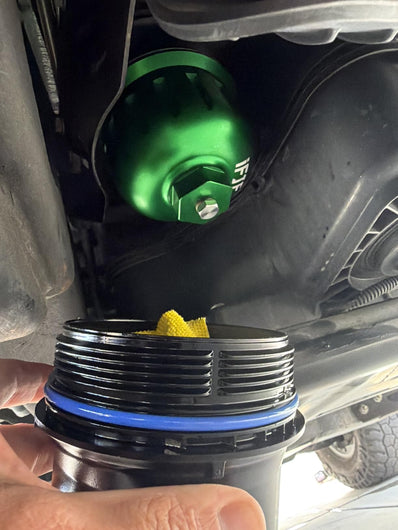
Fix: Replace the plastic cap with a billet aluminum upgrade. Our Duramax Billet Aluminum Filter Cap is CNC-machined from 6061-T6 aluminum with an integrated drain plug for no-mess filter changes. Torque spec: 18 ft-lbs — no more, no less. Lubricate the O-ring with clean diesel before installation. The OEM plastic cap has a factory torque of 25 N·m (18.4 ft-lbs), but the billet cap's thread engagement is deeper and more consistent.
We also stock the OEM-style replacement: the Duramax L5P Fuel Filter Cap for those staying stock. Either way, inspect the housing threads with a flashlight before threading the new cap — if the housing-side threads are damaged, you'll need the full housing assembly.
Shop cost estimate: Dealer replacement of the complete filter housing assembly runs $350-$550 (parts + 1.5 hrs labor). DIY cap replacement: $20-$60 and 10 minutes with a 32mm socket.
What goes wrong: The water-in-fuel (WIF) sensor at the bottom of the frame-mounted fuel conditioning module on 2011-2020 Ford 6.7L Powerstrokes uses a pair of small Viton O-rings to seal against the housing. After 80,000-120,000 miles of exposure to diesel fuel, biodiesel blends, and winter anti-gel additives, those O-rings shrink, harden, and flatten. The result is a slow drip that most owners don't notice until there's a puddle under the driver's side frame rail.
Warning signs:
The real danger here: A leaking WIF sensor doesn't just waste fuel — it introduces air directly into the low-pressure fuel supply to the CP4.2 injection pump. The 6.7L Powerstroke's fuel system runs at 8-12 PSI on the low side feeding the high-pressure pump. Any air in that stream creates cavitation in the pump, and cavitation is a CP4 killer. The metal-on-metal contact from air bubbles chews up the pump internals within 5,000-10,000 miles of a persistent leak.
Fix: Drop the fuel tank skid plate (if equipped), disconnect the WIF sensor electrical connector, drain the fuel module completely, then unscrew the sensor. The sensor threads are plastic — do not use a wrench on them. Hand-tighten only. Replace both O-rings with Viton (not Buna-N — diesel and biodiesel will swell Buna-N in under 6 months). Apply a thin film of clean diesel to the O-rings before installation — never use petroleum jelly or silicone grease near diesel fuel system components.
If the sensor itself is corroded (green/white crust on the probe tips), replace the entire sensor assembly. The sensor element degrades from water exposure and will give false-positive "Water in Fuel" warnings. A complete sensor runs $35-$55. For the full frame-mounted separator assembly, check our Ford Powerstroke collection for complete drop-in replacements.
Torque note: WIF sensor hand-tight plus 1/8 turn. Overtorquing cracks the plastic boss and now you're buying a new housing. We've seen it happen.
What goes wrong: This is the one that diesel owners do to themselves. The factory service interval for most diesel fuel filters is 15,000-22,500 miles depending on the platform. But real-world conditions — high-idle hours, contaminated fuel from truck-stop tanks, biodiesel blends, winter fuel waxing — can collapse that interval to 8,000-10,000 miles. A filter run past its capacity doesn't just get dirty — the media physically collapses under vacuum, creating a restriction that starves the injection pump.
The mechanics of filter collapse: A clean 5-micron cellulose/synthetic blend filter element has a pressure drop of roughly 0.5-1.5 PSI at rated flow. As contaminants load the media, the differential pressure climbs. At approximately 8-10 PSI differential, the pleated media begins to deform. At 12-15 PSI, you get full collapse — the pleats crush together, creating a near-total blockage. The lift pump can't overcome it. Fuel rail pressure drops. The engine enters limp mode — or shuts off entirely.
Warning signs:
Platform-specific intervals (real-world, not marketing):
Prevention: Keep a spare filter on the truck. Carry a filter wrench. Know how to prime your specific engine. For Duramax owners, the pump-to-prime procedure is: key on (not start) for 30 seconds, key off, repeat 5-6 cycles. For Powerstroke 6.7L: cycle the key 6 times (10 seconds each), then crank. For Cummins: use the in-tank lift pump (key on, listen for pump to stop humming, cycle twice).
The best insurance? Run a high-capacity aftermarket filter head conversion that accepts readily available CAT 1R-0750 elements. Bigger filter = longer service life = less chance of collapse under load.
What goes wrong: Nearly every modern diesel fuel filter housing has a water drain — a small valve or plug at the lowest point of the housing designed to purge accumulated water. The problem is that drain mechanisms (O-ring plungers, threaded plugs, butterfly valves) are small, delicate, and subjected to vibration, temperature swings, and the corrosive chemistry of water-laden diesel. A drain that doesn't seal perfectly becomes an air leak on the suction side of the lift pump.
Why air intrusion is worse than a fuel leak: A diesel fuel leak is visible and smells. An air leak is invisible — no puddle, no drip, no evidence except performance degradation. On a suction-side system (pre-lift-pump), a tiny air leak lets the pump pull air instead of fuel. Even a 0.010" gap at a drain O-ring can aspirate enough air at idle to cause fuel pressure fluctuations of 3-5 PSI. At WOT, the vacuum at the drain plug increases, the leak rate increases, and you get a positive feedback loop of starvation.
The most failure-prone designs:
Diagnosis: Vacuum test the fuel system. A hand vacuum pump (Mityvac) connected to the fuel supply line between the tank and lift pump should hold 20 inHg for at least 5 minutes without dropping. If it bleeds down, pressurize the system to 5-8 PSI with regulated compressed air and spray soapy water on every connection, drain, plug, and sensor port. Bubbles = your leak.
Fix:
Post-repair test: After fixing any drain leak, prime the system, start the engine, and let it idle for 10 minutes. Check fuel rail pressure (FRP) on a scan tool — should be a steady line, not a sawtooth pattern. Any fluctuation over 100 PSI at idle means you still have air somewhere.
What goes wrong: Frame-mounted fuel/water separators — common on Ram Cummins chassis-cab trucks, Ford 6.7L Powerstrokes, and nearly all medium-duty commercial diesels — use cast aluminum housings that live in one of the worst environments on the truck: mounted to the frame rail, exposed to road salt, de-icing chemicals, gravel spray, and constant moisture. After 5-7 years of winter driving, the aluminum housing develops intergranular corrosion, pitting, and in severe cases, through-wall porosity.
The chemistry behind the corrosion: Cast aluminum (typically A356 or A380 alloy) forms a protective aluminum oxide layer that's stable in neutral pH environments. But calcium chloride and magnesium chloride road de-icers create an acidic electrolyte (pH 3.5-4.5) when dissolved in water. This strips the oxide layer and attacks the aluminum grain boundaries. Once intergranular corrosion starts, it propagates through the casting at roughly 0.002-0.005" per year — but road salt exposure accelerates this by a factor of 10-20x. A 0.200" thick housing wall can perforate in 3-5 severe winters.
Warning signs:
Prevention — the only real solution: A heavily corroded housing CANNOT be repaired. The corrosion is through the grain structure, not on the surface. Chemical stripping and re-coating won't restore lost wall thickness. If you catch it early:
If you have active leaks or visible pitting deeper than 0.040" (roughly the thickness of a credit card), replace the housing. A complete separator assembly — filter head, heater element, WIF sensor, and housing — runs $200-$400 for most platforms. Check our Ram Cummins collection and Ford Powerstroke collection for complete drop-in fuel/water separator replacements including the FF63009 / FS1098, Cummins FS1098, and Ram 68157291AA filter elements.
We've covered the five big failures. Here's a consolidated checklist — if you see any of these, your fuel filter housing needs attention today, not next weekend:
Let's be blunt about the economics. Here's what we see in the real world:
| Fix It Now (Prevention) | Cost | Wait Until It Fails | Cost |
|---|---|---|---|
| Billet aluminum filter cap replacement | $60 | CP4.2 pump failure + injector set | $4,000-$8,000 |
| WIF sensor O-ring replacement | $5-$15 | HFCM replacement due to air-damaged pump | $800-$1,500 |
| Fuel filter change (on schedule) | $15-$40 | Collapsed filter + pump cavitation + injector nozzle erosion | $3,000-$5,000 |
| Drain plug O-ring replacement | $2-$5 | Air intrusion → injection pump failure | $2,500-$6,000 |
| Annual housing corrosion treatment | $15 | Complete separator assembly + tow + downtime | $500-$1,200 |
The math is simple: spend $100-$200 on preventive maintenance parts every year, or spend $4,000-$8,000 on a fuel system rebuild after a preventable failure. Your call.
Every product below is in stock at iFJF.net, ships from our US warehouse, and has been vetted by real diesel technicians.

Direct OEM replacement for 2017-2020 Silverado/Sierra 2500HD 3500HD 6.6L L5P. OEM-grade nylon construction. Includes new O-ring. $55.99
Shop Now →
CNC-machined 6061-T6 aluminum upgrade with integrated brass drain plug. Eliminates plastic cap cracking and thread stripping. Torque to 18 ft-lbs. $59.99
Shop Now →
10-micron fuel water separator with enhanced water coalescing media. Fits 3/8" NPT outboard motors. Replaces 802893Q01, 35-809097, 35-60494-1, S3214. Marine-grade corrosion-resistant canister. $23.99
Shop Now →Browse all fuel system parts: Fuel Filter Collection | GM Duramax Collection
Every 10,000-15,000 miles for trucks that tow regularly, 15,000-22,500 for highway-only use. Always follow the "shortest interval" rule: if your truck sees high-idle time, biodiesel blends, or you fuel at older stations, replace every 10,000 miles. For marine applications, replace every 100 engine hours or 6 months — water contamination accelerates filter loading dramatically in a marine environment. Our S3213 Marine Separator is rated for 100-hour service intervals.
Short answer: NO. A leaking housing introduces air into the fuel system. On modern common-rail diesels with CP4.2 or CP3 high-pressure pumps, air in the fuel equals pump cavitation. Cavitation creates micro-pitting on the pump's internal surfaces. Over 5,000-10,000 miles of driving with a small leak, this can cause catastrophic pump failure — metal debris from the disintegrating pump travels through the fuel system and destroys all injectors. A $60 cap replacement today prevents a $6,000 fuel system rebuild. Don't risk it.
Five tell-tale signs: (1) Diesel smell from the engine bay after shutdown, strongest near the passenger-side firewall. (2) Visible wetness or drip at the filter cap-to-housing seam — wipe with a white paper towel and look for yellow diesel staining. (3) Engine takes 5+ seconds of cranking to fire on a cold start — it's losing prime overnight through the crack. (4) The cap clicks or skips before reaching 18 ft-lbs during installation — stripped thread symptom. (5) P0087 or P0191 codes for low fuel rail pressure. If you see any of these, replace the cap immediately. Our billet aluminum upgrade eliminates this failure mode permanently.
Four common causes: (1) Dried-out O-rings at the drain plug, WIF sensor, or filter seal — Viton O-rings harden and shrink after 3-5 years in diesel service. (2) Over-torqued drain plugs that have deformed the plastic sealing surface. (3) Corroded aluminum housing pores from road salt exposure (intergranular corrosion, see Problem #5 above). (4) Cross-threaded sensor or plug ports from someone using a wrench where hand-tight plus 1/8 turn was correct. For Ram Cummins owners, the 68197867AA chassis-mounted separator is particularly prone to drain valve leaks. Our Ram 6.7L Fuel Filter Set includes both filters and new seals.
18 ft-lbs (25 N·m) for both OEM and aftermarket caps on 2017-2020 L5P. Do NOT exceed this — the housing-side threads are nylon and will strip at roughly 25-28 ft-lbs. Use a calibrated torque wrench, not an impact gun. For the OEM plastic cap, lubricate the O-ring with clean diesel fuel (not grease) before installation. For the billet aluminum cap, the thread engagement is deeper — 18 ft-lbs is still correct, but the aluminum threads are far more resistant to stripping than the OEM plastic. Always start the cap by hand (at least 2 full turns) before applying torque to prevent cross-threading.
Platform-specific priming procedures:
Duramax L5P (2017-2020): Cycle key to ON (not start) for 30 seconds, then OFF for 10 seconds. Repeat 5-6 times. The in-tank lift pump will fill and pressurize the filter housing and low-pressure lines. You'll hear the pump change tone when the system is full.
Ford 6.7L Powerstroke (2011-2020): Cycle key ON for 10 seconds, OFF for 5 seconds. Repeat 6 times. The frame-mounted pump will fill the primary side, then the HPFP inlet.
Ram 6.7L Cummins (2013-2018): Turn key to ON (do not start). Listen for the in-tank lift pump to stop humming (roughly 25-30 seconds). Turn key OFF. Repeat once. The chassis-mounted filter housing has a manual primer plunger — pump it until firm.
After priming: The engine should fire within 3-5 seconds of cranking. If it takes longer, repeat the priming cycle. Extended cranking without fuel pressure will damage the injection pump over time.
Two likely causes: (1) The WIF sensor probes are corroded from chronic water exposure. Water sits at the bottom of the filter housing and the sensor probes are constantly immersed in the water/fuel interface. Over time, electrolytic corrosion creates a conductive path between the probes that mimics water detection. Replace the sensor — it's a $35-$55 part. (2) The filter housing has an internal layer of emulsified water/oil sludge that isn't draining properly. Remove the filter, wipe out the housing with a lint-free cloth, and inspect for rust or sludge. If you find significant rust inside the housing, the entire separator assembly may need replacement. For Ram owners using the 68157291AA filter, check the black canister cap O-ring condition — a leaking cap seal introduces contamination that feeds back to the sensor.
Ready to fix that fuel system? Shop our tested Duramax L5P upgrade parts below:
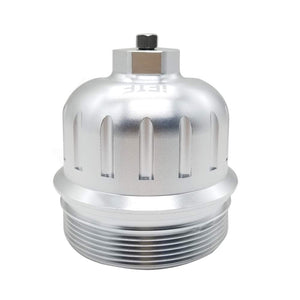 134001 Fuel Filter Housing Cap for 6.6L Duramax L5P 2017-2023 | iFJF
$69.99
134001 Fuel Filter Housing Cap for 6.6L Duramax L5P 2017-2023 | iFJF
$69.99
 Fuel Filter Assembly for 1992-2002 Chevy GMC 6.5L Diesel — Suburban Tahoe Silverado Sierra Yukon Hummer H1 — Replaces 10226035
$177.99
Fuel Filter Assembly for 1992-2002 Chevy GMC 6.5L Diesel — Suburban Tahoe Silverado Sierra Yukon Hummer H1 — Replaces 10226035
$177.99
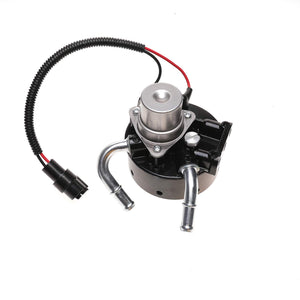 12642623 Fuel Filter Head + 1R-0750 Refit for 2005-2016 Duramax 6.6L
$87.99
12642623 Fuel Filter Head + 1R-0750 Refit for 2005-2016 Duramax 6.6L
$87.99
 FS1098 Fuel Water Separator w/ PCV for Cummins B6.7 ISL8.9 — 10 Micron
$79.99
FS1098 Fuel Water Separator w/ PCV for Cummins B6.7 ISL8.9 — 10 Micron
$79.99


