Lennox Furnace Won't Heat? Work the 6-Step Diagnosis
, by iFJF Direct, 25 min reading time
, by iFJF Direct, 25 min reading time

A Lennox furnace that will not heat is a sequence problem, not automatically a parts problem. This guide works six checks in order — filter and door switch first, then what the furnace sounds like, then where the ignition sequence stops — and only then moves to the control board. Includes the three fingerprints of a failed 94W83 board, the fitment list for Lennox 80AF1, 92AF1 and 95AF1 furnaces, and the six-step swap.
Your furnace picked a great night to quit. It is the first cold one, the house is already dropping, and the thing is humming away down there without producing a single degree of heat. Now what?
The instinct is to call somebody, or to type the model number into a search bar and buy the first part that looks right. Both are expensive guesses. A no-heat call is not a mystery, it is a sequence. The furnace runs the same six steps every time it lights, and if you walk them in order, it will tell you which part gave up.
That is what this page is: six checks, cheapest first. Odds are decent you stop well before the control board — a clogged filter, a door switch, a dirty flame sensor, a pressure switch hose full of water. But if the trail does lead to the board, we go all the way: which number you need, whether it fits your furnace, and how to swap it without creating a second problem.
One thing first. If you smell gas, or your CO alarm is going off, stop reading and get out of the house. Nobody should be troubleshooting a gas appliance by nose. Everything below assumes the air is clean and it is safe to take the panel off.
Six checks. Each one removes a layer. Skip ahead and you end up buying a control board to fix a filter.
| # | Check | What you do | Time |
|---|---|---|---|
| 1 | Rule out the free stuff | Filter, door switch, breaker, gas valve, thermostat | 5 min, no tools |
| 2 | Listen to it | Does the inducer start? Does the igniter glow? | 5 min, just ears |
| 3 | Find where the sequence stops | Walk the six ignition steps, spot the gap | 15 min, eyes |
| 4 | Prove it is the board | Three fingerprints vs. a sensor problem | 10 min, multimeter |
| 5 | Match the number | Which control is actually in your cabinet | 5 min, flashlight |
| 6 | Decide: fix or call | Gas smell, CO, cracked exchanger, or gut feeling | Your call |
Five things cause a big share of no-heat calls, and not one of them needs a part. Look at these first. It takes five minutes and it saves people a lot of money.
All five good, still nothing? Now it is electrical. On to check 2.
Turn the thermostat up and stand next to the furnace for a minute. What you hear in that first minute splits the diagnosis in half.
| What you hear | Most likely cause | Next move |
|---|---|---|
| Nothing. Dead silence. | Power, door switch, board fuse, transformer | Meter 120 V into the board, then 24 V out of the transformer. No 24 V, and the transformer is your problem, not the board. |
| A low hum that runs a few minutes, then quits. | Inducer starts but the pressure switch never proves | Check the pressure switch hose for water, kinks, a plugged port. Then check the flue for a nest or ice. |
| Inducer runs, a click, then nothing. | Trial for ignition started, no flame | Watch the igniter. No glow means igniter or its circuit. Glow with no gas means the valve or the board's output to it. |
| Burner lights, dies a few seconds later. | Flame sensed, then lost | Dirty flame sensor, nine times out of ten. Steel wool on the rod, and do that first. |
| Burner lights, runs, shuts down hot. | Limit tripping on temperature | Airflow again. Filter, blower wheel, blocked return. Not the board. |
| Everything runs, the blower never stops. | Blower relay welded shut on the board | This one really is the board. Pull the fan lead to confirm. |
A gas furnace lights in six steps. The control board triggers every single one of them. So find the step that does not happen, and you have found the part that is not doing its job.
| # | Step | What should happen | If it does not |
|---|---|---|---|
| 1 | Thermostat call | 24 V shows up on W at the board | Thermostat, thermostat wire |
| 2 | Inducer + pressure switch | Inducer starts, switch closes | Inducer motor, switch, hose, flue |
| 3 | Igniter warm-up | Igniter glows orange in about 30 seconds | Igniter, igniter circuit |
| 4 | Gas valve opens | Click, then flame | Valve, gas supply, board output |
| 5 | Flame proving | Flame holds past five seconds | Flame sensor, ground, gas pressure |
| 6 | Blower delay | Blower starts once the exchanger warms | Blower, board timing, limit string |
Read that as a chain, not a checklist. The board is the only part that shows up in every link. It powers the inducer, fires the igniter, opens the valve, reads the flame, starts the blower. Which is exactly why a bad board can imitate any of those parts, and why you test the parts one at a time before you point at the board.
Also notice what is not on that list: anything you set. No schedule to program, no reset beyond killing power for a minute. The board takes a request and turns it into fire. When it stops, the furnace is not running badly. It is not running.
This is where the money gets wasted, in both directions. Plenty of boards get replaced that were never the problem. The ones that really were dead tend to leave the same three fingerprints.
| Fingerprint | What you see | Verdict |
|---|---|---|
| Dead, but power is there | Board LED dark, no inducer, 120 V at the furnace, about 24 V out of the transformer, fuse good | Board |
| One part never energizes while everything around it tests fine | You hear the relay click, nothing downstream moves. Or silence where a click belongs | Board output stage |
| Blower runs no matter what | Fan never shuts off. Pull the fan lead and it stops | Board blower relay, welded closed |
Now the three that look like a board and are not.
Two things do genuinely kill a board: a surge, from a nearby strike or the utility switching, and water — a clogged condensate line backing up, or a coil above the cabinet dripping on it. Both usually leave evidence. Scorching. A burnt smell. Green crust on the traces. A capacitor with a bulging top. If you see none of that and the checks still point at the board, you are probably looking at plain wear: relay contacts and solder joints, twenty years old, doing what old electronics do.
Lennox put more than one control in the same cabinet over the years, so the model number on the door does not settle it. Read the number off the board you are pulling out. That is the only one that matters.
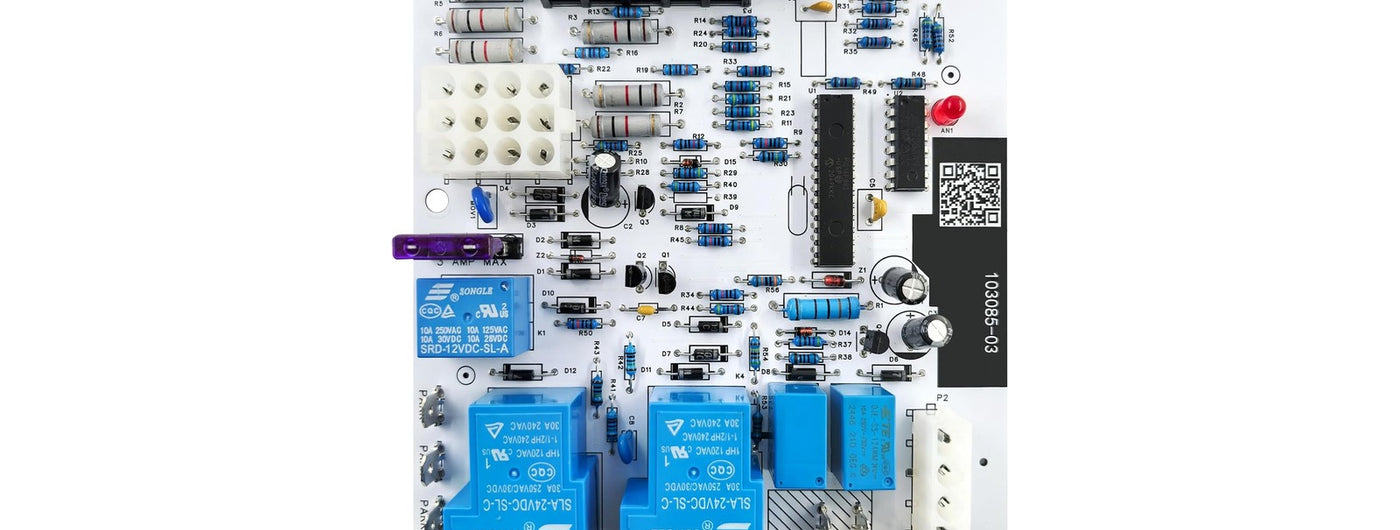
When it does land on this board, one part covers a lot of ground. The 94W83 is the Lennox catalog number for the single-stage ignition control in the 80AF1DF, 80AF1UH, 92AF1DF and 95AF1UH furnaces, plus Armstrong and Ducane units built on the same platform. It replaces Lennox 103085-01, 103085-02, 103085-03 and 81W11, and it crosses to the Honeywell / UTEC number 1012-977A, which shows up on the box as 1012-977A-I.
| Number | What it is |
|---|---|
| 94W83 | Lennox catalog number for this board |
| 103085-01 | Lennox control part number |
| 103085-02 | Lennox control part number — the one you will see most often |
| 103085-03 | Lennox control part number |
| 81W11 | Earlier Lennox / Honeywell number, same board |
| 1012-977A | Honeywell / UTEC number |
| 1012-977A-I | UTEC number as printed on the box |
| Furnace series | Brand | Notes |
|---|---|---|
| 80AF1DF | Lennox | 80% AFUE single-stage gas furnace |
| 80AF1UH | Lennox | 80% AFUE single-stage gas furnace, upflow / horizontal |
| 92AF1DF | Lennox | Same board position, 92 platform |
| 95AF1UH | Lennox | Same board position, 95 platform |
| Armstrong / Ducane | Armstrong, Ducane | Same Lennox platform, 1012-977A board inside |
On the list? The swap is wire-for-wire. Same spade terminals, same multi-pin plug, same mounting pins. No cutting, no adapter harness.
Not on the list? Stop right there. The 94W83 is an ignition control. It is not a blower control and it is not a gas valve control, and putting the wrong function in the cabinet is how you get a furnace that happily runs the inducer forever and never lights.
While you are reading numbers, a few neighbors get confused for each other. The 1012-925C is the Honeywell 1012-family board for Rheem and Ruud furnaces. The 50A55-843 is the White-Rodgers / Lennox crossover. The 920915 is the Nordyne G7 and M7 board. Same job in a different cabinet, and none of them are interchangeable with this one.
There is a line between a homeowner diagnosis and a dangerous one, and it is worth being honest about where it sits. Stop and call a licensed tech if any of this is true:
Everything else — confirmed dead board, right number in hand, main power off — is a Saturday morning job with a nut driver and your phone camera.
Moderate difficulty, and nothing to program. Every connection is a plug or a spade terminal. What makes it take 45 to 90 minutes is care, not skill.
Service switch off, breaker off, manual gas valve closed. The 24 V control circuit is fed from a transformer inside the same cabinet, so flipping the service switch alone does not make that board safe to touch. Meter it and confirm 0 V before your hand goes anywhere near it.
One phone photo, board in place, every lead where it belongs. This is the step people skip and then regret at 9 p.m. with the heat off. Thermostat leads, gas valve, igniter, flame sensor, inducer, limit — they all land on that board and half of them look identical in a dim basement.
Fuse on the board. Door switch. Pressure switch hose. Ground. If that fuse is open, find the short first. Otherwise you pop the new fuse on the very first call for heat and you are right back where you started.
Touch the cabinet before you pick the board up, and keep your fingers off the pins and the relay tops. Static takes out more boards than heat does, and a board you killed with your hands looks exactly like a board that died on its own.
Pull a lead off the old board, land it on the matching terminal of the new one, then do the next. One at a time and a mis-wire is almost impossible. Pull them all off first and a twenty-minute job turns into a service call.
Power on, call for heat, and stand there: inducer, igniter glow, valve click, flame, blower after the delay. Watch it through to the end, not just to the flame. And if the burner lights and drops out a few seconds later, clean that flame sensor first. It usually is not the board.
| The mistake | Why it costs you | What it looks like |
|---|---|---|
| Read the flash code before you pull the board | Once it is gone, it is gone | That code names the safety that opened. After the old board is in the trash you are guessing, and guessing is what this whole page is trying to save you from. |
| Use the legend on your board, not a forum | Codes are not standardized | Six flashes on a Trane is not six flashes on a Goodman. The chart on your own board's label is the only one that applies to your furnace. |
| Do not force the multi-pin plug | It only goes on one way | If it fights you, the pins are off by one position. Pull it off and look. Bent pins are not covered by anything, including us. |
| Watch a full cycle, not just ignition | The second fault hides behind the first | A furnace that lights and then trips a limit looks fixed for ten minutes. Let it run to temperature and shut down on its own before you put the door back on. |
Catalogs sometimes tack a revision suffix onto these. Match the base number, and match the function while you are at it — an ignition control is not a blower control.
| Part Number | Brand | Notes |
|---|---|---|
| 94W83 | Lennox | Catalog number — this board |
| 103085-01 / -02 / -03 | Lennox | Control numbers it replaces |
| 81W11 | Lennox / Honeywell | Earlier number, same board |
| 1012-977A | Honeywell / UTEC | Cross-reference number |
| 1012-977A-I | UTEC | As printed on the box |
Then you need the board that platform shipped with, not a universal one and not a guess. For Lennox 80AF1, 92AF1 and 95AF1 furnaces, that is the 94W83.

Single-stage ignition control for Lennox 80AF1DF, 80AF1UH, 92AF1DF and 95AF1UH furnaces. Runs the standard 18-30 VAC, 50/60 Hz control circuit. Same spade terminals, same multi-pin plug, same mounting pins as the one you are taking out, and nothing to program afterward.
Number on your old board appears on the crossover list? Then it drops straight in. No cutting, no adapter harness, no DIP switches to figure out.
Shop Now →Still not sure which one you have? The whole HVAC control board lineup is on one page. And if your furnace happens to be a York or a Coleman, the 031-01267-001A is the board people end up comparing against this one.
A: Start with the cheap stuff. Filter, blower door switch, breaker, gas valve, thermostat. Then stand there and listen: does the inducer start when you turn the heat up? If it runs, your problem is further down the ignition sequence. If nothing at all happens, it is upstream - power, the door switch, the 3 A fuse on the board, or the transformer.
A: You are down to three parts: igniter, gas valve, or the board that feeds them. Watch the igniter during the trial. If it glows and no gas arrives, put a meter on the valve coil. You get 24 V and still no flame, the valve is the problem. No voltage at all, and the board never sent the signal. If the igniter never glows, test the igniter first, not the board.
A: Watch the timing. That is the whole trick. A dirty flame sensor lets the burner light, then drops it out three to five seconds later, every cycle, until it locks out. A dead board usually quits earlier, so the burner never lights in the first place. And before anything else, hit the flame rod with steel wool. It is free and it answers the question in five minutes.
A: Usually, yeah. The blower relay lives on the board, and when its contacts weld shut the blower gets power no matter what the thermostat wants. Confirm it in ten seconds: pull the fan lead off the board. If the blower keeps running with the wire off, the fault is downstream, not on the board.
A: Sometimes, but it is more work than the box suggests. A universal board comes with a pile of harnesses, and you have to pick the one that matches your furnace, then set DIP switches that define the safety timings. Skip those switches and the furnace runs its safeties on the wrong clock. If your number is not on the maker's published cross list, the honest answer is the OEM-style board.
A: It fits and it works the same way: single-stage logic, 18-30 VAC control circuit, same terminals, same mounting pins. What you do not get is the Lennox name on the label. What you do get is the flame proving and the gas valve shutdown on flame failure, which is the part that actually keeps your house safe.
A: 45 minutes to 90 minutes the first time, and most of that is being careful, not being skilled. A few screws, a handful of plugs and spade terminals, nothing to program. The clock mostly disappears into photographing the wiring and moving the leads across one at a time. That step is also what keeps you from buying a second board.