










Marine Fuel Filters, Water Separators & Boat Engine Parts
Marine engines face the harshest operating conditions of any internal combustion application. Saltwater corrosion, constant vibration, high humidity, and — most critically — water-contaminated fuel from marina storage tanks make marine fuel filtration an absolute necessity, not a luxury. A failed fuel filter or water separator at sea is not an inconvenience you can solve with a roadside tow — it is a safety hazard that can leave you adrift in shipping lanes or dangerous weather.
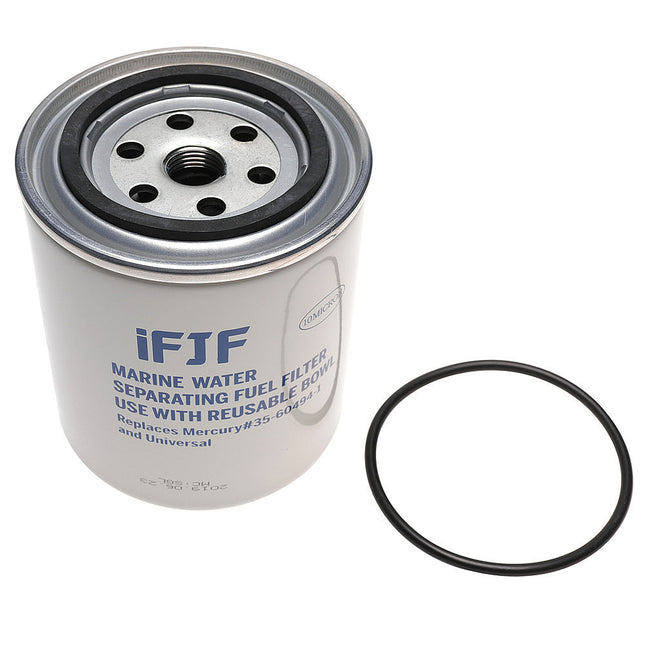
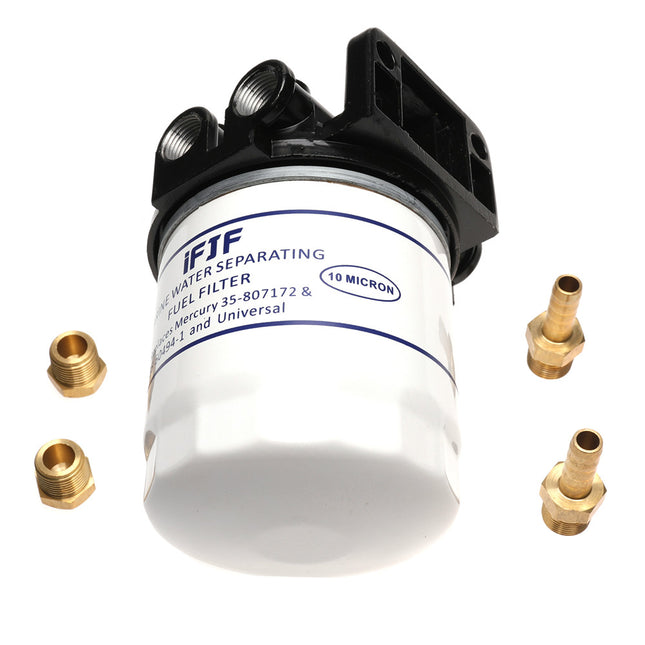
iFJF Direct supplies a complete range of marine-grade fuel water separators, replacement filter elements, outboard motor parts, and marine plumbing components engineered for the demands of saltwater and freshwater boating. Our fuel water separators feature corrosion-resistant aluminum and stainless steel construction, 10-micron absolute filtration media, and clear collection bowls for at-a-glance water level inspection. We serve recreational boaters, commercial fishing operators, and marine service facilities across North America with US-based stock and fast shipping.
Why Marine Fuel Filtration Is Critical
Marine fuel presents unique risks that automotive diesel fuel does not. Understanding these risks explains why marine filtration standards are more demanding:
- Marina fuel storage contamination: Fuel stored in marina underground tanks is exposed to temperature swings, condensation, and infrequent turnover — especially at seasonal facilities. Water accumulates at the tank bottom from condensation cycles, and rust particles from aging tank infrastructure mix with the fuel. A marina tank that sits half-empty all winter develops significant water and sediment contamination by spring launch season. The fuel you pump into your boat may already be compromised before it reaches your tank.
- Onboard condensation cycles: A boat's fuel tank experiences extreme daily temperature swings — cool nights cause moist air to condense inside the tank, and each condensation cycle adds water. Over a season, a 100-gallon tank can accumulate a quart or more of water through condensation alone, particularly in humid coastal environments.
- Ethanol phase separation: E10 gasoline (10% ethanol) is common at marina pumps. Ethanol absorbs water, but when the water content exceeds the ethanol's absorption capacity — typically around 0.5% water by volume — the ethanol-water mixture separates from the gasoline and sinks to the tank bottom. This phase-separated layer is highly corrosive and can destroy fuel system components within weeks.
- Microbial growth (diesel bug): The fuel-water interface in diesel tanks is an ideal breeding ground for bacteria and fungi — Cladosporium resinae, Pseudomonas, and various yeasts. These microorganisms produce acidic metabolic byproducts that corrode aluminum tanks and steel components. Their biomass forms sludge that plugs filters and fuel lines. Marine diesel tanks are particularly vulnerable because boats often sit unused for weeks, giving colonies time to flourish.
- Safety at sea: A clogged fuel filter on the highway means pulling over to the shoulder. A clogged fuel filter 20 miles offshore in 4-foot seas is a mayday situation. Redundant filtration and proactive maintenance are not optional — they are safety-critical systems.
Common Marine Fuel System Issues & Warning Signs
- Engine stalling or hesitation under load: The classic sign of water in fuel. Water droplets reaching the injectors cause momentary misfires and power loss, most noticeable when accelerating onto plane or running at cruise RPM. The engine may run perfectly at idle only to stumble and stall when throttle is applied.
- Water visible in the filter bowl: A clear collection bowl with a visible water layer at the bottom is a definitive diagnosis. Water is heavier than fuel, so it separates to the bottom. Drain the bowl immediately — if water returns within hours of operation, the fuel tank has significant water contamination that requires professional fuel polishing.
- Rust-colored filter media or sediment in the bowl: Brown or orange discoloration indicates rust particles from the boat's steel fuel tank or marina storage infrastructure. Sediment accumulation in the filter bowl means the filter is doing its job — but it also means your tank needs cleaning and the filter needs replacement.
- Black sludge or slime in the filter: Diesel bug biofilm. The filter media will be coated in a dark, slimy substance with a distinct sulfurous or sour odor. This requires immediate filter replacement, fuel tank biocide treatment, and possibly professional fuel polishing to remove the microbial contamination from the entire fuel system.
- Difficulty starting after extended storage: A boat that ran perfectly when winterized but refuses to start in spring typically has phase-separated fuel, a water-logged filter, or a clogged carburetor/injector from evaporated fuel varnish. Always drain and replace the fuel filter as part of spring commissioning.
- Corrosion on filter housing or mounting bracket: Salt spray corrosion on the filter assembly itself compromises the sealing surface and can lead to air leaks on the suction side of the fuel system. A corroded filter housing should be replaced — cleaning and repainting may not restore the sealing surface to the tolerance required for a vacuum-tight seal.
Marine Fuel Filter & Water Separator Buying Guide
1. Marine-Grade Materials
Automotive fuel filters are not designed for marine environments. Look for corrosion-resistant housings — powder-coated aluminum, anodized aluminum, or 316 stainless steel. Avoid raw steel housings (they rust within a season in salt air) and zinc-plated steel components (the plating corrodes in weeks). iFJF marine filter assemblies use marine-grade aluminum with corrosion-resistant coatings rated for 1,000+ hours of ASTM B117 salt spray testing.
2. Clear Bowl vs. Metal Bowl
Clear collection bowls — typically made from heat-resistant nylon or polycarbonate — allow visual inspection of water accumulation and filter media condition without disassembly. This is a significant advantage for boats where filter access may be awkward and frequent disassembly is impractical. However, US Coast Guard regulations restrict clear bowls on gasoline inboard engines in enclosed engine compartments — check your vessel's requirements. For diesel applications, clear bowls are permitted and strongly recommended.
3. Micron Rating and Filtration Efficiency
Marine fuel filtration should meet or exceed 10-micron absolute for diesel engines and 10-21 micron for gasoline outboard motors. Gasoline outboards with carburetors can tolerate slightly larger particles than common-rail diesel injection systems, but the water separation function is equally critical for both fuel types. iFJF R12T series separators achieve 99%+ water removal efficiency in SAE J1488 testing at rated flow.
4. Thread Type Compatibility
This is the most common installation obstacle for DIY boaters. Marine fuel systems use both NPT (National Pipe Thread) and BSPP/ZG (British Standard Pipe Parallel) thread standards. Japanese outboard motors (Yamaha, Suzuki, Honda, Tohatsu) typically use BSPP/ZG fittings. American marine systems (Mercury/Mercruiser, Volvo Penta, Crusader) predominantly use NPT. These thread types are visually similar but not cross-compatible. Forcing mismatched threads damages the housing ports and creates fuel leaks. iFJF's R12T combo kit includes both NPT 1/4-18 and ZG1/4-19 adapters to eliminate this confusion.
5. Flow Rate for Your Engine Size
Match the filter assembly's flow rating to your engine's fuel consumption. A single 150 HP outboard consumes approximately 15 GPH at wide-open throttle. Twin 300 HP outboards can consume 60+ GPH. Our R12T and S3213 assemblies flow 90+ GPH — sufficient for the largest recreational powerboat applications. For diesel inboard engines (Yanmar, Cummins, Caterpillar, Volvo Penta), fuel consumption at cruise RPM is typically 2-8 GPH per engine — well within these flow ratings with ample margin.
Marine Fuel System Installation Tips & Best Practices
- Mount the filter assembly above the fuel tank level when possible. This reduces hydrostatic pressure on seals when the engine is off and makes filter changes cleaner. If below-deck mounting is required, install a shutoff valve between the tank and filter to isolate fuel flow during service.
- Use marine-rated fuel hose (USCG Type A1-15 or SAE J1527). Automotive fuel hose is not rated for marine engine compartment use and will fail USCG inspection. Marine-rated hose has fire-resistant construction and is marked with its rating at regular intervals along the hose length.
- Double-clamp all fuel hose connections below deck. USCG regulations require two stainless steel hose clamps on every fuel line connection in enclosed engine compartments. Orient the clamp screws 180 degrees apart to distribute clamping pressure evenly. Use all-stainless (band, housing, and screw) clamps — not zinc-plated "marine" clamps that corrode at the screw mechanism.
- Install a vacuum gauge between the filter and the lift pump. A vacuum gauge reading of 5 inHg or higher at cruise RPM indicates excessive filter restriction. This allows you to monitor filter condition in real time and change the filter before it causes a performance issue — far better than waiting for the engine to stumble.
- Apply marine-grade anti-seize compound to all threaded fittings. Stainless steel fittings in aluminum housings are a galvanic corrosion risk in saltwater environments. A high-quality anti-seize compound (nickel-based for high-temperature applications) prevents the threads from seizing and allows future disassembly without damaging the housing.
- Prime the system thoroughly after filter changes. Use the integral primer pump if equipped, or fill the filter housing with clean fuel before installation. Crank the engine in 10-second bursts with 30-second cool-down periods to avoid starter motor overheating. For outboard motors, squeezing the primer bulb until firm is usually sufficient — but larger inboard installations may require multiple priming cycles.
- Keep a spare filter element and drain bucket aboard at all times. A spare filter and the tools to change it (filter wrench, drain pan, rags, spare O-rings) should be part of every boat's onboard spares kit. Changing a filter at sea in rough conditions is challenging but possible — and infinitely better than being dead in the water.
Marine Engine Maintenance & Service Intervals
- Fuel filter replacement: Every 100 hours of operation or annually, whichever comes first. This matches the standard marine service interval recommended by Mercury, Yamaha, Suzuki, and Volvo Penta. For commercial vessels with high operating hours, filter changes every 200-250 hours may be appropriate with a vacuum gauge monitoring system.
- Water separator drain: Check and drain the water separator bowl before every trip. In humid climates or after refueling from unfamiliar marinas, check daily. A 5-second visual inspection of the clear bowl takes less time than diagnosing a water-in-fuel problem on the water.
- Spring commissioning: Replace the fuel filter as the first step of spring commissioning, before attempting to start the engine. Fuel that sat in the tank all winter has accumulated water from condensation cycles, and the filter media may have degraded from prolonged water exposure. Fill the new filter with fresh fuel treated with a fuel stabilizer and biocide.
- Winterization: Before winter storage, fill the fuel tank to 95% capacity (minimizing air space for condensation), add a fuel stabilizer, run the engine for 15 minutes to distribute treated fuel through the entire system, and then replace the fuel filter. The new filter will be clean and dry for storage. For gasoline engines, also add a fuel system antifreeze (isopropanol-based) to absorb any residual water.
- Impeller replacement: Replace the raw water pump impeller every 100-200 hours or every 2 years. Impellers take a set when stored dry and lose their flexibility — a failed impeller causes rapid overheating that can destroy an engine in minutes. Always carry a spare impeller and the tools to change it aboard.
- Anode inspection: Check sacrificial anodes (zincs) every 6 months or 100 hours. Replace when more than 50% consumed. Anodes protect aluminum drives, heat exchangers, and through-hull fittings from galvanic corrosion — neglecting them results in expensive corrosion damage to components that are far more costly to replace.
Related Categories
- Diesel Fuel Filters & Water Separators — Complete range of fuel filter assemblies and replacement elements for diesel trucks, RVs, and heavy equipment.
- EGR Delete Kits & Block-Off Plates — Performance engine upgrades for off-road and competition diesel and gas vehicles.
- Oil Filters & Engine Filtration — High-efficiency oil filters for extended service intervals in diesel and gasoline engines.
- Engine Parts & Components — Gaskets, seals, thermostats, sensors, and hardware for comprehensive engine maintenance.
Frequently Asked Questions
How do I know if my boat has water in the fuel?
The most reliable first check is to visually inspect the fuel filter bowl — if your assembly has a clear bowl, water will appear as a distinct layer at the bottom because water is heavier than both gasoline and diesel fuel. If you do not have a clear-bowl filter, remove the filter element and pour the contents into a clear glass jar. Let it settle for 5 minutes: water will form a separate layer at the bottom, visibly different from the fuel above. A laboratory-grade test uses water-finding paste applied to a dipstick lowered into the fuel tank — the paste changes color on contact with water. Finally, an engine that runs smoothly at idle but stumbles, surges, or stalls under load is exhibiting the classic symptom of water-contaminated fuel reaching the combustion chamber.
What is the difference between 10-micron and 30-micron marine fuel filters?
A 10-micron filter captures particles one-third the size of a 30-micron filter — significantly finer filtration. For modern common-rail diesel marine engines (Yanmar, Cummins, Volvo Penta D-series, CAT), 10-micron absolute filtration is the minimum standard, matching the engine manufacturer's specification. For older mechanically injected diesels (Detroit Diesel 2-stroke, Lehman, Perkins) and gasoline outboard motors with carburetors, a 30-micron primary filter followed by a 10-micron secondary filter is a common two-stage setup. Some boaters use a 30-micron primary water separator followed by a 10-micron secondary filter on the engine itself — this two-stage approach captures large debris and free water at the primary stage, extending the life of the more expensive secondary filter element. iFJF offers both 10-micron and 30-micron elements to support both single-stage and two-stage configurations.
Can I use automotive fuel filters on my boat?
Technically, an automotive fuel filter will filter fuel — but it will fail prematurely in a marine environment for several reasons that make it a false economy. Automotive filter housings use materials (bare steel, zinc-plated steel, standard aluminum) that corrode rapidly in salt air and spray — a filter housing that lasts 10 years on a truck may rust through in one season on a boat. Automotive filter media may not include the coalescing layer required for effective water separation — water passes straight through to the engine. Automotive filter gaskets and seals may not be compatible with ethanol-blended marine fuels. Finally, automotive filters are not designed for the vibration profile and mounting angles common in marine installations. Use marine-rated filters specifically designed and tested for the marine environment. The cost difference is modest, and the consequences of a filter failure at sea are severe.
How do I deal with diesel bug in my boat's fuel tank?
Diesel bug requires a three-step treatment protocol, not just a filter change: (1) Shock-dose the fuel tank with a biocide (Biobor JF, Kathon, or equivalent EPA-registered marine fuel biocide) at the concentration specified for severe contamination — usually double the maintenance dose. Run the engine for 30 minutes to circulate treated fuel through the entire system. (2) Replace the fuel filter after 24 hours — the biocide will kill the microbial colony, causing dead biomass to slough off tank walls and quickly clog the existing filter. (3) Consider professional fuel polishing — a fuel polishing service circulates your boat's fuel through a multi-stage filtration system to remove dead microbes, water, and sediment, returning clean fuel to the tank. For severe infestations, fuel polishing is the most thorough solution. After treatment, maintain a biocide maintenance dose at every fill-up and keep the fuel tank as full as possible during storage to minimize condensation.
Why does my outboard motor keep clogging fuel filters?
Repeated fuel filter clogging in an outboard motor almost always indicates a contaminated fuel tank, not a filter problem. The most common causes: (1) phase-separated ethanol fuel that has deposited corrosive water-ethanol sludge at the tank bottom — this sludge is picked up by the fuel pickup tube every time you refuel, (2) a deteriorating fuel tank interior — older aluminum tanks develop internal corrosion that sheds particles, while fiberglass tanks can delaminate, (3) fuel hose liner degradation — ethanol-blended fuel dissolves the inner liner of older non-ethanol-rated fuel hoses, sending rubber particles downstream, and (4) a failing fuel tank vent that allows water intrusion during rain or rough conditions. To diagnose: pump a fuel sample from the very bottom of the tank (use a siphon tube, not the engine pickup) into a clear container and let it settle. The sediment content will tell you whether the tank needs professional cleaning. Until the source of contamination is resolved, you can expect to keep changing filters — they are doing their job by capturing the contaminants before they reach your engine.