




Diesel Performance Exhaust Systems: Headers, Downpipes & Cat-Back Kits
Your diesel engine is an air pump — the faster and more efficiently you can move air through it, the more power it makes. While most diesel enthusiasts focus on the intake side, the exhaust side is equally critical. A restrictive exhaust system creates backpressure that robs horsepower, increases exhaust gas temperatures (EGTs), and reduces turbocharger efficiency. iFJF Direct carries the exhaust components that unlock your diesel's true potential.
Why Upgrade Your Diesel Exhaust System?
Reduced EGTs: The single most important metric for diesel engine health is exhaust gas temperature. Every 100°F reduction in peak EGTs extends turbocharger life and reduces thermal stress on pistons, valves, and cylinder head gaskets. A free-flowing exhaust system can reduce EGTs by 150-300°F under load — the difference between a safe tow up a mountain grade and a melted piston.
Turbocharger Response: A turbocharger operates on a pressure differential — high pressure on the turbine inlet side and low pressure on the outlet side. The larger this pressure ratio, the faster the turbo spools and the more efficiently it operates. Reducing post-turbo exhaust restriction (the downpipe and cat-back system) directly improves turbocharger response, particularly in the 1,400-2,200 RPM range where most towing occurs.
Fuel Economy: Reduced pumping losses — the energy the engine expends to push exhaust gas through the system — translate directly to improved fuel economy. While gains of 1-2 MPG are typical, the real benefit is under load: maintaining speed on grades with less throttle input, and lower RPM for a given cruising speed due to improved torque delivery.
Exhaust Components by Platform
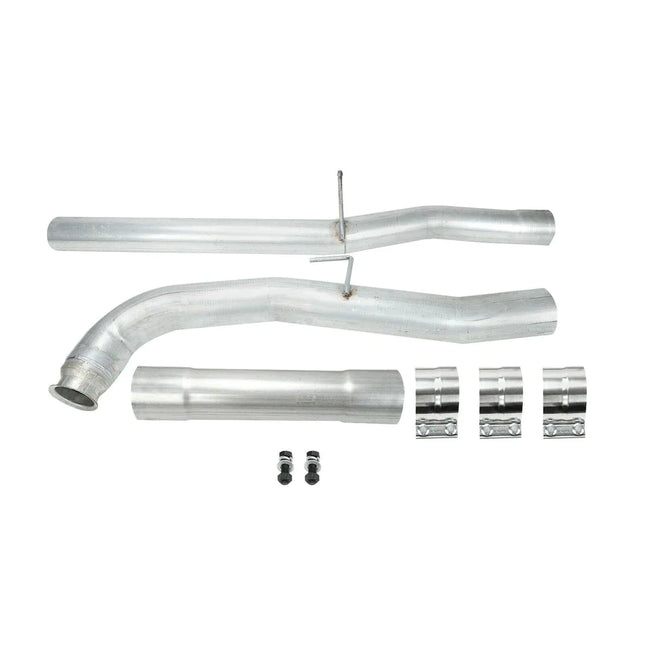
Ford 6.7L Powerstroke (2011+): The factory downpipe is pinched at the firewall pass-through, creating a significant flow restriction. Our 4-inch mandrel-bent replacement downpipe eliminates this restriction, reducing EGTs by 75-125°F at full load. The turbo-back exhaust systems use 304 stainless steel with TIG-welded flanges for corrosion resistance in salt-belt states.
Ram 6.7L Cummins (2007.5+): The factory 4-inch exhaust is actually quite good from the factory — the primary restriction is the catalyst/diesel particulate filter assembly. For off-road and competition applications, our race exhaust headers replace the factory exhaust manifold with equal-length primary tubes for improved cylinder-to-cylinder scavenging.
GM Duramax L5P (2017+): The L5P uses a unique exhaust manifold design that is prone to cracking at the collector under heavy towing conditions. Our aftermarket headers use thicker-wall 304 stainless steel tubing with reinforcement at common failure points. The factory downpipe is reasonably well-designed — gains come primarily from the cat-back section on the L5P.
FAQ: Diesel Exhaust Systems
Q: What diameter exhaust do I need for my diesel?
A: 4-inch is the standard for most diesel trucks up to 500 horsepower. 5-inch systems become beneficial above 550-600 horsepower where exhaust volume exceeds the flow capacity of a 4-inch system. For street-driven trucks under 500 horsepower, 5-inch systems often produce unwanted drone at highway RPM due to the lower exhaust gas velocity (which reduces the natural sound-cancellation effect).
Q: 304 vs. 409 stainless steel — which is better?
A: 304 stainless contains 18% chromium and 8% nickel — it provides excellent corrosion resistance and maintains its appearance over time. 409 stainless contains 11% chromium and no nickel — it's less expensive but will develop surface rust in salt-belt environments. For trucks in the Rust Belt or coastal areas, 304 is worth the premium. For southern and western trucks, 409 is perfectly adequate.
Q: Will an aftermarket exhaust void my warranty?
A: Under the Magnuson-Moss Warranty Act, a manufacturer cannot void your warranty simply because you installed aftermarket parts. However, if an aftermarket part is proven to have caused a failure, the manufacturer can deny warranty coverage for that specific failure. Cat-back exhaust systems are generally warranty-safe. Turbo-back systems that remove emissions equipment (DPF, DOC, SCR) are not legal for on-road use.
Installation Tips: What to Expect When Upgrading Your Exhaust
Installing an aftermarket exhaust system is a moderate-difficulty DIY project that most mechanically inclined owners can complete in a weekend with basic hand tools. Here is what you need to know before turning a single bolt:
Tools Required: A complete set of metric deep-well sockets (10mm through 19mm), ratchet with extensions, penetrating oil (PB Blaster or Kroil — not WD-40), an impact wrench for stubborn bolts, a hanger removal tool or large pry bar, anti-seize compound for new hardware, and safety glasses. A reciprocating saw is sometimes needed for removing the factory exhaust but may not be necessary if you can unbolt the system at the flanges.
Pre-Installation Preparation: Soak all exhaust fasteners with penetrating oil 24 hours before starting the job — this single step can save hours of frustration with rusted bolts. The turbocharger flange bolts are particularly prone to rust-seizing. Apply penetrating oil to the rubber exhaust hangers as well — lubricated hangers slide off their mounts with far less effort than dry ones. Before cutting or unbolting the factory system, test-fit the new components on the ground to confirm all pieces are present and the routing matches your truck's configuration (wheelbase length, cab style, and bed length all affect exhaust routing).
Installation Sequence: Always work front-to-back: downpipe first, then mid-pipe with any resonator or muffler, then over-axle section, and finally the tailpipe. Leave all clamps finger-tight until the entire system is hung — then align the tips for even spacing in the bumper cutouts before torquing. Most T-bolt clamps should be torqued to 45-55 ft-lbs; over-tightening crushes the tubing and creates a leak path.
Post-Installation Check: Start the engine and immediately check for exhaust leaks at every joint (you will feel puffs of hot gas or see condensation droplets forming at leak points). Let the system heat cycle once (drive 15-20 minutes at normal operating temperature), then re-torque all clamps. Stainless steel expands significantly when hot — clamps that felt tight during cold installation will loosen after the first heat cycle. Check all hangers for proper tension — the exhaust should not contact the frame, body, or suspension components at any point through the full range of suspension travel.
Common Problems & Diagnosis: Exhaust System Troubleshooting
Even quality aftermarket exhaust systems can develop issues over time. Recognizing symptoms early prevents expensive downstream damage:
Exhaust Drone at Highway Speed: A deep, resonant hum that peaks at 1,800-2,200 RPM is the most common complaint with aftermarket exhaust. Drone is caused by standing-wave resonance in the exhaust tubing — the pipe length acts like an organ pipe at certain RPMs. Solutions include adding a Helmholtz resonator (a sealed branch tube tuned to cancel the drone frequency), installing a high-flow muffler with internal resonance chambers, or repositioning the exhaust tip so it extends past the bodywork (tips that end under the vehicle reflect sound waves against the floor pan).
Exhaust Leaks at Flanges: A ticking or puffing sound, particularly audible at cold start, indicates a flange leak. Common causes include: incorrectly aligned flanges (bolts tightened unevenly), a missing or misaligned gasket, or warped flange surfaces from over-torquing. Remflex graphite gaskets are an excellent upgrade over standard metal gaskets — they conform to imperfect flange surfaces and are reusable. Always tighten flange bolts in a cross-pattern (like a wheel) in two or three progressive steps to ensure even clamping force.
Soot or Carbon Tracking: Black streaks radiating from a joint indicate an exhaust leak under load — exhaust gas laden with carbon particles escapes through the leak and deposits on adjacent surfaces. This is most commonly seen at slip-fit joints on turbo-back systems. The fix is to loosen the clamp, clean both mating surfaces with a wire brush, apply a thin film of high-temperature copper RTV to the male pipe end, re-insert, and torque the clamp. Copper RTV remains flexible at exhaust temperatures and fills the microscopic gaps that slip-fit clamps cannot seal.
Cracked Exhaust Manifold: Symptoms include a distinct exhaust tick that becomes louder under load and may disappear as the engine warms up (thermal expansion closes the crack). On the 6.7L Powerstroke and L5P Duramax, manifold cracks are most common at the collector where all runners merge — this area experiences the highest thermal stress. An infrared thermometer aimed at each cylinder's exhaust port runner can identify the cracked runner (it will read 50-100°F cooler than adjacent runners). Replacement with a thicker-wall aftermarket manifold or header is the permanent solution.
Compatibility Guide: Matching Exhaust to Your Build
Not every exhaust upgrade delivers the same benefit across different use cases. Match your exhaust choice to how you actually use your truck:
Daily Driver / Occasional Towing: A cat-back system with a high-flow muffler provides the best balance of improved flow, reduced EGTs, and acceptable sound levels. A 4-inch single system is ideal — it flows 40-60% more than the factory system without the drone characteristics of dual systems. You will notice improved throttle response and 50-100°F lower EGTs when towing without making your daily commute unpleasant.
Heavy Towing / Hot Shot: For trucks that spend their lives at high load (towing 15,000+ lbs, hot shot hauling, or heavy fifth-wheel use), a 4-inch turbo-back system with a high-flow catalytic converter yields the most meaningful EGT reduction. The downpipe is the single highest-impact component for these applications — eliminating the factory pinch point reduces backpressure where it matters most (high RPM, high load). Combined with tuning, expect 150-250°F lower sustained EGTs on long grades.
Competition / Off-Road Only: For dedicated competition or off-road trucks, a 5-inch turbo-back system with no muffler maximizes flow. Equal-length headers with merge collectors improve scavenging on inline-six engines like the 6.7L Cummins. Note that these configurations are not street-legal for emissions-regulated vehicles and are intended for closed-course competition and off-road use only.
Cold Climate Considerations: In areas with winter road salt, 304 stainless steel is strongly recommended over 409 — the nickel content in 304 prevents the surface rust that 409 will develop. Exhaust system life in salt-belt states is typically half that of southern trucks, making the 304 premium a cost-effective investment over the life of the vehicle. Consider ceramic coating the downpipe and mid-pipe sections closest to the road surface for additional protection.
Related Collections
- Cabin Air Filters — Breathe clean air inside your truck
- Engine Belts & Pulleys — Serpentine belts, tensioners, and idler pulleys
- Powerstroke Parts — Filters and maintenance for Ford 6.7L, 6.0L, and 7.3L
- Cummins 6.7L Parts — Fleetguard filters and Ram diesel parts