





Ford Powerstroke Parts: All Generations Covered
For over 30 years, the Powerstroke name has defined Ford's heavy-duty diesel lineup. From the legendary 7.3L to the modern 6.7L Scorpion, each generation has its own personality, strengths, and maintenance requirements. iFJF Direct stocks the parts you need — filters, sensors, repair components, and maintenance essentials for every Powerstroke engine built since 1994.5.
Powerstroke Engine Generations
7.3L Powerstroke OBS (1994.5-1997): The original — 215 hp, 425 lb-ft, HEUI injection. These trucks are now classics, and the aftermarket for 7.3L parts is strong. Common needs include the Cam Position Sensor (CPS — carry a spare!), fuel bowl rebuild kits, and UVCH (under valve cover harness) repair kits. The fuel filter is a cartridge inside the engine-mounted fuel bowl — FD-4595.
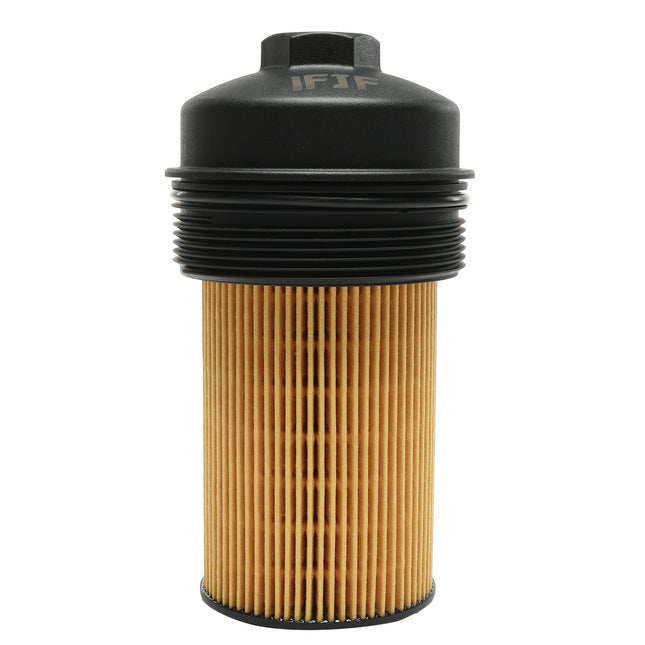
7.3L Powerstroke Super Duty (1999-2003): The "Million Mile Motor." Forged rods, intercooler, and the robust 4R100 transmission. Spin-on fuel filter FD-4596 with integrated cap. Watch for oil pan rust and ICP sensor contamination. With proper maintenance, 500,000 miles is routine — not exceptional.
6.0L Powerstroke (2003-2007): The most misunderstood Powerstroke. 325 hp, 570 lb-ft from the VT365. Known for EGR cooler and head gasket issues, but a properly bulletproofed 6.0L is one of the best value diesel platforms available. Key parts: HFCM fuel filter FD-4616, STC fitting upgrade, coolant filtration kit, and updated oil cooler.
6.4L Powerstroke (2008-2010): A 3-year bridge to the 6.7L. 350 hp, 650 lb-ft with common-rail injection and DPF emissions. The twin-turbocharger setup is complex, and radiator failures are common. Fuel filter FD-4617 fits both primary and secondary positions. Rocker arm failures at the needle bearings are a known weak point.
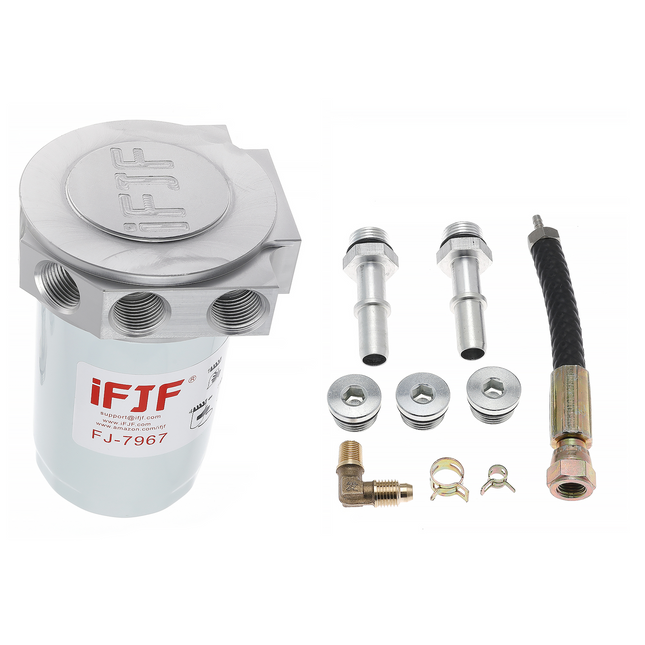
6.7L Powerstroke Scorpion (2011-2016): Ford's first in-house diesel V8. 400-440 hp, 800-860 lb-ft, CGI block. The CP4.2 high-pressure fuel pump is the critical vulnerability — water or debris contamination means $8,000-12,000 in repairs. We stock 5-micron filter upgrade kits for superior CP4.2 protection. Frame-mounted filter: FD-4615.
6.7L Powerstroke Gen 2 (2017-2019): Aluminum-body Super Duty with updated fuel system. 440-450 hp, 925-935 lb-ft. Fuel filter HC3Z-9N184-B/C (FD-4625) — cartridge-style, not spin-on. Watch for the plastic return line connector cracking (HC3Z-9A564-A replacement).
Powerstroke Parts & Maintenance FAQ
Which fuel filter fits my Powerstroke?
7.3L OBS → FD-4595; 7.3L SD → FD-4596; 6.0L → FD-4616 (HFCM); 6.4L → FD-4617; 6.7L Gen 1 → FD-4615; 6.7L Gen 2 → FD-4625. Always change both primary and secondary filters together on 6.4L and 6.7L models — the secondary filter is often overlooked but equally critical.
What is the #1 thing I can do to protect my Powerstroke?
Change your fuel filters on time — every single time. No exceptions. A $35 fuel filter is the cheapest insurance policy you will ever buy for a $10,000+ fuel system. Drain the water separator monthly and use only Motorcraft-specification filters. For 6.7L owners, upgrading to a 5-micron secondary filter provides an additional safety margin for the CP4.2 pump.
What does it cost to bulletproof a 6.0L Powerstroke?
A full 6.0L bulletproofing job typically runs $4,000-$7,000 in parts and labor, depending on scope. The core components include: ARP head studs ($500-$700), EGR cooler delete or upgraded cooler ($300-$600), updated oil cooler ($400-$600), coolant filtration system ($150-$250), and STC fitting upgrade ($75-$150). Many owners also replace the HPOP and injectors while the engine is apart. A properly bulletproofed 6.0L routinely exceeds 300,000 trouble-free miles.
How can I prevent CP4.2 pump failure on my 6.7L Powerstroke?
The CP4.2 high-pressure fuel pump is the Achilles heel of the 2011-2019 6.7L Powerstroke. Prevention comes down to three things: (1) Use a high-efficiency fuel filter with 5-micron absolute rating — factory filters are only 10-micron nominal; (2) Install a disaster prevention kit that captures metal debris if the pump fails, preventing contamination of all 8 injectors; (3) Drain the water separator at every oil change and never run the tank below 1/4 full. A $50 fuel filter habit is infinitely cheaper than a $12,000 fuel system replacement.
Do you offer bulk pricing for shops and fleets?
Yes. Contact our wholesale team for case quantity pricing on all Powerstroke maintenance items. We supply independent diesel shops, fleet maintenance operations, and online resellers across the US with volume discounts on filters, EGR kits, and engine components.
Maintenance Schedule: Powerstroke Service Intervals
A disciplined maintenance schedule is the single most effective way to maximize your Powerstroke's service life. Below are the recommended intervals for every generation, organized by mileage:
Every 5,000 Miles (or 6 Months): Oil and filter change — the #1 maintenance item for every Powerstroke. The 6.0L, 6.4L, and 6.7L all use high-pressure oil systems (HEUI or HPCR) where contaminated oil directly impacts injector performance. Use only CK-4 or CJ-4 rated diesel oil — API SN (gasoline) oil lacks the anti-foaming and soot-dispersant additives required by diesel engines. Fuel filter drain: Open the water separator drain valve (HFCM on 6.0L, frame-mounted on 6.4L/6.7L) and drain until clear diesel appears — if you see water droplets or a milky emulsion, drain the entire separator bowl.
Every 15,000 Miles (or 12 Months): Fuel filter replacement (primary and secondary together on 6.4L and 6.7L). Air filter inspection: Ford's filter minder gauge on the airbox is reliable — replace the filter when the indicator shows restriction, not just on a calendar basis. A restricted air filter increases fuel consumption by 2-3% and accelerates turbocharger compressor wheel wear from ingested dirt. Coolant condition check: Use test strips to verify nitrite and SCA levels — low coolant additive concentration is the #1 cause of 6.0L oil cooler and EGR cooler failures.
Every 30,000 Miles: Transmission fluid and filter (5R110, 6R140, or 10R140 depending on year). Differential and transfer case fluid: These are often overlooked — gear oil oxidizes and loses viscosity over time. Engine belt inspection: Check the serpentine belt for cracks, glazing, and rib damage; check tensioner alignment with a straightedge.
Every 60,000 Miles: Coolant flush and replacement (every 60K on 6.0L using Ford Gold coolant, every 100K on 6.7L using Motorcraft Orange). CCV filter replacement on 6.7L engines — a saturated CCV filter pressurizes the crankcase, forcing oil past seals. Serpentine belt, tensioner, and idler pulleys: Replace as a set — a tensioner that fails at 80,000 miles will destroy a new belt installed at 60,000.
Common Problems & Diagnosis: Know Your Powerstroke's Weak Points
Every Powerstroke generation has known failure patterns. Recognizing them early can mean the difference between a $50 sensor replacement and a $5,000 repair:
7.3L Powerstroke: (1) Cam Position Sensor (CPS) — sudden stalling, crank-no-start when hot, intermittent tachometer drop to zero while cranking. The CPS is so failure-prone that experienced 7.3L owners carry a spare and a 10mm wrench in the glovebox. (2) ICP (Injection Control Pressure) sensor failure — oil wicking through the sensor body contaminates the electrical connector, causing rough idle and stalling. Inspect the connector for oil; if present, replace both sensor and pigtail. (3) UVCH (Under Valve Cover Harness) — burned glow plug and injector pins cause intermittent misfires. A 50-cent mod (shimming the connector with a quarter) is the classic field fix.
6.0L Powerstroke: (1) Oil cooler clogging — indicated by a 15°F+ temperature spread between engine oil temperature and engine coolant temperature on a scan tool. A restricted oil cooler starves the EGR cooler of coolant flow, leading to EGR cooler rupture and hydro-lock. (2) FICM (Fuel Injection Control Module) failure — low FICM voltage (below 45V) causes hard starting, rough running, and injector damage. The FICM power supply board can be replaced separately from the module for a fraction of the cost. (3) STC (Snap-To-Connect) fitting on the high-pressure oil pump — causes hot no-start because the fitting leaks at operating temperature but seals when cold. The updated one-piece fitting is a permanent fix.
6.7L Powerstroke (2011-2019): (1) CP4.2 fuel pump failure — metallic debris contamination of the entire fuel system. Prevention (5-micron filtration, disaster prevention kit, water separator drainage) is your only defense. (2) EGT sensor failure — sensor 1/1, 1/2, or 1/3 codes are the most common CEL on the 6.7L. The sensors are fragile and easily damaged during exhaust work; treat them as consumable items. (3) Radiator leaks — the plastic end tanks on the factory radiator develop cracks at the upper hose connection. An all-aluminum aftermarket radiator eliminates this failure mode permanently.
Related Collections
- Engine Belts & Pulleys — Serpentine belts, tensioners, and idlers for every Powerstroke generation
- Exhaust System — Downpipes, cat-back kits, and performance exhaust for Powerstroke
- Cabin Air Filters — Cabin air quality for Ford Super Duty trucks
- Cummins 6.7L Parts — Ram HD maintenance parts